


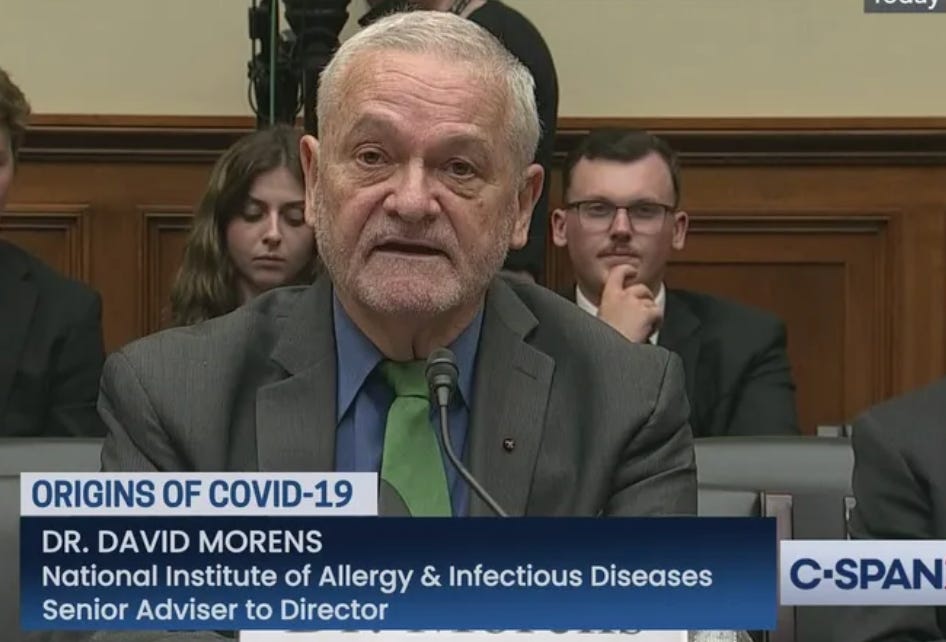
WASHINGTON — A federal grand jury has indicted the man who served for nearly two decades as Anthony Fauci’s closest aide at the National Institutes of Health, accusing him of conspiring to conceal the origins of the COVID-19 pandemic, destroy federal records, and accept bribes from Peter Daszak, the head of a nonprofit called EcoHealth Alliance that had funneled American government grant money to the Wuhan Institute of Virology.
The alleged gratuities — bottles of The Prisoner Red Napa Valley wine delivered to his Maryland home, and promises of Michelin-starred meals in Paris, Washington, and New York — were payment, prosecutors contend, for writing a scientific paper endorsing the theory that the virus emerged naturally from animals rather than a Chinese government laboratory.
The indictment names no individuals beyond the defendant, Fauci’s aide David M. Morens, 78. But a comparison of its allegations with congressional testimony and the documented public record establishes with near certainty that Fauci, Daszak, EcoHealth Alliance, and other figures at the center of the Wuhan Institute’s bat coronavirus research — among them University of North Carolina virologist Ralph Baric, referred to in the charging document as “North Carolina Scientist 1” — are the players described in its most explosive passages.
The indictment, unsealed Tuesday in federal court in Maryland, is the most significant criminal action to date flowing from years of congressional investigation into whether senior American health officials deliberately suppressed evidence pointing to the Wuhan Institute of Virology as the pandemic’s source.
The conspiracy the indictment alleges ran from approximately April 2020 through at least June 2023 — more than six months after Morens retired from NIH at the end of 2022. At its core, the Morens case is about whether the most consequential scientific and public health question of the 21st century — where did COVID-19 come from — was deliberately obscured by the people best positioned to answer it, using the tools of science and public service as cover. The indictment alleges a systematic effort to ensure that the theory of a Wuhan lab origin was never seriously pursued — protecting both the official narrative and the millions of dollars in federal grants flowing to EcoHealth Alliance, the organization that had not only funded the Wuhan Institute’s coronavirus research but conducted it jointly.
The case is built on emails — and the deletion of emails. The wine, prosecutors allege, came with a note from Co-Conspirator 1 — whose description in the indictment matches Daszak’s — that was explicit about what it was for, thanking Morens for his “behind-the-scenes shenanigans” against the senior officials he served. Some of those emails, as the pages that follow make clear, contain sentences that reframe not only the origins of COVID-19, but the government’s conduct during the crisis and in the years that followed.
Two months after the wine arrived, the exchange grew more explicit still. On approximately August 27, 2020, after the National Institutes of Health awarded Co-Conspirator 1’s organization a $7.5 million grant — the same funding stream the conspirators had feared the bat coronavirus grant termination might jeopardize — Morens emailed Co-Conspirator 1 from his NIH account: “Ahem…. do I get a kickback???? Too much fooking money! DO you deserve it all? Let’s discuss….”