


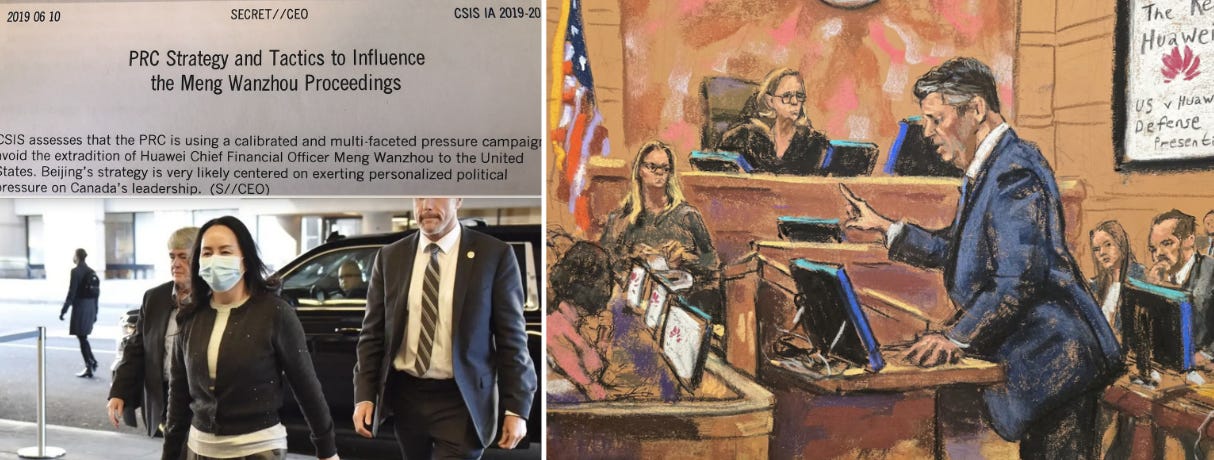
NEW YORK — As a Brooklyn jury enters deliberations today in one of the most consequential criminal cases in recent American history, prosecutors have left jurors with a portrait of Huawei as a company whose leaders built its global reach on theft, money laundering and concealment.
In the government’s closing argument, Assistant U.S. Attorney Meredith Arfa alleged that Huawei’s leaders paid employees for competitors’ secrets, concealed work with Iranian intelligence to enable surveillance and repression, and sought to obstruct an American criminal investigation by plotting to destroy evidence and move knowledgeable employees beyond investigators’ reach.
The allegations were connected by a common purpose, Arfa argued. Huawei sought to grow and protect its business, with senior executives setting the example and employees across its international operations following it.
That design, the government argued, included evading American sanctions by selling sensitive technology to Iran’s security apparatus, lying to global banks to keep its Iranian business moving through the New York clearing system, and reinvesting the enterprise’s income in Huawei’s American subsidiaries, whose operations in the United States were used to steal American technology.
In her November 16 closing, Arfa returned directly to the defense’s opening assertion that there was no blueprint for corporate crime.
“But you saw the blueprints,” she told jurors.
Arfa pointed to Huawei’s leadership and to Meng Wanzhou, known as Cathy Meng, the company’s chief financial officer and daughter of founder Ren Zhengfei.
As The Bureau has exclusively reported, a classified Canadian Security Intelligence Service assessment described an extraordinary Chinese intelligence campaign to pressure Canada after Meng’s arrest. It included interference in Canada’s 2019 election and calibrated tariff pressure on Canadian business leaders with direct access to the country’s elected officials. Beijing feared that, if extradited, Meng might cooperate with American authorities and disclose privileged information. The assessment was not part of the evidence before the Brooklyn jury.
The Brooklyn jury heard its own account of a company whose business reached well beyond telecommunications sales. Prosecutors alleged that Huawei worked with an arm of Iranian intelligence, then lied about its Iranian operations to the congressional committee that oversees American intelligence.
“The tone was set at the top by Huawei leaders and executives who themselves engaged in criminal conduct,” Arfa told jurors. “Like lying to Congress, lying to banks, violating U.S. sanctions and trying to interfere with the very criminal investigation that led to this case.
“Those leaders not only modeled the behavior they wanted their employees to copy, but they approved documents that reflected official company policy to lie, cheat, steal, all to make sure Huawei got a competitive advantage to help grow and protect its business.
“Cathy Meng, Huawei’s chief financial officer, committed crimes on Huawei’s behalf. As you heard, she appeared in this Court before Judge Donnelly and under oath and under the penalty of perjury, she admitted that as Huawei’s chief financial officer, she lied to Huawei’s primary bank, and she admitted that Huawei violated U.S. sanctions. And after Meng admitted those lies, Huawei promoted her.”
Huawei and three affiliated companies have pleaded not guilty to the 12 remaining counts. The company disputes the prosecution’s portrayal of an organized criminal enterprise and attributes its growth to legitimate engineering, investment and innovation.
Arfa’s summation challenged the suggestion that legitimate business activity answered the charges. The alleged crimes, she argued, were committed through the same corporate structure and for its benefit, and the proceeds flowed back into Huawei’s American operations.
“From 2008 to 2018, Huawei China, including Huawei Tech, sent a net total of over 1.7 billion to the United States to fund the operations and growth of its U.S. subsidiaries. That money came from the same enterprise that profited through the racketeering acts you just saw — trade secret theft, money laundering, fraud — it’s money the enterprise reinvested back into American operations. And you know what Huawei’s U.S. subs did with that money. They stole American technology.”
The distinction between an isolated theft and a corporate system was particularly sharp in her treatment of Heather Campbell’s testimony.
As The Bureau previously reported, Campbell, a corporate trainer and former Marine trained as a Mandarin linguist, received an envelope from Huawei’s in-house lawyer at its Plano, Texas, offices in July 2013.
Inside was a headquarters document titled “Management Criterion Of Competition Info Collection.” It set financial rewards according to the value and confidentiality of information collected from competitors, directing that the most sensitive material be encrypted and sent to a designated mailbox.
Campbell took it to the Federal Bureau of Investigation. Her description of the document as “a directive to steal information” became a central point in Arfa’s closing.