Prosecutors Say Harry Lu Was ‘Chosen’ to Build Beijing’s New York Police Outpost
Brief trial closes with jury not hearing two prosecution witnesses.
NEW YORK — In a surprisingly brief trial, prosecutors and defense lawyers presented closing arguments Tuesday in the case of Harry Lu, a naturalized American whose phone allegedly contained contacts for 50 Chinese public-security and political-legal officials, after the judge sided with defense arguments that kept jurors from hearing evidence involving two additional alleged victims in Beijing’s alleged overseas-policing network.
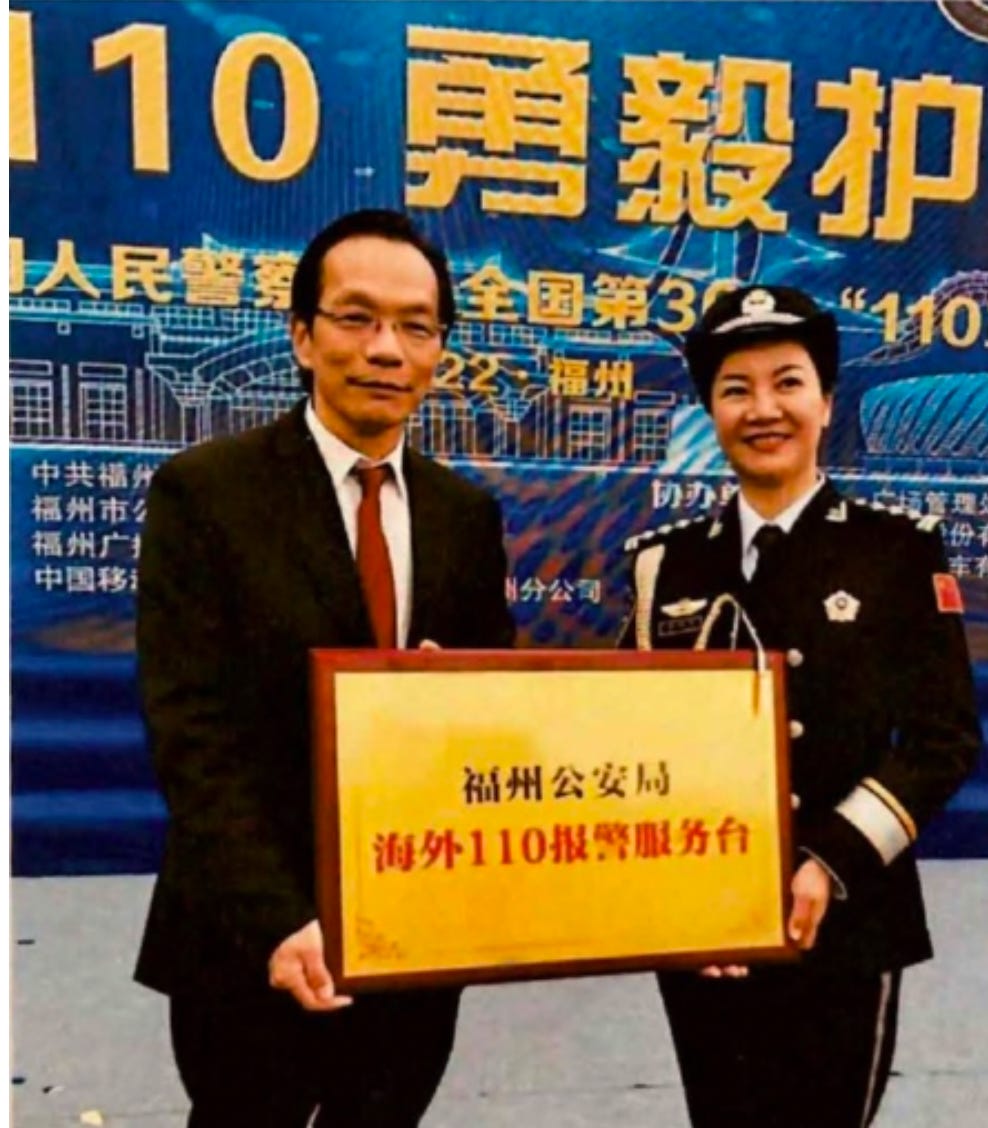
The case against Lu Jianwang, the former chairman of the New York Changle Association, centers on a site inside the association’s Manhattan Chinatown office that prosecutors say functioned as an “Overseas 110 police-overseas Chinese service station” linked to Fuzhou public security.
Assistant U.S. Attorney Antoinette Rangel told jurors Tuesday that Lu had maintained close contact with China’s public-security system for years and was “ready, willing and able” to help them. The prosecution’s central point was that the station was not Lu’s personal idea, but part of a global plan directed by Chinese public-security officials — with Lu “chosen” to implement it in New York.
The prosecution displayed WeChat conversations, photographs and group records that Rangel said outlined a “power chain” linking Lu to the Chinese public-security and political-legal systems. According to Epoch Times court reporting, the evidence included contact information on Lu’s phone for 50 officials in those systems, including Fuzhou public security, Beijing public security, Ministry of Public Security officials from the “610 Office,” and Liu Rongyan, identified in court reporting as the Fuzhou Public Security Bureau official overseeing the Overseas 110 project.
“Ordinary people do not maintain dozens or even hundreds of contacts with the Ministry of Public Security,” Rangel said, arguing that the volume and nature of Lu’s contacts showed he had long assisted Chinese public security and earned its trust.
The timeline presented by prosecutors was compact.
On Jan. 10, 2022, Lu attended a United Front-linked political-consultative conference in Fuzhou and participated in the launch ceremony for “Overseas 110 police-overseas Chinese service stations.” Two days after returning to the United States, the New York Changle Association established its own “police-overseas Chinese service station.”
A video conference shown in court appeared to place the New York site inside a broader Fuzhou network. The courtroom display showed Liu Rongyan connecting with the heads of five Fuzhou “pilot” stations around the world, with the New York Changle Association appearing in the upper-left panel.
The prosecution also pointed to the rank of officials connected to the project. Wang Xizhang, described as the deputy mayor overseeing the Fuzhou Overseas 110 project, also served as Fuzhou’s public-security chief, party secretary and deputy secretary of the municipal political-legal committee before later becoming deputy director of the Fujian provincial public-security department.
The jury heard evidence concerning Xu Jie, a Tiananmen-era dissident. About one month after the New York Overseas 110 site was established, Liu Rongyan asked Lu to help confirm whether Xu, a Chinese dissident living in the United States, was still in Los Angeles, the jury heard. Xu was described in the court reporting as a longtime critic of the Chinese government after the 1989 Tiananmen student movement who later fled to Laos, moved to the United States and operated a YouTube channel critical of Beijing.
A prosecution exhibit showed the request. In the WeChat exchange, Liu’s account provided identifying details for Xu and then wrote in Chinese: “Just help me confirm whether this person is there, that’s all. Thank you.” A follow-up message said: “A friend is looking for him about a private matter. No need to contact him personally. Just confirm whether he is there.”
Lu then forwarded the information to Fujian association leader Zheng Siqi, asking him to help confirm Xu’s whereabouts.
Rangel argued the request was not an ordinary personal favor, but part of the Chinese state’s transnational repression of dissidents. She cited testimony from China scholar Julian Ku, who said Chinese public security has long focused on the addresses, activities and family members of overseas dissidents in order to identify, track and pressure critics into silence.
Lu’s defense rejected the prosecution’s interpretation.
Defense lawyer John Carman argued that official photographs and contacts did not prove Lu was a Chinese government agent, calling such pictures with officials a common feature of Chinese community and political culture. He said the Changle Association was a Chinese community center and that the “police-overseas Chinese service station” merely provided computers, internet access and space so Chinese nationals overseas could renew driver’s licenses by video link — a function he compared to a Department of Motor Vehicles service.
Prosecutors answered that the service-station explanation was a facade. “The police-overseas Chinese service station was only the front,” Rangel argued, saying the visible driver’s-license services concealed a darker channel of political tasking after the station was created.
The defense had already won an important evidentiary ruling before closing arguments. Epoch Times reported May 11 that prosecutors sought to introduce evidence involving two additional alleged victims and communications involving alleged co-conspirators identified as CC-1 and CC-2. One alleged episode involved a request to help locate and “repatriate” a Chinese person in the United States, while another involved identifying a Manhattan-based Chinese person from personal data and a covertly taken photograph.
But the judge ruled that prosecutors had not yet sufficiently connected the first two alleged-victim incidents to the Chinese government, excluding that evidence from the jury. That meant jurors heard the Xu Jie evidence, but not the two other alleged-victim episodes that prosecutors had sought to use to broaden the alleged pattern.
The compressed trial now leaves jurors to decide whether the Manhattan site was, as Lu’s defense says, a pandemic-era community-service center for Chinese nationals — or, as prosecutors argued Tuesday, a carefully selected New York node in Beijing’s global Overseas 110 system. A verdict is expected this week, possibly as soon as Wednesday.


