BROOKLYN, New York — Federal prosecutors are fighting to show Huawei’s jury internal bank records citing alleged links to China’s military and intelligence services, and to play videotaped testimony in which they asked a veteran banking compliance executive about “general concerns about Huawei’s ties to the Iranian military.”
Huawei wants that material kept out of court, calling it vague, unreliable, riddled with hearsay and so inflammatory that jurors could treat disputed allegations as proven facts.
As one of the most geopolitically consequential corporate cases in recent American history opened this week in New York, hundreds of pages of filings analyzed by The Bureau show a shadow war between the prosecution and defense continuing over what the jury will get to consider, in a case wrapped in sealed filings and classified national security procedures.
One 83-page government filing, made public in heavily redacted form, shows prosecutors defending their questions to Huawei’s bankers.
The filings also reveal a separate sealed Huawei motion seeking to block evidence about its alleged export of telecommunications equipment to Iran — and disclose how one institution went on banking Huawei after its own log recorded that its banker had “witnessed Huawei’s sales contract for Skycom stating that it sold its entire stake in the company to a third party.”
Skycom is the Hong Kong subsidiary prosecutors say Huawei secretly controlled and used to provide telecommunications infrastructure and services in Iran, while assuring its bankers it had cut the company loose. That concealment is the heart of the fraud charges.
A companion Huawei filing says that, in a 2017 government interview, the banker acknowledged he knew the Skycom purchaser was not an independent third party.
At least three banks are named as victims of the fraud Huawei is charged with, and none of their names appears on the public docket.
Two of their executives were deposed on video in March and a third was deposed in July.
The first is a former senior officer who reported directly to his bank’s board and sat on the committee that served as its “final arbiter” for reputational risk. The second spent nearly thirty years at his institution and voted on which clients it kept. The third managed the relationship with a Huawei affiliate abroad. Each bank faced the same decision at a different moment between 2010 and 2018: whether to go on banking Huawei.
Huawei says banking records the government seeks to show the jury are unreliable compilations of news clippings. One of those clippings is where the allegations about Iran’s military enter this case.
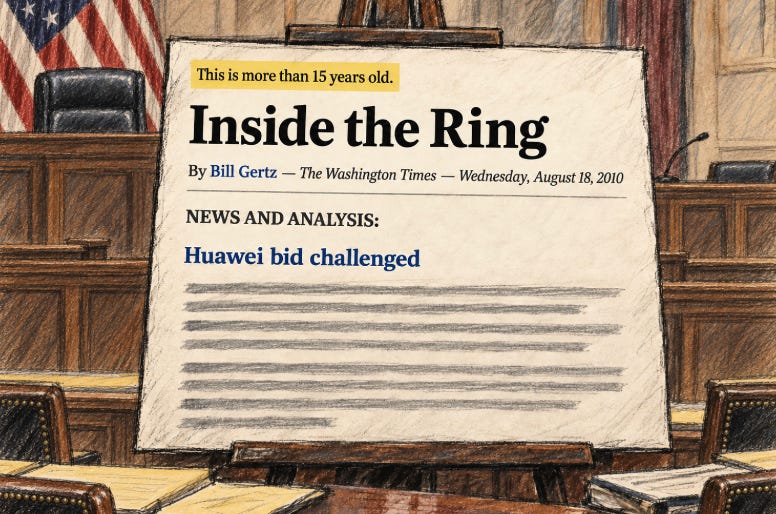
The article was written by Bill Gertz, in his Inside the Ring column, and it ran on August 18, 2010.
Eight Republican senators had written that week to Treasury Secretary Timothy F. Geithner, Commerce Secretary Gary Locke and Director of National Intelligence James R. Clapper Jr., asking the Obama administration to investigate whether national security would be compromised if Huawei sold equipment to Sprint Nextel, a supplier to the American military and law enforcement.
The senators set out what they said was Huawei’s history of selling telecommunications equipment to Saddam Hussein’s Iraq and Taliban-ruled Afghanistan, and its dealings with Iran, “including the Iranian military.” Huawei’s link to the Iranian military, they wrote, “suggests that Huawei should be prohibited from doing business with the U.S. government,” and they cited reports that the company was working closely with the Islamic Revolutionary Guard Corps. “A Chinese company with such a leading role in Iran’s economy and close relationship with the IRGC should not be able to do business in the U.S.”
The “most troubling” aspect of the Sprint deal, they said, was Huawei’s “direct ties” to the Chinese military. Those ties, the column noted, “have raised concerns among the intelligence services of Britain, France, Australia and India,” which had warned that Huawei equipment could “facilitate remote hacking.”
A congressional aide quoted in the column put it more bluntly: “There is clear evidence that Huawei will steal corporate secrets from anyone it does business with, like Motorola and Cisco.”
Huawei did not respond to the column. Someone at a global bank clipped it and attached it to an internal compliance file. The bank’s own words are now a government exhibit: “In view of the adverse news [concerning Huawei] in the Washington Times and the sensitivity of its products supplied to sanctioned countries, escalation to [a senior committee] for second consideration and approval to maintain the relationship is considered necessary.”
That file is what an unnamed risk executive at one of the victim banks was questioned about under oath in March, 15 years later. Unidentified, he is a man with nearly three decades at the institution who sat as a voting member of the committee that decided which clients it would keep.
Government lawyers asked him whether he remembered having “general concerns about Huawei’s ties to the Iranian military.” Huawei objected that the question was too vague to answer.
It’s not clear which way Judge Ann M. Donnelly will rule on this particular piece of evidence, but the government’s reply says it was a simple question with a simple answer.
“The Court should overrule the defendants’ vagueness objection … because the government’s question about the risk inherent in banking a client with ties to the Iranian military was not unreasonably difficult to understand. Indeed, ███ had no trouble answering it.”
The question the trial now poses is how much of that 2010 letter from the Republican senators was prescient, and whether jurors will ever get to read the Washington Times column at all.
The indictment goes further than the senators did, alleging Huawei supplied surveillance equipment “used to monitor, identify and detain protestors” during Tehran’s 2009 demonstrations.
The institution at the center of the case is HSBC, which Meng Wanzhou acknowledged in her 2021 statement of facts that she had misled about Huawei’s control of Skycom — a Hong Kong company that supplied telecommunications infrastructure and services in Iran, and which the indictment says Huawei controlled while telling its bankers it had sold.
Meng is not in the Brooklyn courtroom.
As The Bureau has reported exclusively, a classified June 2019 Canadian Security Intelligence Service assessment found that Beijing feared her extradition would lead her to cooperate with American investigators and disclose privileged information. Units of China’s Ministry of State Security were tasked “from high levels” to stop it, the assessment says, and the campaign that followed combined trade retaliation, pressure on politically connected Canadian business leaders, clandestine interference in the 2019 federal election, and the detention of Michael Kovrig and Michael Spavor.
In one contest the judge has already ruled against Huawei. The court barred the defense from cross-examining bank witnesses about the banks’ own prior enforcement proceedings, after prosecutors warned that allowing it “would essentially put [the banks]—that is, the victims—on trial.”
The senators’ “most troubling” allegation—that Huawei might be “acting at the direction of and funded by the Chinese military”—is not charged. Neither is a relationship with the Revolutionary Guard. Neither are backdoors, or remote hacking, or the sales to Iraq and Afghanistan. Donnelly told prospective jurors that China and the Communist Party are not on trial, and the government has not asked them to find otherwise.
At one deposition, Huawei’s lawyers questioned the banker about the column itself—whether he understood that the Washington Times is “a conservative newspaper,” and whether he would be surprised to learn “it no longer exists.”
Prosecutors pointed out that this was not true, telling the court a “simple Google search would have confirmed” the Washington Times continues to publish.
The congressional aide's line, reported in the Washington Times column, echoes conduct ultimately charged against Huawei in later superseding indictments.
Cisco and Motorola Solutions are both among the companies the government says Huawei stole from, alongside Fujitsu, Quintel Technology, T-Mobile and CNEX Labs. Prosecutors withdrew the Motorola episode as a building block of the racketeering charge days before trial, but Cisco’s router source code remains part of the case the jury is hearing.
Meanwhile, Huawei is fighting to put a different kind of intelligence evidence before the same jury.
The company wants jurors told that the United States National Security Agency spent years inside its servers in Shenzhen, mapping its networks and reading the email of its most senior executives—an operation code-named Shotgiant, disclosed in March 2014 by The New York Times and Der Spiegel from documents leaked by Edward Snowden. Prosecutors have moved to strike it, warning that jurors might otherwise believe the government “infiltrated, and thus, harmed, the very company it is prosecuting.”
When Huawei’s lawyers put those reports to the first bank’s senior compliance executive at his deposition — asking whether a passage in the bank’s own risk file referred to “recently leaked reports that the US national security agency had infiltrated Huawei and had been monitoring its email traffic among senior Huawei executives for years” — he answered: “I have no idea what you are talking about.”
Huawei Technologies and three subsidiaries are charged with racketeering conspiracy, conspiracy to steal trade secrets, bank and wire fraud, money laundering and obstruction of justice, in a scheme prosecutors date from approximately August 2010 to May 2018.
The company denies all of it and has pleaded not guilty. Its lead trial lawyer, Brian Heberlig, told jurors in his opening statement that the government had taken ordinary global commerce and the misconduct of a handful of employees and dressed it up as a criminal organization. “There was no blueprint for crime,” he said. According to the filings, one banker for the Huawei account told United States investigators that he deliberately left out of a November 2013 report to his own compliance committee the fact that “HUAWEI controlled SKYCOM and CANICULA”—”even though he knew that to be true”—because he “did not want to lose the HUAWEI account or trigger an investigation.” He knew Skycom had carried out transactions with Iran and “did not report the illegal transactions to his superiors,” he said, because “he did not want to trigger more work for himself.” Three months later he prepared another report for the same committee and left it out again.
When the committee met on March 31, 2014, it voted to keep Huawei—on the strength, the government says, of the company’s denial of wrongdoing in Iran, its representation that it had sold its stake in Skycom, and its representation that it complied with American sanctions.
On Thursday, as the government’s second witness testified in Brooklyn, Huawei filed a sealed letter objecting to three exhibits: the two 2014 reports and the minutes of the March 31 meeting. They are the documents that carry, among other evidence, the congressional report and the material on the Chinese military and intelligence services.
On one disputed intelligence item the roles reverse: Huawei wants it admitted, and prosecutors want it excluded.
Huawei says that when a bank committee weighed whether to keep the company as a client in March 2014, a former British intelligence officer employed by the bank reported that he had engaged with “the government,” which was “comfortable with Huawei.” The committee, the witness acknowledged under cross-examination, treated it as a mitigating factor.
Prosecutors call the passage irrelevant hearsay that could misleadingly suggest Huawei had been cleared of misconduct. They also dispute Huawei’s claim that the information came from British intelligence, noting that the minutes identify only an unspecified “government.”
Six years later, public reports show, Britain ordered Huawei stripped out of its 5G networks.


In the book Hidden Hand by Clive Hamilton - it is written that Huawei shot itself in the foot because , by law -the CCP's - Huawei is to report its findings to the mainland . I stopped a Bell telephone guy in our area just two weeks ago and asked if Huawei is still in our telephone systems . He said they have transitioned out with another company (?) but something tells me that the systems for info gathering may still be in place.