By Ian Bradbury
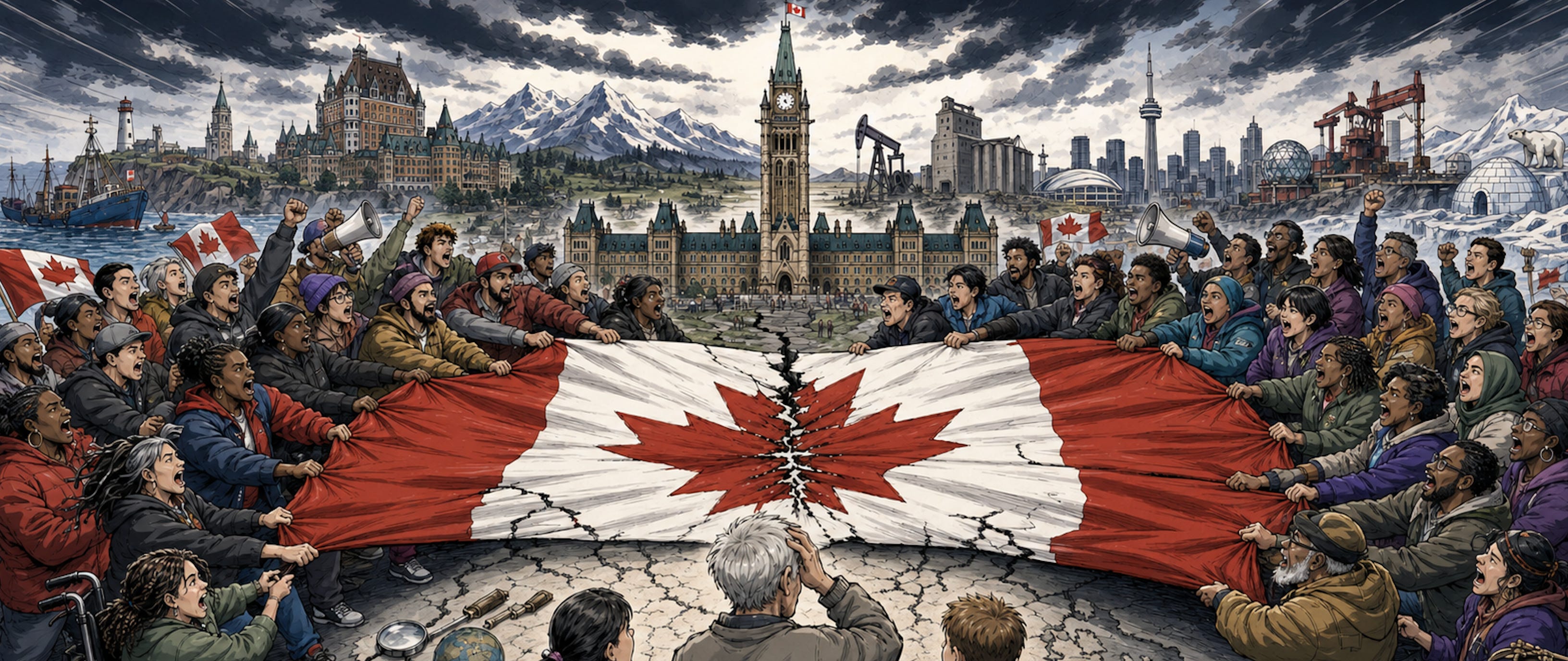
OTTAWA — Political tribalism and bandwagon loyalty permeate Canadian public life across every region and the full spectrum of parties and interests, representing a measure of political division beyond even hyper-partisanship.
Partisanship in itself is neither inherently harmful nor incompatible with a healthy democracy. Political parties exist to organize competing ideas, interests, priorities, and visions for the country, and democratic government necessarily involves disagreement, debate, competition, and loyalty to particular political principles.
The problem arises when ordinary partisanship progresses into tribalization: when political affiliation becomes less about advancing a set of ideas or principles and more about defending the group itself, regardless of evidence, consistency, consequences, or legitimate criticism or opposition, and when that behavior spreads beyond individual political groups into broader public life.
Whether expressed through unwavering support for Liberal, Conservative, New Democratic Party, Bloc Québécois, Green, or other political alignments, or through single-issue movements that demand absolute conformity, supporters too often treat political affiliation as an identity that overrides evidence, principle, and independent judgment.
Positions advanced by “our side” are reflexively defended, while dissenters, including those within the same coalition, are attacked as traitors or enablers of the enemy — people who are no longer considered part of “our side.”
This pattern is not confined to one ideology or region. It appears wherever group belonging substitutes for serious evaluation of ideas, evidence, and outcomes, and it is a recurring historical phenomenon within societies organized around competing identities and interests.
The damage to democracy is both direct and cumulative.
Free and fair debate requires citizens and representatives who can revise their views when indisputable facts emerge or circumstances change, and individuals who can criticize their own leaders without fear of exclusion or expulsion from their political tribe.
When tribalized loyalty tests demanding complete adherence become the baseline for political judgment and replace scrutiny, accountability weakens. Leaders face less pressure and fewer incentives to correct course, while government and opposition alike become increasingly theatrical rather than substantive.
Voters are consequently left with simplified narratives, slogans, and cherry-picked information instead of meaningful and informed choices. Parliamentary institutions, already strained by partisanship, lose much of their capacity for the cross-party problem-solving that a diverse federation requires.
The common good suffers when policy is judged first by its effect on a particular political tribe rather than by its measurable impact on Canadians’ lives. Concrete outcomes, such as housing availability and affordability, health care access and wait times, productivity, economic stability and growth, and fiscal responsibility and sustainability, become secondary to scoring political points or preserving a preferred political narrative.
In this environment, evidence that contradicts the preferred story or interpretation is discounted, while potentially successful approaches pioneered by political rivals are resisted simply because they originated outside the in-group. Resources and public attention that should be directed toward solving problems and improving standards for all citizens are instead consumed by perpetual political and cultural combat.
Social stability erodes and becomes increasingly fragile as mutual distrust both expands and hardens.
Regional tensions, linguistic divides, urban-rural differences, and ideological and identity-based grievances are amplified rather than mediated, and increasingly appear alongside or become associated with tribalized messaging on unity, patriotism, and nationalism.
In this condition, neighbours, colleagues, and family members who hold different political views are increasingly recast as moral adversaries, defined by political team identity and viewed as people to be resisted or outright fought. Public discourse becomes coarser, while institutions that depend on shared factual standards, such as courts, public broadcasters, colleges and universities, and the public service, lose legitimacy among significant segments of the population.
The space for ordinary civic cooperation consequently shrinks and becomes much harder to restore, particularly when periods of heightened national unity are most necessary.
The national interest is compromised when political loyalty takes precedence over collective needs.
Canada cannot effectively manage cross-spectrum cohesion or federal-provincial relationships, conduct coherent foreign and defence policy, or effectively adapt to economic and demographic pressures when team loyalty takes precedence over collective needs. Persistent tribalism leaves the country more brittle in a crisis, more vulnerable to adversaries, and less capable of making the trade-offs required to protect its interests.
A healthy democracy does not require the absence of strong convictions or organized interests. It requires that convictions remain open to evidence and that organized political interests remain accountable to something larger than their own survival. Political loyalty can be legitimate and even necessary, but it should never become a substitute for judgment.
Canada is not so far gone that the course we are on cannot be corrected.
We still have the institutions, civic capacity, and democratic traditions necessary to change direction. Doing so requires citizens, political leaders, institutions, and organized interests to place evidence above tribal loyalty, principle above political convenience, and the long-term national interest above the immediate demands of their political camp.
Doing so also requires the willingness to disagree without treating disagreement as betrayal, to recognize when political opponents have a valid point, and to change one’s position when the evidence warrants it.
The standard should be simple: political loyalty may inform our convictions, but it must never determine what we are willing to believe.
Ian Bradbury, a global security specialist with over 25 years experience, transitioned from Defence and NatSec roles to found Terra Nova Strategic Management (2009) and 1NAEF (2014). A TEDx, UN, NATO, and Parliament speaker, he focuses on terrorism, hybrid warfare, conflict aid, stability operations, and geo-strategy.


Tribalism is hurting everyone. Territorial demons hate each other. Lower scales do not negotiate/reason.
Who was it that said, "don't argue with stupid people. They will just drag you down and beat you with experience".
Some are confused.
But most are pissed, as they can no longer "game" the system. AND "they" hate change for that reason.
There's more, but I'll leave the rest for discussion.
"Free and fair debate requires citizens and representatives who can revise their views when indisputable facts emerge or circumstances change" <-- Leftists, Marxists and Islamists - but I repeat myself - included?