


LONDON – British counterterrorism police arrested a 27-year-old dual British-Iranian national in London on Thursday on suspicion of preparing terrorist acts, a significant development in the investigation surrounding RAF Fairford, the British air base used by American bombers during the U.S.-Israeli war against Iran.
Counter Terrorism Policing said the man was arrested Thursday afternoon in Westminster under Section 5 of the Terrorism Act in connection with the investigation into events near RAF Fairford in Gloucestershire. Police also searched two properties in Westminster.
Yesterday, Prime Minister Andy Burnham said Britain sees “strong indications” that Iran played a part in the incident.
A second man, a 26-year-old British national, was questioned under caution but was not arrested.
“The investigation into circumstances surrounding events in Gloucestershire is hugely complex, and our specialist teams are interrogating multiple lines of enquiry,” Vicki Evans, the senior national coordinator for Counter Terrorism Policing, said Thursday.
“As we’ve made clear, we’re looking at all possible angles—including possible foreign state involvement.”
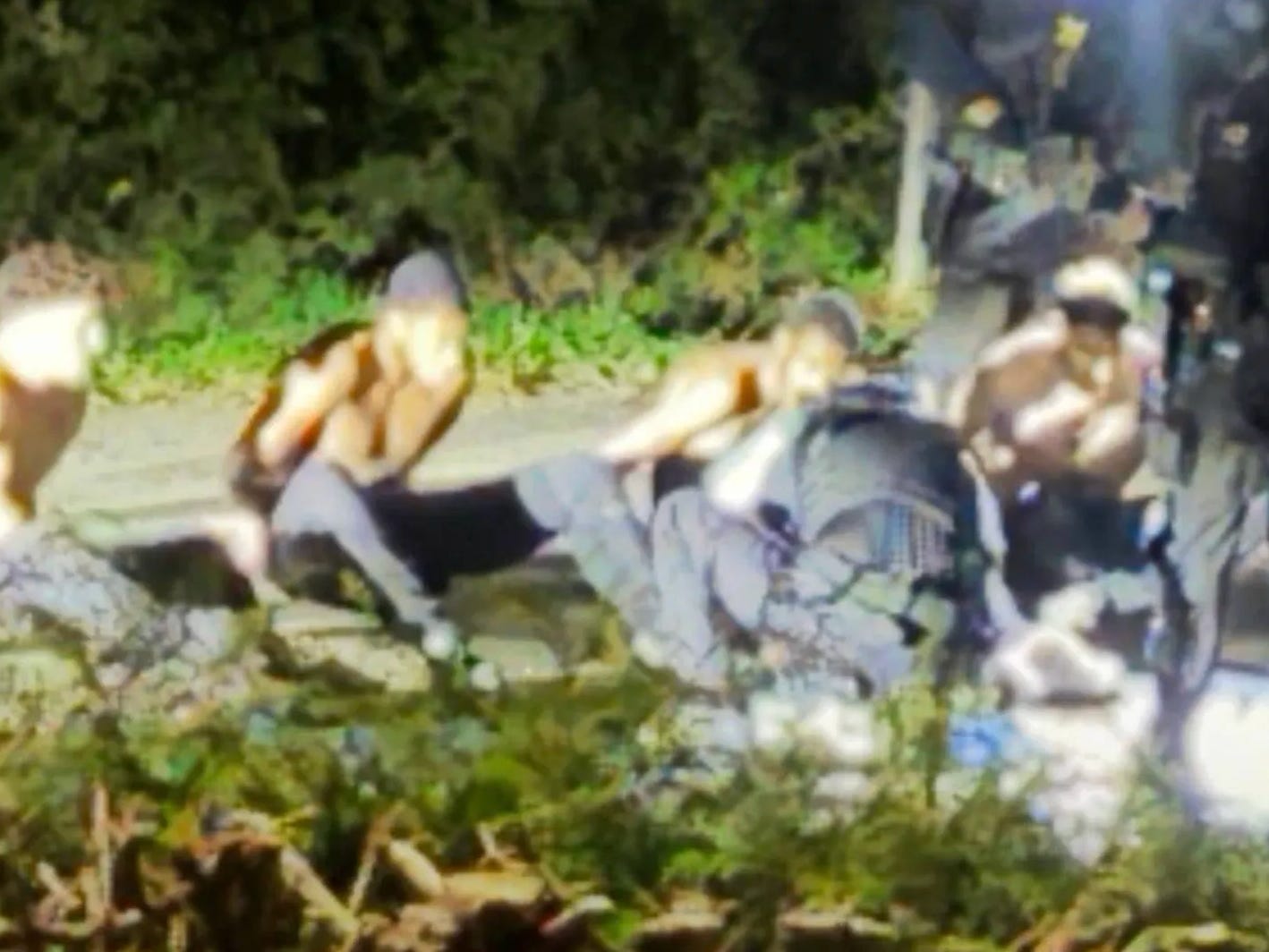
The arrest appears to deepen the same investigation that began early Sunday morning, when armed police detained five British men after receiving information about three suspicious vehicles apparently travelling toward RAF Fairford.
The 27-year-old was arrested in Westminster, where police also searched two properties. Three of the original five suspects are Westminster residents, while the others are residents of Camden and Willesden, according to Counter Terrorism Policing. All five are British nationals in their 20s.
Police have not alleged publicly that the six men were acting together.
But Counter Terrorism Policing had already publicly identified possible foreign-state involvement as a central line of inquiry days before Thursday’s arrest.
In a detailed update, Assistant Commissioner Laurence Taylor, head of National Counter Terrorism Policing, said investigators were considering the incident “from every possible angle,” including the possibility that it involved proxies or people “either knowingly or unknowingly, working on behalf of a foreign state.”
Taylor placed the Fairford investigation within a broader threat environment in which hostile-state activity may initially resemble ordinary crime.
“Often this threat becomes visible to us as criminal activity, often at a small scale and committed by individuals whose primary aim is not terrorism but a quick financial gain,” Taylor said.
Counter Terrorism Policing’s broader guidance on state threats makes the same convergence explicit. It identifies assassinations and physical attacks against dissidents and other regime opponents, financial activity supporting terrorism or corruption, and threats designed to suppress opposition among the methods foreign states can employ.
That description underlines a critical theme in The Bureau’s reporting on alleged Iranian threat networks in Canada and the United States: the increasingly blurred boundary between organized crime undertaken for money and violence allegedly commissioned in the interests of a foreign state.
The Bureau reported in June on U.S. federal allegations that Mohammad Baqer Saad Dawood Al-Saadi, identified by American authorities as a commander in Iran-backed Kata’ib Hezbollah, directed criminal associates to attack the U.S. Consulate in Toronto and was connected to a separate alleged plot targeting a synagogue in New York. U.S. prosecutors alleged payments were offered for violent operations, illustrating what authorities described as a model in which ideologically motivated actors can outsource violence to financially motivated criminal intermediaries.
The Toronto investigation subsequently took a deadly turn.
Toronto Police Constable Marc Pinizzotto was killed on June 11 while executing search warrants connected to the investigation into the March shooting at the U.S. Consulate.
The Bureau has reported more broadly on what U.S. and Canadian national-security officials describe as the use or attempted recruitment of organized-crime actors as proxies against Iranian dissidents, Jewish targets and other critics of Tehran in North America—a model in which people motivated principally by money can allegedly be recruited to carry out acts serving the interests of a hostile state.
The Canadian and American cases are not known to be operationally connected to the Fairford investigation. But the alleged model is strikingly similar to the threats British counterterrorism officials are now publicly describing.
That warning potentially provides important context for investigators’ efforts to determine the knowledge and motivations of the men arrested near Fairford.
The original incident began at about 12:45 a.m. Sunday, when police received information concerning three suspicious vehicles apparently travelling toward RAF Fairford.
Armed officers intercepted the vehicles in the Whelford area and arrested the five men. Counter Terrorism Policing described the subsequent investigation as a “hugely complex and large-scale operation” involving local and national police, the Ministry of Defence and other agencies.
The vehicles underwent extensive examination involving military assets and forensic specialists. Police subsequently said no improvised explosive devices had been discovered, although a quantity of petrol was recovered.
The five men were released on police bail Monday, a development that generated considerable public attention and criticism from President Donald Trump. Trump said the incident “might be” linked to Iran, while Secretary of State Marco Rubio alleged foreign involvement and pointed to Tehran’s threats against American interests worldwide.
Trump also said British and American authorities had worked closely on the case and that the suspects had been under observation for some time, suggesting a significant counterterrorism operation involving two members of the Five Eyes intelligence alliance.
Iran has denied involvement.
Right now, distinguishing between terrorism and false flags will be interesting.