Pentagon Suspends 86-Year-Old Canada-US Defense Board, Citing Ottawa's Failure to Meet Commitments, in Direct Rebuke of Carney's Davos Speech
WASHINGTON – On Monday morning, the Pentagon’s senior defense strategist suspended the oldest bilateral defense institution in North American history and pointed the announcement at Mark Carney’s Davos speech — a four-month-old address the Canadian prime minister’s admirers had called Churchillian, and that Washington now treats as a case study in the gap between rhetoric and reality.
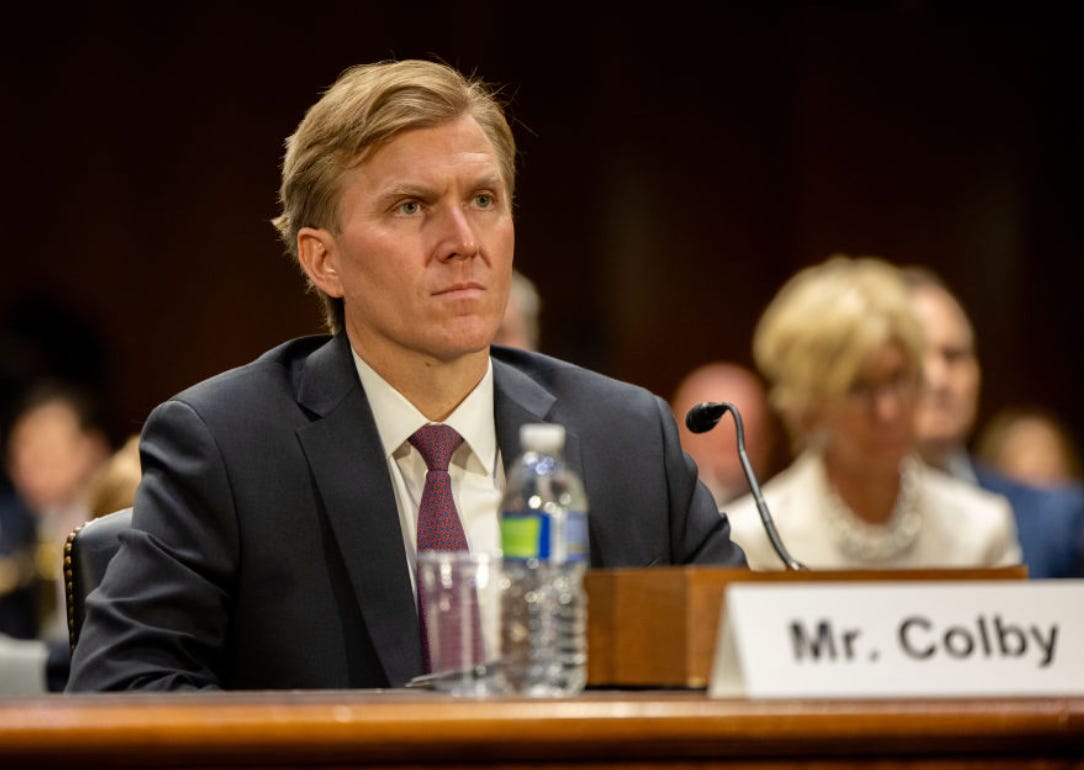
Elbridge Colby, Under Secretary of War for Policy and the principal architect of American defense strategy under the Trump administration, announced that the Department of War is pausing the Permanent Joint Board on Defense to “reassess how this forum benefits shared North American defense.” The board was established by Franklin Roosevelt and Mackenzie King at Ogdensburg, New York in 1940 and has operated continuously for 86 years.
“A strong Canada that prioritizes hard power over rhetoric benefits us all,” Colby wrote. “Unfortunately, Canada has failed to make credible progress on its defense commitments.” In a subsequent post, Colby attached a map of North America and wrote that “delivering on shared continental defense begins by recognizing our shared geography.” A third post revealed that Colby had recently hosted US Ambassador to Canada Pete Hoekstra at the Pentagon, and that the two are “working closely” to ensure Canada reaches the Hague Summit’s 3.5% of gross domestic product defense spending target.
The implications for Canada are potentially generational.
Carney’s government had heralded crossing NATO’s 2% of gross domestic product defense spending threshold — for the first time since the end of the Cold War — as a landmark achievement. Washington has already moved the standard to 3.5%, meaning Canada would need to more than double its current defense budget to satisfy the new American benchmark. That scale of spending increase, if pursued, would reshape federal fiscal priorities for years, at a moment when the Carney government is simultaneously attempting to negotiate the renewal of the Canada-United States-Mexico Agreement ahead of a July 1 review deadline. US Trade Representative Jamieson Greer has signaled that formal talks with Mexico are moving faster than those with Canada.
The defense pressure lands against a backdrop that Washington has watched with mounting unease.
In January, Carney traveled to Beijing and declared a “new strategic partnership” with China — the first visit by a Canadian prime minister to China in eight years — striking agreements on electric vehicles, agriculture, and energy, and meeting personally with President Xi Jinping.
Trump threatened Canada with 100% tariffs over the deal, warning that Carney should not make Canada “a drop-off port for China to send goods and products into the United States.” NBC News reported at the time that Trump had been privately complaining to aides about Canada’s vulnerability to adversaries in the Arctic, and that a Pentagon working group had warned the White House that Canada’s exposure to China and Russia along its northern border was among the most significant strategic risks facing the United States in the region.
The Five Eyes intelligence relationship — the foundational signals-sharing architecture binding the US, Canada, the United Kingdom, Australia, and New Zealand — has come under renewed scrutiny in that context, with Washington increasingly regarding Canada as the alliance’s weak link on Chinese interference.
Erin O’Toole, former leader of the Conservative Party and recently named to the Advisory Committee on Canada-US Economic Relations by Carney, reacted to Colby’s post with his own on X Monday morning.
“This is profoundly misguided and quite strange coming right after the President’s visit to China,” O’Toole wrote. “Canada has been and will be an ally that shares values of liberty. As a Canadian whose grandfather deployed to Alaska for joint defence in WWII, I hope we don’t lose sight of that.”
Monday’s suspension of the Permanent Joint Board on Defense is not entirely surprising given the signals that have been coming from Washington, where lawmakers over the past few weeks have reportedly become increasingly impatient with the rhetoric coming from Carney and his surrogates.
Carney went to Davos in January and told the world that middle powers negotiating bilaterally with a hegemon “negotiate from weakness” and risk “the performance of sovereignty while accepting subordination.”
His coded message was understood to point at President Trump’s administration.
More recently, he posted a video address to Canadians in which he declared that the country’s once-close economic ties to the United States had become a liability. “Many of our former strengths, based on our close ties to America, have become weaknesses,” Carney said. “Weaknesses that we must correct.” In the same address, Carney held up a miniature statue of Major-General Sir Isaac Brock — a British commander who fought against US forces during the War of 1812 — and said the figure reminds him “that when we’re united as Canadians, we can withstand anything.”


I do not trust the Liberal Government's Strategic Partnership with China. The allowance of the RCMP working with the CCP security in Canada, not to mention them allowing China's media access to Canada, screams out loud to all countries once allied with Canada to be very wary. The Liberal's Bill C-22 is essentially following in the very foot steps of the Communist Regimes acts of servailence of their own citisens. All allied countries should engage only under deep cautionary rules, as Canada is now a vassal state of the Chinese Communist Party. This is how I, as a Canadian citisen, see our once free and democratic country, let alone any of our allies, the Five Eyes Security, or our long time neighbor and biggest trading partner, the United States. Canada is now a failed democracy, with infiltrated and failed Institutions through out all levels of Governence.
As an Alberta separatist, this is just another reason to divorce Canada.
Alberta's trade with the US accounts for about 90% of our trade, something like $130 billion in bilateral trade.
Considering that the rest of Canada is okay with land locking us, yet taking billions of dollars from us annually, we have a better friend in the US, Ottawa certainly is our enemy.
The US relies on Alberta supply chains for many jobs. Ottawa relies on us for our money. With the US we have bilateral trade agreements. With Ottawa we just get to give them our money and get pretty much nothing in return.