Parliament's Ethics Committee Calls on Carney to Sell Brookfield Stakes, Citing Reporting From The Bureau on His China Business Ties and CCP Official Meetings
OTTAWA — A landmark parliamentary ethics report recommends that Prime Minister Mark Carney — and all future prime ministers — be required to sell their investments within 60 days of taking office, while citing this reporter’s testimony on The Bureau‘s reporting into Carney’s China-linked business exposure and high-level Chinese Communist Party official visits.
If recommended reforms were followed by Canada’s government, the report — which includes a dissenting opinion from Liberal committee members — could end an era in which the country’s most powerful public official can legally profit in secret from companies affected by government decisions.
The 79-page report, tabled in Parliament on Thursday by the Standing Committee on Ethics under Conservative chair John Brassard, makes 20 recommendations for strengthening the Conflict of Interest Act. Its central finding: blind trusts — the financial arrangement Carney has used to hold his substantial stake in Brookfield Corporation, the global investment giant he helped lead before entering politics — are insufficient to prevent conflicts of interest at the highest level of government. “Individuals with greater decision-making authority should be held and must be held to a higher standard,” Brassard wrote in the report.
Duff Conacher, of the ethics watchdog Democracy Watch, who also testified before the committee, welcomed the report in pointed terms. “The committee’s report should be applauded and acted on by the Liberal majority government as it calls for most of the long-overdue changes needed to close huge loopholes in the ethics law, and to make the ethics commissioner more independent and enforcement more transparent, and to ensure violators of the law are penalized,” he said.
Conacher said that if enacted, the recommendations would mean Carney “would essentially be required to sell his investments in Brookfield and other companies that cause a serious, ongoing financial conflicts of interest for him.”
He added that “several Cabinet ministers and top government officials would also have to sell their investments in businesses that cause conflicts, which would be important steps forward to reduce their many serious conflicts.”
The committee’s examination of Carney’s blind trust revealed significant gaps in the public-accountability framework governing the Goldman Sachs alum and former central banker’s financial affairs.
Canada’s Conflict of Interest Commissioner told the committee that Carney placed all his assets in a blind trust and makes no decisions about it. But the commissioner acknowledged that Carney’s holdings can nevertheless grow while he leads Canada. “Decisions relating to companies in which he held assets could be profitable for him if those decisions led to an increase in the assets’ value,” the current commissioner testified.
The ethics screen, witnesses including Duff Conacher testified, has structural limits. The committee heard that neither of its two administrators knows the specific assets inside the Brookfield Global Transition Fund — the vehicle tied to Carney’s future bonus pay, potentially worth tens of millions of dollars and calculated against the fund’s performance.
Justin Beber, Brookfield’s chief operating officer, told the committee that increases in the company’s share price benefit holders of instruments such as stock options and deferred share units “whether during employment or following employment,” and that information about these instruments is publicly disclosed. He rejected allegations of tax avoidance, stating the company paid more than $750 million in federal taxes in Canada in 2024 and engages in tax planning “in the same manner as other companies.”
But other testimony before the committee carried international weight.
Jason Ward, principal analyst of the Centre for International Corporate Tax Accountability and Research, testified from Sydney, Australia, where his organization has built one of the most extensive independent records of Brookfield’s global tax practices. Ward noted pointedly that his research on Brookfield “mostly occurred during the period when Prime Minister Mark Carney was chair of Brookfield.”
Over the past four years, Ward’s organization has published reports examining what it characterizes as Brookfield’s tax avoidance across multiple jurisdictions — from a 2023 report on the company’s use of Bermuda-based structures, to investigations of Brookfield investments in Colombian hydropower, Brazilian water and sanitation services, and Australian private hospitals. In each case, the research identified use of tax havens and profit-shifting mechanisms to reduce tax obligations in the countries where Brookfield operates. Radio-Canada has separately reported that while at Brookfield, Carney co-chaired two investment funds worth approximately $25 billion also registered in Bermuda.
When asked by Conservative MP Michael Barrett whether the same kinds of opaque corporate structures Brookfield uses — subsidiaries in tax havens, related-party debt arrangements, trust vehicles — could be used by public office holders to shield their financial interests from scrutiny under Canada’s Conflict of Interest Act, Ward was direct. “Absolutely,” he said. “The use of subsidiaries in tax havens and the use of trust structures can shield public office holders from having their income taxed as it was intended to be in Canada.”
The committee’s final report also cites testimony from this reporter, drawing on findings published by The Bureau.
"Samuel Cooper, a journalist with The Bureau, said he believes that full divestiture is a good solution for restoring public confidence in the integrity and transparency of the federal government," the final report states. It adds that "Cooper said that Brookfield's investments with Chinese state entities, investments connecting to Middle East entities and its use of investment vehicles — which are based in lower-transparency jurisdictions in the Caribbean — raise legitimate questions about the company's practices."
This reporter testified that while Carney served as governor of the Bank of England, he worked on establishing a special relationship with the Bank of China.
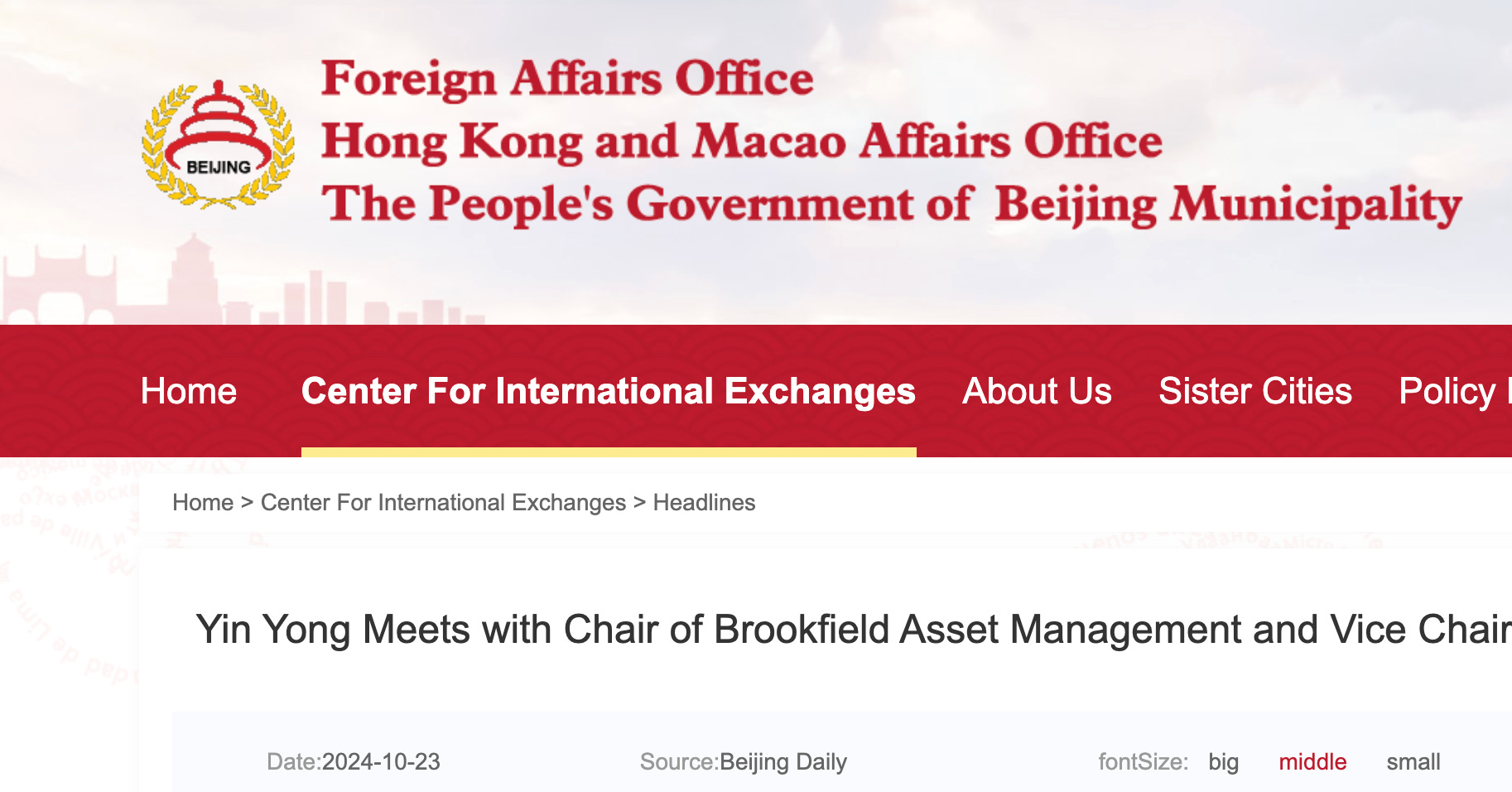
After 2015, Brookfield made substantial China-based real estate investments, and around the time of the Bank of China’s assistance with refinancing Brookfield’s real estate dealings — a $276 million loan, secured in November 2024, after Brookfield’s Shanghai real estate holdings had fallen sharply in value — Carney traveled to China to meet with Beijing Mayor Yin Yong on October 20, 2024, on the sidelines of the Financial Street Forum in Beijing.
That visit took place roughly three months before Carney formally announced his candidacy for the Liberal Party leadership, which had fallen precipitately in election polling under Liberal Prime Minister Justin Trudeau, whom Carney had been serving as an economic advisor in the final years of Trudeau’s tenure.
Six weeks after Trudeau appointed him, on September 9, 2024, to chair the Liberal Party’s Task Force on Economic Growth, Carney travelled to Beijing and met with Beijing’s mayor, the trip that occurred shortly before Brookfield secured its $276 million loan.
A Chinese Communist Party state readout of the October 2024 meeting quoted Beijing Mayor Yin Yong as declaring that “The Third Plenary Session of the 20th CPC Central Committee has drawn a new blueprint for China’s reform and opening-up,” and stated that Yin encouraged Brookfield Asset Management and BlackRock to “seize opportunities.”
The same readout reported that Carney “highlighted Brookfield Asset Management’s keen interest in seizing development opportunities in China, further expanding its business in Beijing, and deepening cooperation with relevant partners in areas such as green finance, fund management, and infrastructure investment.”
The committee’s final report notes that this reporter acknowledged the broader commercial context, stating that “a business analyst would say it’s almost impossible for international business persons to not be doing business with Chinese state entities in some ways.” The conclusion drawn before the committee, nonetheless, was that Canadians should be aware when a Canadian company has significant interests in China.
The committee’s recommendations include a new prohibition on public office holders investing in companies that use tax havens.
Liberal members of the committee filed a nine-page dissenting report, accusing the opposition of targeting Carney personally and arguing that experts who appeared before the committee affirmed that blind trusts are effective — a position that Ward’s testimony directly contradicted.
Conacher framed the report as a direct test of Carney’s character and intentions. “The committee’s report presents a real challenge to the prime minister — will he continue to blow smoke about his ongoing multiple financial conflicts of interest and hide behind a loophole-filled ethics law that allows him to secretly profit from his own decisions, or will he make the changes the committee calls for to make the federal ethics law much more effective at actually preventing conflicts of interest?”
He warned that the political stakes of inaction are high. “If the Liberals use their majority to bury the ethics committee’s report, they will say loud and clear to voters that they are fine with Prime Minister Carney and many Cabinet ministers and top government officials having unethical financial conflicts of interest that corrupt and taint many of their decisions on important issues and problems, and that they are fine with secretive, ineffective enforcement of one of the key laws that protects Canada’s democracy.”


Thanks for the information.
I find it strange that most of the rest of the media is very uninterested in this topic.
For over 10 years Canadians (voters) have allowed the Liberal gov't to do whatever they want. The Liberals play by their rules; not fairly, not with integrity and not in the best interest of Canadians.