

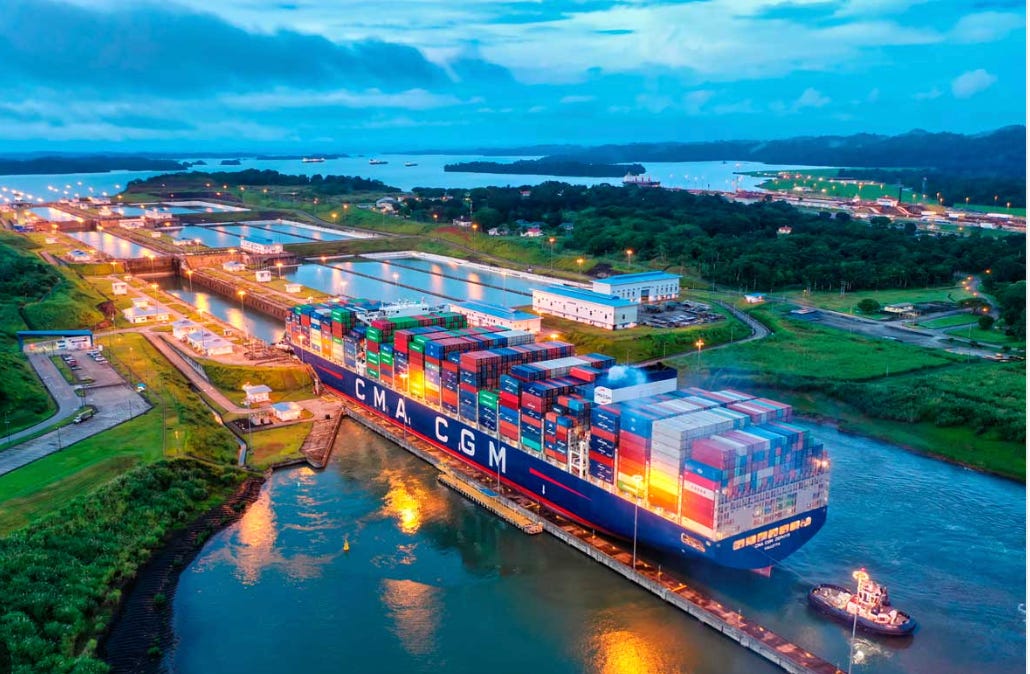
OTTAWA — The Panama Canal is one of the great arteries of the world economy, a narrow thread of water through which roughly five percent of global maritime trade passes each year. For three decades, the ports at each end of it — Balboa on the Pacific, Cristobal on the Atlantic — were operated by a subsidiary of CK Hutchison, the Hong Kong conglomerate controlled by the family of billionaire Li Ka-shing. That arrangement ended this year when Panama’s Supreme Court ruled it unconstitutional, the government physically seized the terminals, and Beijing erupted in fury, threatening that Panama would “pay a heavy price.”
What looked to casual observers like a commercial dispute over a port concession is, in fact, a chapter in a far larger and more dangerous story — the slow-motion cold war between Washington and Beijing for position, dominance, and leverage that could turn hot at any number of flashpoints, with Taiwan the most volatile of them.
In that context, the Panama Canal is not a secondary theatre. It is closer in strategic weight to the Cuban Missile Crisis than to a contract disagreement — a chokepoint whose control carries consequences that extend far beyond Central America. Few analysts have mapped that terrain as carefully as Matt Brazil.
A senior fellow at the Jamestown Foundation, former US Army officer, diplomat, and intelligence professional, Brazil co-authored with ex-Central Intelligence Agency counterintelligence analyst Peter Mattis the definitive English-language primer on Beijing’s espionage and influence architecture. His analysis of the Panama situation, published by the Jamestown Foundation, is essential reading for anyone who wants to understand what is actually at stake — and why the canal’s fate carries warnings far beyond Central America, including for Canada.
Brazil documents how Beijing’s penetration of Panama was never simply about ports. It was a multi-domain strategy. When Panama switched diplomatic recognition from Taiwan to Beijing in 2017, it became the first Latin American country to join the Belt and Road Initiative. What followed was a textbook influence operation: infrastructure investment, a $900 million port deal with the Shandong-based Landbridge Group, construction projects, a new cruise terminal, a convention center, and a fourth canal bridge now under construction.
Simultaneously, Beijing worked the softer registers — media penetration, academic relationships, law enforcement cooperation, diaspora organizations tied to the Communist Party’s United Front system advocating Beijing’s positions on Taiwan and sovereignty. Taiwan-based DoubleThink Lab, which tracks Chinese state influence worldwide, ranked Panama twelfth globally and second in Latin America for the depth of that penetration, concentrated most heavily in media, technology, politics, and law enforcement.
The ports were the anchor for a much deeper play for sphere-of-influence dominance. Their military value towers above all other factors. Around them, Beijing built layers of dependency, presence, and leverage — what Brazil describes as a strategy to expand influence in what Chinese strategic doctrine calls “intermediate zones.”
These are nations outside the formal US alliance structure, where Washington’s reach can be quietly contested and Taiwan’s diplomatic space steadily compressed.
The canal itself was the strategic jewel at the center of all of it.
The Hutchison concession, awarded in 1997, gave a Hong Kong conglomerate with deep ties to the mainland operational control of the two chokepoints through which the canal’s commercial traffic flows. At the time, Admiral Thomas Moorer — former Chairman of the Joint Chiefs of Staff — testified before the Senate that the arrangement was a strategic catastrophe in the making, warning that Hutchison held the legal right to deny passage to American naval vessels and that the Clinton administration was sleepwalking into Chinese control of a hemisphere-defining chokepoint.
The former naval commander testified that Hutchison Whampoa’s “business empire has long been intertwined with the enterprises that front for the Communist military intelligence arms of the People’s Republic of China.” The Clinton administration ignored him.