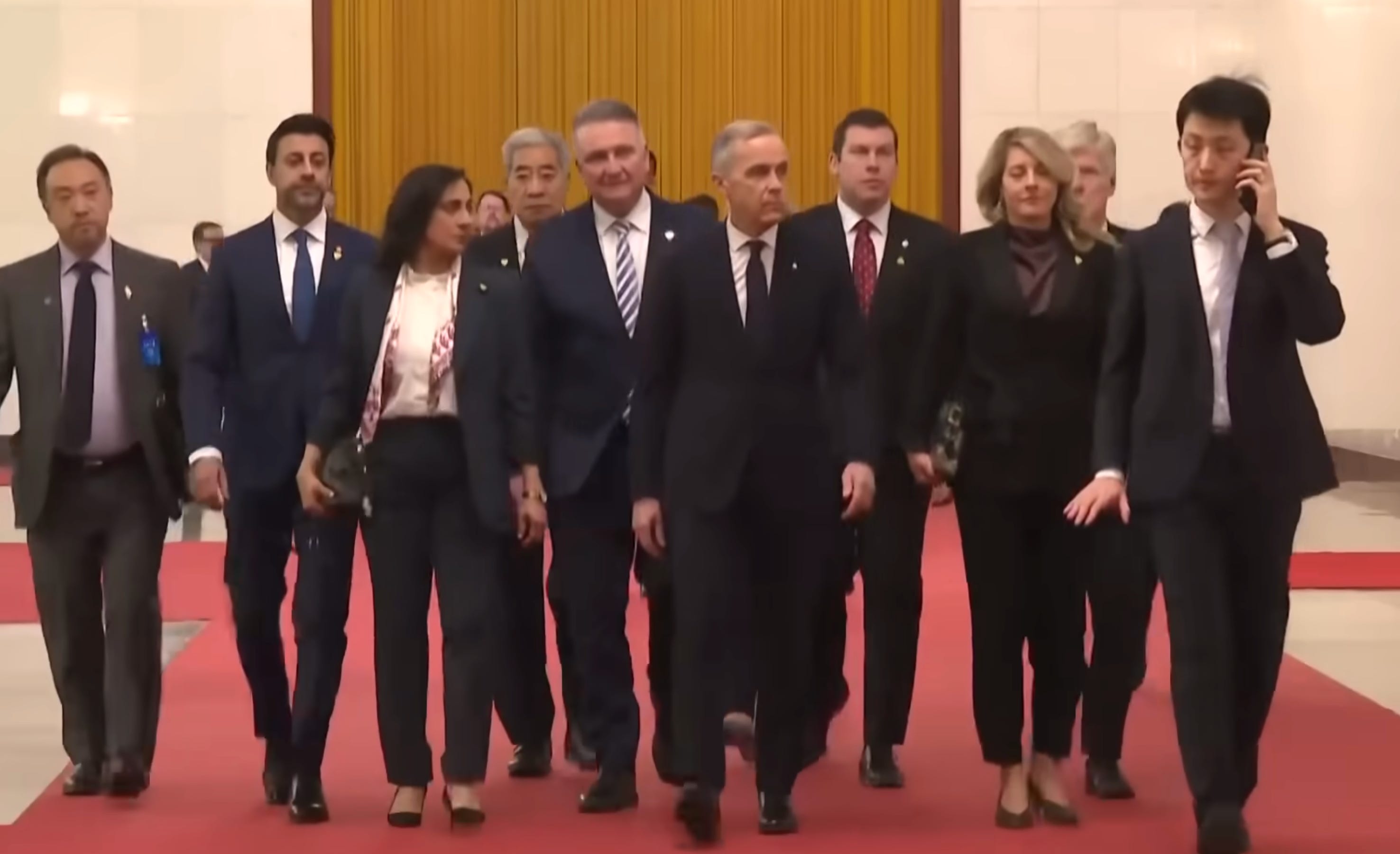
Op-Ed: Hong Kong Diaspora Groups Sound the Alarm on Carney's Secret PRC Police Deal—The Bureau's Reporting Already Proves Them Right

OTTAWA — Ten Hong Kong diaspora organizations—spanning Canada, the United States, the United Kingdom, and Europe—have issued an extraordinary open letter to the Government of Canada expressing “deep fear and anxiety” over Mark Carney’s deal on law enforcement cooperation signed between the RCMP and the Ministry of Public Security of the People’s Republic of China.
The letter, released February 12, is a plea from communities that fled Chinese state repression and now fear that Carney’s Liberal government has formalised cooperation with the very security apparatus that drove them from their homes—without telling them what the deal contains, what safeguards exist, or who is watching.
What makes this open letter so significant is that the concerns it raises are not speculative. They are already powerfully evidenced in The Bureau’s reporting—based on classified documents, federal intelligence assessments, and the expert analysis of former senior RCMP officer Garry Clement, who spent nearly five decades in policing, intelligence, and financial-crime investigations, including professional experience in Asia.
Ottawa says the “memorandum of understanding” with Beijing is meant to “enhance cooperation on corruption and transnational crimes, including cyber and telecommunications fraud, synthetic drugs, narcotics trafficking, and money laundering,” and to “continue bilateral law enforcement working-level engagement between the two sides.”
But Hong Kong diaspora groups say formal cooperation with China’s Ministry of Public Security is not a neutral technical partnership. For communities that fled repression, it can only mean deeper engagement with an internal security apparatus that has provably been exported into Western nations and is now associated—through lived experience—with “surveillance, harassment, intimidation, and pressure” directed at Hong Kongers overseas and their families.
They explain that the inescapable effect is immediate and corrosive: even “the perception of closer engagement” between Canadian agencies and Chinese security authorities chills “free expression, civic participation, journalism, and advocacy,” and drives vulnerable people out of public life.
“Trust between law enforcement and diaspora communities is essential,” they add—and without confidence their privacy and safety are protected, communities may hesitate to report crimes or work with police.
As one Hong Kong diaspora member put it: “I no longer feel safe reaching out to the RCMP. I fear that my identity could be exposed or that information I share could somehow reach the Chinese authorities.”
Documents obtained and reported by The Bureau point directly at Chinese police agents illegally working with Canadian law enforcement, in warnings from CSIS to Mark Carney’s predecessor, Justin Trudeau.
The most critical piece of evidence is a classified June 2019 NSICOP report, which The Bureau reported on in July 2023. The unredacted and classified version, available only through The Bureau’s reporting, states:
“PRC officials have used covert and unauthorized tactics, including unauthorized trips to Canada, threats, intimidation, harassment, arresting relatives in China as a form of leverage, paying Chinese-language journalists to locate and track individuals, and discouraging people from reporting their covert activities to Canadian police.”
Read that again. Chinese police have paid Chinese-language journalists in Canada to locate and track targets. They have arrested family members in China to coerce compliance. They have actively discouraged victims from reporting to Canadian police.
The Bureau can further confirm, through expertise that includes consultation with diaspora groups and Canadian police forces, that these concerns are real. As part of our public-interest outreach, we have briefed a Greater Toronto Area police force on the very real fears of Asian diaspora members who are holding back from engagement with officers—because their interactions have led them to believe their information was not safe.
Consider the state of affairs in Canada. Just over a week ago, a major scandal upended the Toronto Police Service, with allegations that numerous officers accessed internal databases on private citizens at the behest of gangsters—and that a Canadian law enforcement officer who stood in the way of drug trafficking into a large prison faced a murder attempt.
The Hong Kong diaspora groups are right to be fearful. The evidence is on their side—not on the side of Mark Carney’s government.
In fact, Carney’s Liberal government has largely ignored the concerns of the diaspora and the warnings from CSIS, as The Bureau’s rigorous reporting on the NSICOP and other documents has shown.
Their concerns have already been supported by the expert analysis of former senior RCMP officer Garry Clement, who spent nearly five decades in policing, intelligence, and financial-crime investigations, including professional experience in Asia.
Clement has written in these pages that cooperation with the PRC “is never just technical, never apolitical, and never insulated from the priorities of the Chinese Communist Party.” He has warned—from direct operational experience—that the party-state does not compartmentalize criminal enforcement from intelligence collection and political repression. It blends them seamlessly. And he has described in detail how liaison relationships erode caution over time, how criminal labels are applied to political targets, and how information shared in good faith migrates to coercive ends.
The open letter, co-signed by organisations including Hong Kong Watch, Canadian Friends of Hong Kong, the US HongKongers Club, the European Hong Kong Diaspora Alliance, and six other groups, is direct about what is at stake.
“Hong Kongers living overseas have faced surveillance, harassment, intimidation, and pressure directed at themselves and their families by Chinese authorities,” the letter states. “For communities that fled repression, any expansion of official engagement with China’s internal security apparatus is profoundly alarming.”
The groups identify the core failure: a total absence of transparency. They note that the Government of Canada has “not publicly released the full text of the MoU, nor explained what safeguards, limitations, or oversight mechanisms are in place.” This opacity, they argue, has “intensified fears that cooperation on crime-related matters could, intentionally or unintentionally, expose individuals or community networks to harm.”
The Hong Kong diaspora groups do not need to theorize about what happens when the PRC’s security apparatus targets people on Canadian soil. It has already happened to Joseph Tay.
Joe Tay, a pro-democracy activist and Canadian citizen, sought the Conservative nomination in Markham–Unionville for the 2025 federal election, before ultimately running in neighbouring Don Valley North. In December 2024, Hong Kong police issued a $184,000 bounty for his arrest, accusing him of “inciting secession” and “colluding with foreign forces.” In January 2025, Liberal Member of Parliament Paul Chiang told a Chinese-language media event that attendees could claim the bounty “if you bring him to Toronto’s Chinese consulate.”
On April 21, 2025—one week before the election—the federal Security and Intelligence Threats to Elections (SITE) Task Force issued a public warning confirming a “transnational repression operation” targeting Tay’s campaign, featuring mock “wanted posters” and coordinated suppression efforts across Chinese-language platforms.
The RCMP advised Tay it was unsafe to campaign publicly.
Since then, in testimony before the House Affairs Committee following the election, Tay described a pattern of physical intimidation that accompanied the digital campaign: a venue owner who had hosted a private event he attended was summoned twice by the Chinese consulate; volunteers and Tay himself were followed, photographed, and had their homes surveilled by unidentified vehicles; and elderly Chinese-Canadian voters received warnings that if they voted for Tay, the consulate would know, and they would lose their visas to visit China.
The Bureau can further confirm that a specific member of Joe Tay’s campaign team filed a complaint with police after fearing that a suspicious person who may have been armed was following the campaign team. The concerns have not been verified, but are being investigated, The Bureau has been informed.
Meanwhile, a new report from Washington’s Jamestown Foundation has documented that Canada is an outlier in the Western world for “united front” cells that are said to aid China’s repression in Western nations. With 575 documented organizations planted within a population of only 40 million people, Canada hosts 14.38 united front groups per million residents—nearly five times the U.S. rate of 2.89 per million, more than double the United Kingdom’s density, and over three times Germany’s penetration rate.
“Operating through an extensive web of affiliated organizations, the united front system engages actors at every level from the national to the local,” the report states. “These connections facilitate technology transfer, government influence, transnational repression, emergency mobilization, and criminal activities such as human trafficking and money laundering.”
This is the security environment in which Mark Carney chose to deepen law enforcement cooperation with the Ministry of Public Security—the same ministry that oversees the operations that targeted Tay and that NSICOP documented as running covert police operations on Canadian soil.
If Mark Carney cannot release the text of this agreement and demonstrate that the safety of diaspora communities has been protected, the conclusion is inescapable: either the safeguards do not exist, or they are too weak to survive public scrutiny.
Either answer is an indictment.
The charge, if Canadians care to level it? Mark Carney has intelligence warning that Chinese police are working with united front operatives to target Canadians on Canadian soil. He is ignoring it in favour of trade deals with Beijing. That is not leadership. It is negligence. It is recklessness. It is endangerment.
Editor’s Note: This piece was clarified to note Joe Tay sought the Conservative nomination in Markham–Unionville for the 2025 federal election, before ultimately running in neighbouring Don Valley North.


How much longer will the U.S, put up with this nonsense? They know their neighbour is not behaving in a manner that keeps North America at an arms length from from these CCP cretins. The administration down south will react to this threat, the sooner the better. I say bring it on.
One would be inclined to wonder what a forensic audit would uncover, regarding how much money has flowed from Peoples Republic of China to King Kong Carney's personal coffers.