One Minister, Two Mandates: Marc Miller's Antisemitism Council and the "Palestine Uprooted" Exhibit His Portfolio Funds
Op-Ed: Former MP Nelly Shin releases a public letter arguing Ottawa cannot credibly fight antisemitism while a federal museum prepares to open a "Nakba" exhibit she warns could inflame it.
OTTAWA — On the evening of June 1, at Holy Blossom Temple in Toronto, Prime Minister Mark Carney told an audience of Jewish leaders something no Canadian prime minister had said so plainly: that the country’s “civic compact is failing Jewish Canadians.” Antisemitism, he said, had surged to levels not seen since the postwar period.
To mark the moment, he unveiled the Ministerial Advisory Council on Rights, Equality and Inclusion, with the former senator Marc Gold, a past chair of the Jewish Federations of Canada, among its members.
Within a single day the gesture was already coming apart.
Marc Miller, the minister of Canadian identity and culture and the official responsible for the new council, spent June 2 defending its composition.
The most pointed objection came from Conservative leader Pierre Poilievre, who told reporters on Parliament Hill: “I remember Mr. Alghabra lobbying me before he was in politics to keep Hezbollah legal, so I’m not sure that he’s the right guy to combat antisemitism.”
Omar Alghabra, the former transport minister, had led the Canadian Arab Federation in 2004 and 2005, when it objected to news organizations labeling Middle Eastern militant groups as terrorists; the federation’s broader record included opposition to the terrorist listing of Hamas, Islamic Jihad and Hezbollah. Hezbollah, experts cited in these pages have argued, is an Iranian state-sponsored terror and narcotics network that, alongside Iran’s Islamic Revolutionary Guard Corps, is believed to sponsor antisemitic attacks across the West — an effort to “globalize the intifada” by treating Jewish people everywhere as if they were parties to a Middle Eastern war.
Now, within two days, a former member of Parliament had drawn attention to a contradiction sitting inside Mr. Miller’s own portfolio.
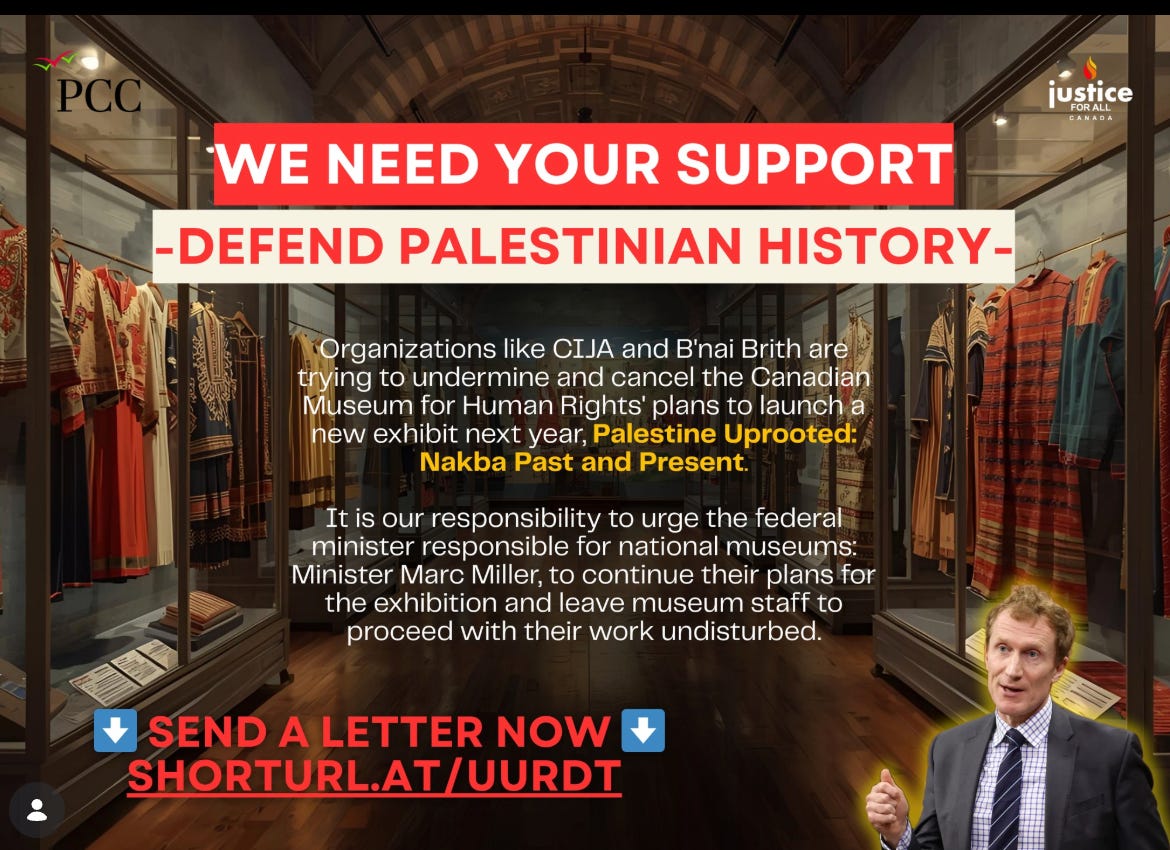
In an open letter published June 3 on her Substack, Nelly Shin — the former Conservative deputy shadow minister for Canadian Heritage — wrote to Mr. Miller about an exhibit his portfolio funds. On June 27, the federally financed Canadian Museum for Human Rights in Winnipeg will open “Palestine Uprooted: Nakba Past and Present,” a permanent display drawing on the testimony of Palestinian Canadians.
She wrote: “As we are already witnessing an antisemitism crisis in Canada, I am asking for the exhibit to undergo due process with appropriate consultation to ensure it will not inadvertently serve to promote antisemitism in an already volatile environment against Canadians of Jewish ancestry.” The exhibit is already a source of concern; the Jewish Federation of Winnipeg and the Centre for Israel and Jewish Affairs have opposed it.
Shin’s letter, copied to the Canadian Security Intelligence Service and the Royal Canadian Mounted Police, treats the museum wall as a security matter, warning that “our country should not be permitted to become a theatre of imported conflicts that stoke intercultural hostilities or projected hate and violence.”
The council’s makeup compounds the impression of confusion. Alongside the appointment of Liberal insider Omar Alghabra was that of Avnish Nanda, an Alberta litigator. Nanda’s signature recent case was a Charter challenge against the University of Alberta over its decision to call police to clear a 2024 protest encampment, arguing the university had violated the protesters’ rights to free expression and peaceful assembly; clients included two Palestinian Canadian students and a professor who is a member of Faculty for Palestine and Independent Jewish Voices.
The pro-Palestine protesters reportedly had four core demands: the disclosure of institutional and financial investments with Israeli institutions; divesting from these investments; defending the right to protest; and declaring and condemning the situation in Gaza as a genocide while calling on the federal government to end military contracts with Israel.
Many security experts would take the other side of Nanda’s argument, pointing to networks outside Canada as potential organizers — and even funders — of such campus protests.
These include organizations that seek not only to fuel social divisions in nations like Canada and the United States through the issue of antisemitism and the cause of Palestine, and now the war waged by Israel and the United States against Iran, but that, it can be reasonably argued, pursue sharper objectives still, as set out in a George Washington University study reported on by The Bureau.
This is the deepest failure of the June 1 speech, not particularly who was named to the council, but the fact that the Prime Minister would not name the forces behind antisemitic extremism.
The Bureau has documented their architecture.
In a federal complaint unsealed last month in New York, a commander of Kata’ib Hizballah — the Iraqi proxy militia of Iran’s Islamic Revolutionary Guard Corps, distinct from but networked with Lebanese Hezbollah — was charged with directing a campaign of nearly 20 attacks on Jewish and Western targets after the February military strikes on Iran. Two of those attacks were on Canadian soil: a shooting at the United States consulate in Toronto and an assault on a Toronto synagogue. The commander financed his operatives the way a cartel moves money, routing payments through exchange houses with a refund if an attack failed, and he tried to hire a man he believed was a Mexican cartel operative to burn synagogues in three American cities. Asked where the conflict was headed, he was direct: “This war will not end. Either they eradicate us or we eradicate them.”
Behind the demonstrations that have unsettled North American campuses sits a different but related machine.
Researchers at George Washington University have traced a network funded through the Shanghai-based tech magnate Neville Roy Singham, whose money has flowed to the pro-Palestinian mobilization that erupted after October 7, 2023, and which intersects with Samidoun, the prisoner-solidarity network banned in Canada and sanctioned by Washington for its ties to the Popular Front for the Liberation of Palestine.
Samidoun’s most prominent figure, the Vancouver lawyer Charlotte Kates, stood at Columbia University in 2024 and declared: “Hamas is not a terrorist organization. Islamic Jihad is not a terrorist organization. The Popular Front for the Liberation of Palestine is not a terrorist organization. Hezbollah is not a terrorist organization.” She called them “resistance fighters” and “heroes.”
That is the concern that looms over Mark Carney’s government — Beijing’s money and Tehran’s proxies converging on a single denial.
Mr. Carney was careful at Holy Blossom to insist that none of his measures would amount to “constraints on legitimate criticism of any government on any subject anywhere,” and to ask Canadians not to “transpose foreign conflicts onto each other.”
It is a strange thing to say in the same month that one’s own government prepares to transpose a foreign conflict onto the wall of a national museum, as Nelly Shin’s open letter implies.
A former member of Parliament, writing to Carney’s own minister and copying the country’s security services, did the naming that Mr. Carney would not.
Countering antisemitism requires “plain old decisive action — prevention, intervention and prosecution — not silence, complicity or deflection.”


"theatre of "imported" conflicts that stoke intercultural hostilities or projected hate and violence."
Best description yet. We have IMPORTED our enemies under the guise of compassion.
Is anyone really surprised by this. Another group of talking heads that do nothing but recommend more talking heads