


KINMEN, Taiwan — On a beach facing Communist China, a small group of Taiwanese Roman Catholics stood near the water, singing a hymn toward the people on the other side.
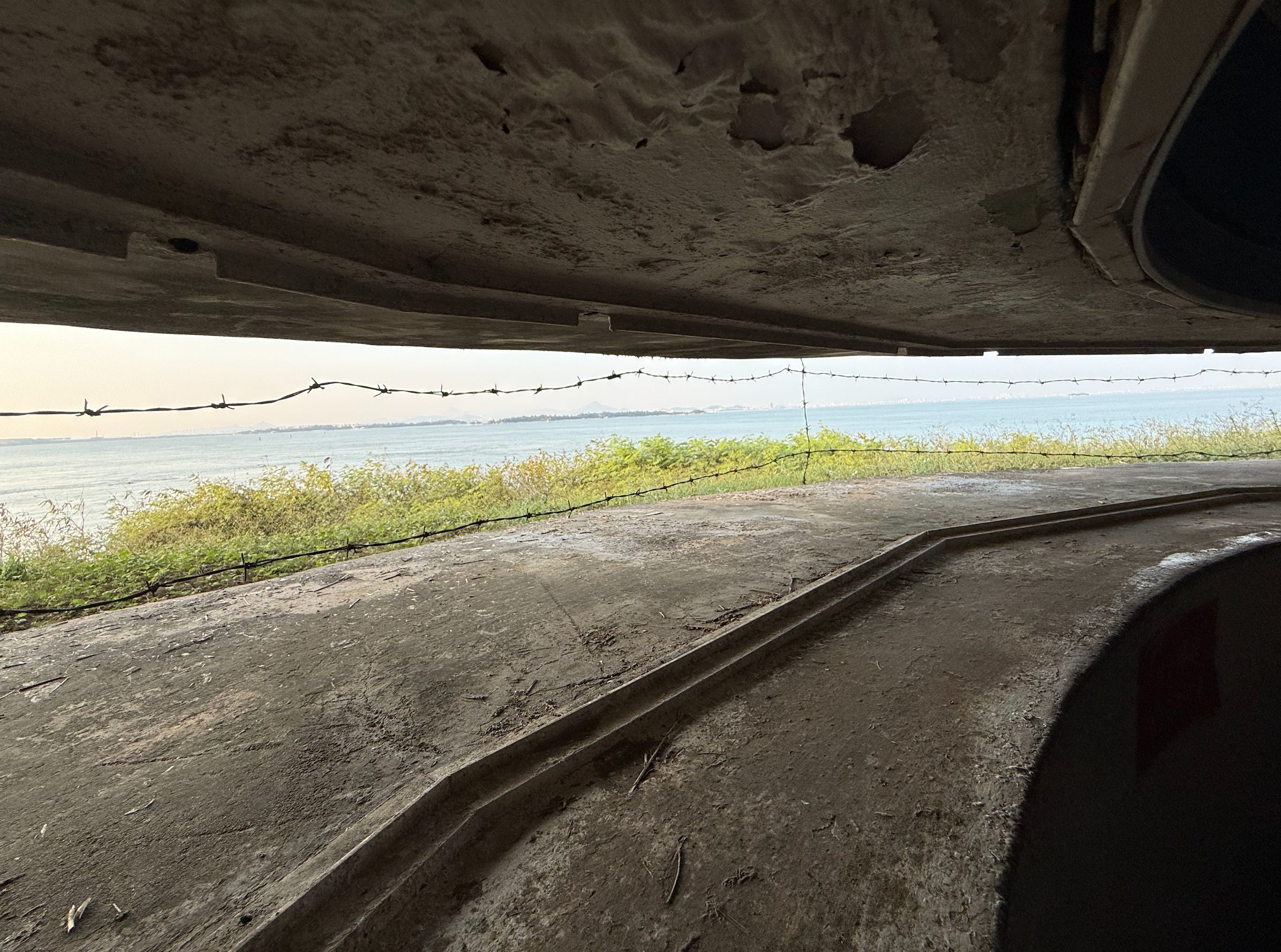
Beyond the placid bay lay Xiamen, its apartment towers and the hills of Fujian province visible through the haze.
My colleague Charles Burton, a former Canadian diplomat and Mandarin-speaking China scholar, walked over to introduce himself. A brief conversation brought some laughter. Then the group headed toward the nearby bunker.
I asked Burton what they had said.
“I said I am Protestant, and they said “Same Jesus.”
Burton told us his work in China had involved quietly distributing Bibles during his years teaching there.
Now he was closer to the mainland than he had been since 2018, when, he says, Chinese Ministry of State Security officers detained and interrogated him in Shanghai. As I reported in The Bureau in November 2025, Burton recounted hours of questioning and a covert flight from China aided by old friends who feared for his safety. He says his interrogators offered him $2 million to put his academic expertise at Beijing’s service rather than criticize it.
“A lot of good memories there,” he said with a smile, as we looked through a bunker window strung with barbed wire at the port metropolis across the water.
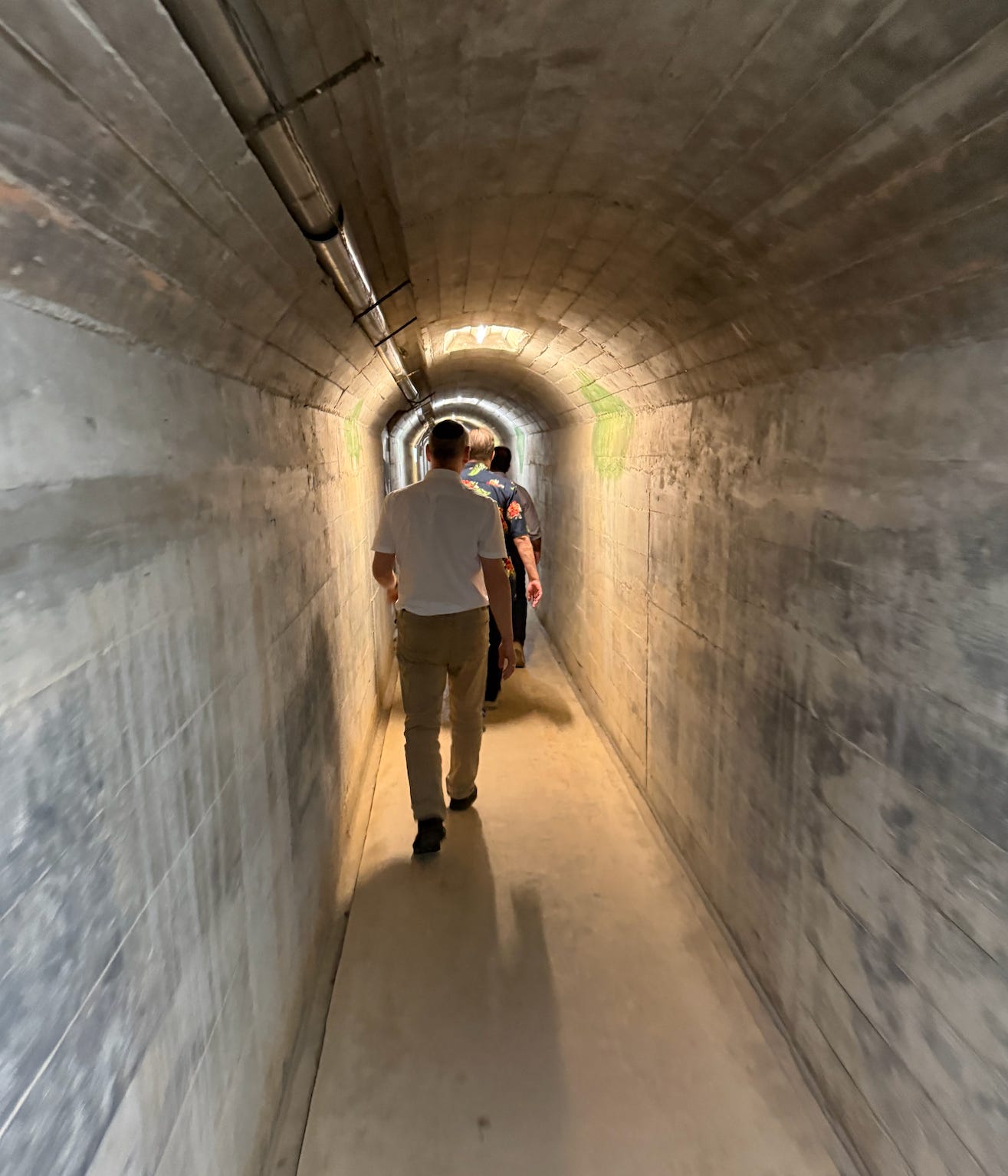
Behind the beach, a tree-lined path led to a concrete passage under the peninsula and into a former psychological warfare broadcasting station.
From powerful loudspeakers facing the mainland, Chiang Kai-shek’s Nationalist government broadcast music, political appeals and women’s voices into Mao Zedong’s China. The Communists in Xiamen answered with martial anthems.
Some of the voices from Kinmen belonged to popular female singers; others to women in military psychological warfare units. Their task was to persuade Communist soldiers and civilians that the Nationalists offered a better life.
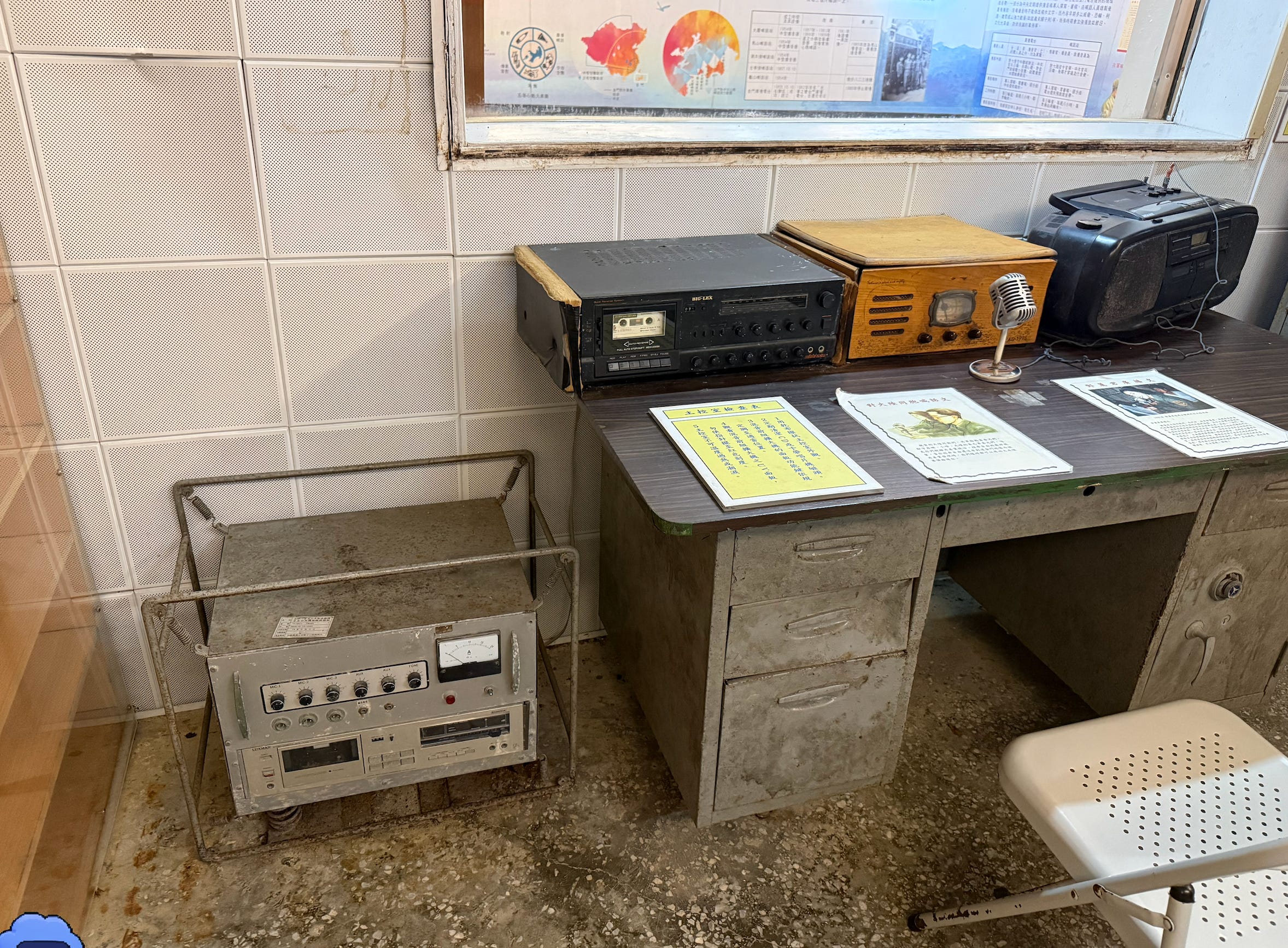
Inside the old broadcasting room, time had stopped somewhere around the invention of the cassette tape.
Heavy metal desks, battered tape machines, wooden radios and a silver microphone sat beneath faded displays. Two cabinets held rows of cassette recordings, many bearing the faces of female Taiwanese performers. One display preserved a 1991 broadcast by Teresa Teng, whose songs were enormously popular in mainland China despite Communist restrictions on her music.
Speaking to her mainland compatriots from the front line, Teng described Taiwan’s freedom and democracy and expressed hope that young people across the strait would have opportunities to develop their talents.
But today, some of the Kinmen inhabitants we spoke with, mostly shopkeepers, described themselves as Chinese, not Taiwanese.
Beijing is offering closer economic integration — and a bridge whose mainland section is already taking shape.
On November 10, Chinese state media reported that the main sea bridge of the Xiamen section of the proposed Xiamen-Kinmen Bridge had been joined, completing its principal structure. The section connects Xiamen Island with Dadeng Island, serving the new Xiang’an International Airport.
The proposed extension from Dadeng to Kinmen remains unbuilt. Taipei has not approved it.
For some residents, a bridge could mean more business, cheaper transportation and easier access to the mainland economy. For others, it could become a permanent instrument of Chinese political pressure, or possibly, a highway for Chinese tanks.
More immediate pressure arrives in the form of coast guard cutters.
Chinese vessels, often operating in formations of four, enter the restricted waters around Kinmen and assert a right to enforce Chinese law. Taiwan’s coast guard challenges them, shadows them and orders them to leave.
Kuan Bi-ling, Taiwan’s Ocean Affairs Council minister, told the cabinet earlier this month that her officers had responded to 39 Chinese coast guard incursions near Kinmen this year, along with 13 near the Dongsha Islands in the South China Sea.
Guermantes Lailari, a retired United States Air Force foreign area officer, argues in his published commentary that Beijing is testing a strategy around Kinmen that could be applied more broadly against Taiwan. He calls it the Kinmen model. Combine economic inducements, assertions of legal authority and maritime pressure, backed by military force, to erode Taiwanese control without provoking a war. Each advance is calculated to appear too small to justify a major confrontation.
Lailari traces the approach to the Taiwan Strait crises of the 1950s. Communist bombardments began in 1954; the Nationalists evacuated the Dachen Islands in 1955. In August 1958, Mao unleashed a massive artillery assault on Kinmen, testing both the Nationalists’ ability to hold the islands and Washington’s willingness to support them.
That September, Beijing declared a 12-nautical-mile territorial sea, asserting a legal claim alongside its military campaign. American warships nevertheless escorted Nationalist supply convoys to within three nautical miles of Kinmen, leaving Taiwanese vessels to complete the passage.
Beijing shifted to alternate-day shelling in October. In Lailari’s interpretation, keeping Kinmen and Matsu in Nationalist hands but under Communist guns served Mao’s political purposes because the islands bound Taiwan to the unresolved civil war and complicated proposals for a permanent separation from the mainland.
The use of military pressure to deliver political messages continued. Chinese forces bombarded Kinmen around President Dwight D. Eisenhower’s visit to Taiwan in 1960. In 1996, Beijing fired missiles near Taiwan’s ports ahead of its first direct presidential election. Lee Teng-hui won with 54 percent of the vote.
Nancy Pelosi’s visit in 2022 brought Chinese military exercises and ballistic missile launches around Taiwan. President Tsai Ing-wen’s meeting with House Speaker Kevin McCarthy in 2023 was followed by the Joint Sword exercises; President Lai Ching-te’s inauguration and National Day address in 2024 brought further drills involving the navy and coast guard.
Another political contest comes on November 28, when Taipei elects its mayor. President Lai’s Democratic Progressive Party candidate, Puma Shen, has gained support among younger voters while campaigning against Chinese influence. He has also become a target of fabricated videos and false claims — bringing the struggle over political persuasion into the election itself.
Disclosure: Journalist Terence Shen organized this trip for Canadian journalists, with businessman Robert Tsao contributing to its costs. Tsao is an outspoken critic of Beijing’s interference in Taiwan. The Bureau retains full editorial independence over its reporting.