New York Spy Trial Exposes Beijing's Blueprint for Embedding Huawei Cloud Linking CCP Police Stations From New York to Toronto to Fujian Secret Police
Deleted files, a Huawei cloud link to China's security apparatus, and a Chinatown hall bearing a Ministry of Public Security banner. The federal trial of Harry Lu commences.
NEW YORK — A six-story glass-clad building in Manhattan’s Chinatown — wedged between a hotel, a spicy Fuzhou noodle shop and a business billed as a high-end private spa — became this week the unlikely center of one of the most revealing federal trials yet of how Beijing’s security apparatus has allegedly embedded itself inside American society.
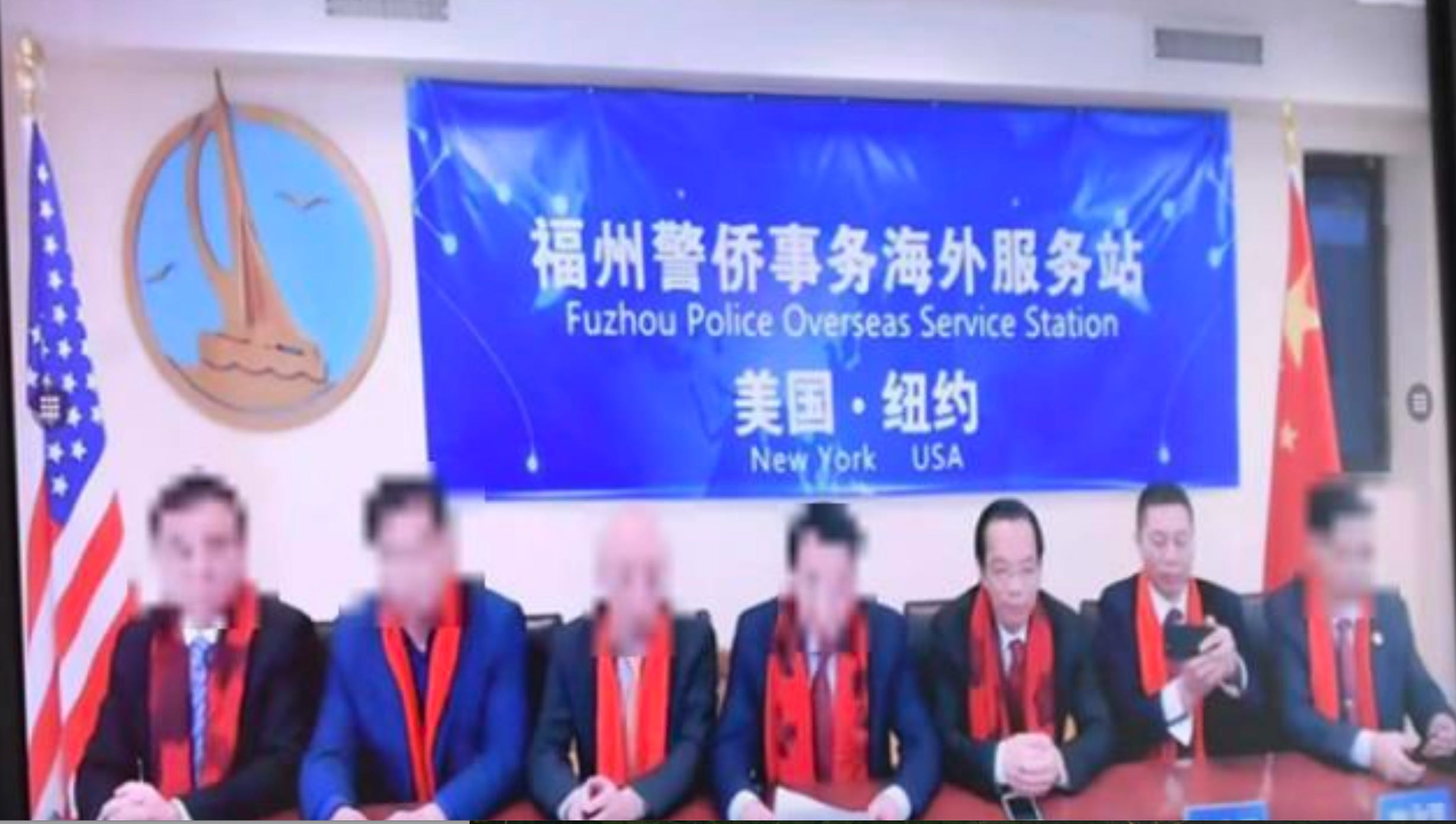
Before an FBI raid shuttered it in October 2022, that narrow glass structure bore a banner on its wall that said everything prosecutors needed: “Fuzhou Police Overseas Service Station, New York USA.”
The defendant, Lu Jianwang, 64, a naturalized American citizen from China’s Fujian province who built a decades-long career in restaurants, real estate and global trade while holding Fujian provincial credentials in a system U.S. filings describe as part of Beijing’s United Front architecture, went on trial Wednesday in Brooklyn federal court charged with operating a covert outpost of the Chinese Ministry of Public Security, acting as an undeclared agent of a foreign government, and obstructing justice by deleting his communications with a Chinese state security handler.
The most alarming evidence to emerge yet came on Day Two, when an FBI computer analyst testified that data retrieved from Lu’s deleted files included WeChat groups drawing members from overseas police-service stations across multiple countries — and plans for Chinese technicians to install a Huawei cloud system connecting the New York operation to the Fuzhou Public Security Bureau, within an overseas police-station architecture that also included Toronto, Spain, France and the Netherlands.
The trial, expected to run two weeks in the same New York court that produced last year’s mistrial of former New York State official Linda Sun on parallel Chinese influence charges, is drawing scrutiny far beyond the U.S. charges — pointing to sprawling Fujian-based chamber of commerce networks with alleged connections to Chinese secret police infrastructure across the northern border into Toronto, and over the Atlantic to France and Spain.
The Bureau’s open-source research into the Fujian community association records linking the Sun and Lu cases also connects Lu to John Chan — a Brooklyn restaurateur, former human trafficker, heroin dealer and underground casino operator, whose community events have intersected with an individual identified in the Sun trial as an alleged Chinese secret police operative.
The evidence emerging in Brooklyn is building the most granular courtroom picture yet of a specific architecture — one in which United Front-linked diaspora associations, consular officers, and hometown community organizations functioned as interlocking layers of a covert infrastructure, reaching from Fuzhou’s municipal public security bureau to the living rooms and community halls of Chinese America.
The government’s first witness was Julian Ku, Professor of Constitutional Law at Hofstra University and a recognized expert on the Chinese Communist Party’s global tactics. Ku testified about the scale of the Ministry of Public Security — which he described as “gigantic,” estimating roughly two million personnel — and explained to jurors a structural feature central to the prosecution’s case.
Ministry officers are prohibited from traveling internationally in their official capacity. As a result, Ku testified, they rely on overseas “friends and allies” of the Chinese Communist Party to communicate with them and investigate on their behalf. Ku testified in the same courthouse last year, laying similar evidentiary groundwork for the Linda Sun prosecution before that jury deadlocked.
Prosecutor Lindsey Oken framed the case plainly in her opening: “In 2022, the defendant Lu Jianwang was living in New York City, but he was working for the Chinese government.” What the station provided openly — help for Chinese nationals renewing driver’s licenses during pandemic travel restrictions — was itself a violation of American law, she told jurors, because it was conducted without notifying United States authorities. But the public services, she said, were cover. “The darker parts operated in secret.”
Outside the courtroom were familiar signs of the same Fujian community mobilization that leaders like Harry Lu and John Chan — and their counterparts in Toronto — have long been celebrated for in fawning Chinese-language reports showing them mingling with consular figures and local elected officials from Ontario to New York.
Dozens of supporters, many from Lu’s hometown of Changle in Fujian province, gathered at a park across from the federal courthouse in Brooklyn before proceedings began, carrying American flags and signs reading “We Love America,” “No Bias, No Profiling,” and “Chinese Americans Are Americans.” Prosecutors raised the demonstration with the presiding judge before the first witness was called, characterizing it as a coordinated effort and “an attempt to send a message to the jury.”
Lu, also known as Harry Lu, is accused of establishing and running the Manhattan outpost in coordination with a co-defendant, Chen Jinping, who pleaded guilty in December 2024 to acting as an unauthorized foreign agent and awaits sentencing.
Prosecutors say Lu admitted to FBI agents in October and December 2022 interviews that he had opened the station and maintained a handler inside the Ministry of Public Security, communicating through WeChat messages he later deleted — the deletion forming the obstruction charge.
But long before Harry Lu and his counterparts in Toronto, Spain and France allegedly set up brick-and-mortar Chinese secret police offices, Lu was already working with the Overseas Chinese Affairs Office, United Front officials, and the Ministry of Public Security to coerce Chinese dissidents to return to China, the United States government alleges.
According to the amended complaint, FBI agents interviewed one target of the operation — identified only as Victim-1 — who confirmed repeated harassment by members of the America ChangLe Association beginning in 2018, the same year prosecutors say Lu received his initial tasking.
The harassment included unsolicited telephone calls and explicit threats of violence against Victim-1’s family members living in the United States if Victim-1 refused to repatriate. Members of Victim-1’s family remaining in China, the complaint states, have been separately harassed by Ministry of Public Security officials since Victim-1’s arrival on American soil.
Around 2020, a co-conspirator sent Lu electronic communications asking him to help locate a Chinese national — identified as Victim-2 — who had previously lived in Manhattan. The co-conspirator provided Victim-2’s name, a last-known address from 2016, and birthdate, then instructed Lu to identify anyone in Victim-2’s close social circle. The correspondence included what appears to be a photograph of Victim-2 surreptitiously taken while sitting in a public park.
According to the amended complaint, a Ministry of Public Security official asked Lu to help locate Victim-3 — identified in the filing as a Chinese pro-democracy advocate living in California who had served as an advisor to a 2022 New York congressional candidate.
That candidate, identified as Yan Xiong, was himself a student leader of the 1989 Tiananmen Square protests who later served in the United States Army before running for Congress in Brooklyn. Victim-3 told the FBI they had been harassed on multiple occasions by individuals they believed to be proxies for the Chinese government — including having their vehicle broken into immediately after delivering a pro-democracy speech, and receiving threatening telephone calls and electronic messages from social media accounts they assessed to be associated with Beijing.
The Lu complaint cross-references United States v. Qiming Lin — in which a Ministry of State Security officer was charged with hiring a private investigator to surveil, smear, and physically harm Yan Xiong to prevent him from winning his seat.
“Beat him, beat him until he cannot run for election,” Lin was captured saying in a voicemail. “You think about it. Car accident, [he] will be completely wrecked, right?”
The Day Two testimony, reported by the Epoch Times from inside the courtroom, sharpened the prosecution’s case against Harry Lu.
FBI computer analyst Jessica Volchko testified that data deleted from Lu’s phone and technically recovered showed his contacts included three WeChat groups created by Liu Rongyan of the Fuzhou Public Security Bureau, totaling 2,619 chat records. One group comprised 65 members drawn from “Police-Overseas Chinese Service Stations” around the world; the other two groups held 39 and 81 members respectively.
The recovered messages revealed requests from Fuzhou for New York to submit event schedules, review of press releases drafted by the station, and arrangements for Chinese technicians to install a Huawei cloud system connected to the Fuzhou Public Security Bureau enabling what was described internally as “backend police-overseas residents access permissions.”
FBI agent Devin Perry, who conducted Lu’s first post-raid interview, testified that Lu told him he had been introduced to the “Overseas 110” concept in early 2022 by Lin Yuping, director of the Fuzhou Overseas Chinese Federation, who described the plan as a pandemic-era service measure and then introduced Lu to Officer Liu Rongyan. Perry testified that Lu attended the official January 10, 2022 launch ceremony at Wuyi Square in Fuzhou, where Liu was described to those assembled as a “hero of the establishment of the Global Overseas Police-Citizens Platform,” and that the New York station opened at the America ChangLe Association two days after Lu returned through John F. Kennedy International Airport on February 13.
Among the evidence agents put to Lu during his October 2022 FBI interview was a series of photographs recovered from his device.
According to the DOJ’s amended complaint, the photographs included an image from the opening ceremony of the “Overseas 110” program documenting the five countries selected to first establish overseas police service station locations. Agents asked Lu to identify the individuals depicted. He did so, naming association presidents from Spain, France, Canada, and the Netherlands, as well as the “Deputy Chairperson” of the Fuzhou All China Federation of Returned Overseas Chinese — a body that United States government reporting has identified as a known United Front Work Department organization.
The Canadian association president’s presence at the founding ceremony places Canada squarely within the original five-nation architecture of the overseas police station program from its January 2022 inception.
The prosecution also introduced photographs from a public April 2022 press conference held by the ChangLe Association to announce the “Overseas 110” launch. The images show Wu Xiaoming, Deputy Consul General of the People’s Republic of China Consulate General in New York, in attendance. A banner at the event reads “Overseas Service Station for Police and Overseas Chinese Affairs.” A wall sign reads “Deputy Consul General Wu Xiaoming visited and provided guidance.”
The prosecution’s introduction of the consular presence echoes a central element of the Linda Sun prosecution, in which an FBI agent testified that he had warned Sun that a consular official she frequently met with at Chinese community events was operating as a covert Ministry of State Security officer concealed behind the title of Overseas Chinese Affairs Officer.
That same office — along with the Ministry of Public Security — sits at the center of the United States government’s allegations that Lu established a secret Chinese police station under the direction of those two Chinese state organs, with the New York consulate serving as the visible civilian face.
Prosecutors also gave notice during a recess that they intend to introduce evidence that during Chinese President Xi Jinping’s visit to the United States in 2015, Lu organized participation in counter-demonstrations against Falun Gong practitioners in Washington.
The defense’s counter-argument has been consistent. Attorney John Carman told jurors in his opening that his client “was asked, not tasked” — a distinction to sever Lu from formal command structures — and that the case amounts to a failure to file a Foreign Agents Registration Act form. Carman has also noted that neither of Lu’s two-hour FBI interviews were recorded.
The connections between the Lu network and the broader Fujian influence architecture documented in The Bureau’s prior reporting extend beyond the courtroom.
Chinese-language reporting from ChinaQW — China’s official overseas Chinese news outlet — documents two direct co-appearances between Lu and John Chan, the Brooklyn restaurateur, convicted snakehead, and prominent Fujian community leader whose network The Bureau has previously investigated. A 2015 ChinaQW report on a New York event commemorating the 70th anniversary of the end of the war against Japan records that American ChangLe Association chairman Lu Jianwang and Brooklyn Asian association chairman Chen Shanzhuang — John Chan’s Chinese name — both spoke and stated they would mobilize their respective association members to attend.
A second ChinaQW report documents that the 2015 “Impression Fuzhou” youth arts and writing contest launch in Manhattan Chinatown was attended by a New York consulate official, Chan, and Lu.
The Bureau’s investigation into Chan documented that a man identified in the Linda Sun trial as a Ministry of State Security officer operating under an Overseas Chinese Affairs Office cover in the New York consulate — Li Qing — was photographed at a March 2019 banquet at Chan’s Brooklyn restaurant standing alongside Chan and the president of the Fuzhou Langqi Friendship Association. That event took place three years before “Overseas 110” was formally launched.
The Canadian dimension of alleged Chinese Communist Party police station leadership embedded in Toronto’s Fujian diaspora — documented briefly in the FBI’s case filings against Lu and echoed in Chinese government photographic records showing Lu meeting with several Toronto Fujian community leaders and Chinese officials in 2022 — has not resulted in prosecutions in Canada, although the RCMP announced investigations into a Fujian chamber of commerce network that year.
No charges have been laid in Canada.


Seems like an open and shut case until you realize where the case is being adjudicated
because the jury is most likely commie libtards who will either set this guy free or not be able to come to a decision just like the Sun case. When a Marxist gets elected to run NYC you also get justice according the same people who elected him to be their leader. Fingers crossed this jury was chosen wisely and we can dent this one outpost for the Chinese secret police. I have to imagine they have another already up and running but this at least sends a message.
What has been widely reported is that Chinese criminals with thick pockets of stolen money (fraud) have fled China…. and China wants them to face Justice…..and obviously have the $millions returned to China. In that respect who can blame the Chinese Communist Party.
Canada has signed some kind of an ultra secret deal with China…. that…. . I guess…. is none of our business …..and Cornhole Conflicted Carnage Liberals have no intention of letting the public know. what the deal includes. The deal is the coordinating of information “between” the RCMP and…the Chinese Police Stations in Canada…..for god sake? ? ?
Question…..is the purpose of the secret deal to chase down these thieves that have fled China OR to help other Chinese embedded hit men hunt down and murder those that speak bad of China?
There is a hell of a lot of stuff going on here Sam….HOWEVER we know from your excellent reporting those that support you financially will eventually know.. We sure as hell won’t be reading what you have reported here in Canada. …from the bought and paid for rotten and compromised Canadian mainstream media. Yyaaahh that only recently ……that hav received billions more of “hush” money disguised as “Media bailout packages”money media bail out package.