NDP's Jenny Kwan Demands Ottawa Release Secret Police Deal With Beijing, Calling Continued Secrecy a Threat to Diaspora Safety
OTTAWA — A senior New Democratic Party parliamentarian has formally demanded that the Carney government release the full text of its secret law enforcement agreement with China’s Ministry of Public Security, echoing a set of facts The Bureau has been reporting for months, while warning that Ottawa’s continued refusal to disclose the deal is fueling legitimate fear among diaspora communities who have experienced or fear transnational repression by the Chinese state.
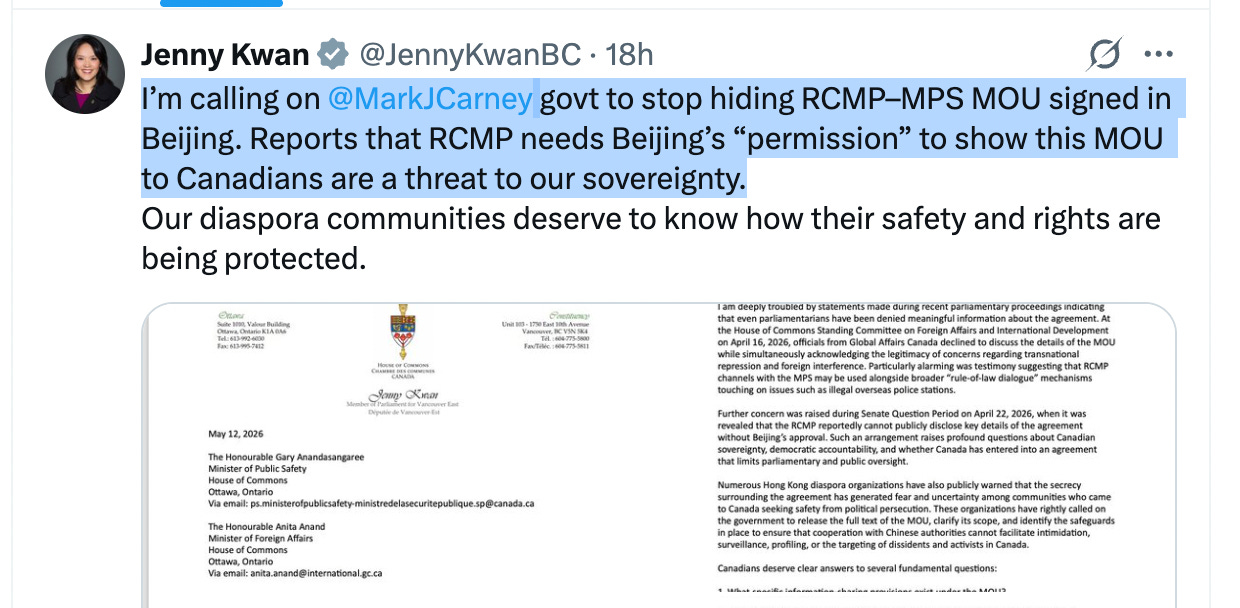
Jenny Kwan, MP for Vancouver East and one of Parliament’s most prominent voices on Hong Kong and Chinese diaspora issues, wrote to Minister of Public Safety Gary Anandasangaree and Minister of Foreign Affairs Anita Anand on May 12, calling the government’s silence on the agreement “particularly troubling” given what she described as the “problematic history of China’s foreign interference in Canada.”
“I’m calling on Mark Carney govt to stop hiding RCMP–MPS MOU signed in Beijing,” Kwan posted to X. “Reports that RCMP needs Beijing’s “permission” to show this MOU to Canadians are a threat to our sovereignty.”
The letter, addressed to both ministers, focuses on the memorandum of understanding on cooperation in combating crimes signed between the Royal Canadian Mounted Police and the Ministry of Public Security during Prime Minister Mark Carney’s January 2026 visit to Beijing.
Kwan noted a troubling asymmetry.
The government has publicly released other agreements signed during the Beijing visit — including the Canada-China Economic and Trade Cooperation Roadmap and a memorandum of understanding on culture — but has declined to proactively disclose the police cooperation agreement, despite what she called its “significant implications for public safety, civil liberties, diaspora communities, and national sovereignty.”
“Without seeing the formal written arrangement,” Kwan wrote, “widespread uncertainty and legitimate concern” has been created among Canadians, “particularly within Hong Kong, Uyghur, Tibetan, and broader Chinese diaspora communities who have experienced or fear transnational repression by the Chinese state.”
Kwan’s letter is the latest in a widening chorus of alarm that now spans diaspora organizations, independent researchers, American national security officials, and Parliament itself — and it lands directly on ground The Bureau has been reporting for months.
The Bureau was first to report the national security implications of the memorandum of understanding, drawing on classified documents and expert analysis to establish that the Ministry of Public Security is not a neutral law enforcement counterpart. It is the same apparatus that Canada’s own National Security and Intelligence Committee of Parliamentarians documented running covert operations on Canadian soil — including unauthorized trips to Canada, payments to Chinese-language journalists to locate and track dissidents, and the arrest of relatives in China to coerce compliance from targets on Canadian soil.
The Bureau reported in February on an extraordinary open letter from ten Hong Kong diaspora organizations spanning four countries, expressing “deep fear and anxiety” over the agreement and warning that even the perception of closer engagement between Canadian agencies and Chinese security authorities chills free expression, civic participation, and journalism among vulnerable communities. That letter, like Kwan’s, went unanswered in any substantive public way by the Carney government.
Former senior RCMP officer Garry Clement, writing in these pages, warned that cooperation with the Ministry of Public Security “is never just technical, never apolitical, and never insulated from the priorities of the Chinese Communist Party” — and described in operational detail how liaison relationships erode caution over time, how criminal labels are applied to political targets, and how information shared in good faith migrates to coercive ends.
Those warnings have now been echoed at the highest levels of American national security. At the Canada Strong and Free conference in Ottawa last week, former CIA Director and Secretary of State Mike Pompeo described the Chinese Communist Party’s inside-the-gates operations in Canada and the United States as the primary threat facing Western democracies — more immediate, he argued, than the prospect of a military invasion of Taiwan. Another American expert, Michael Lucci of State Armor, at the same conference, specifically cited the Ministry of Public Security’s role in running covert repatriation and repression networks, the same apparatus Carney’s government has now formalized a cooperation agreement with.
The Bureau has documented transnational repression operations on Canadian soil in granular detail — the coordinated campaign against pro-democracy candidate Joe Tay, including a Hong Kong police bounty, mock wanted posters, and a Security and Intelligence Threats to Elections Task Force warning issued one week before the federal election.
Kwan’s letter does not mince its assessment of where responsibility lies. The government has chosen transparency on trade and culture agreements signed in the same Beijing visit while withholding the one agreement that carries the gravest implications for the safety of Canadian citizens, she argues.


Wow I never thought I could be impressed with Jenny Kwan. I’ve disagreed with her on many issues but this one I fully support!
Oppression of the Chinese diaspora in Canada by the ccp is awful, illegal and Incompatible to our western values however our cdn gvt under the current liberal stranglehold of power is just as bad, frightening and undemocratic Not the country I grew up in or the one my grandparents help build.