

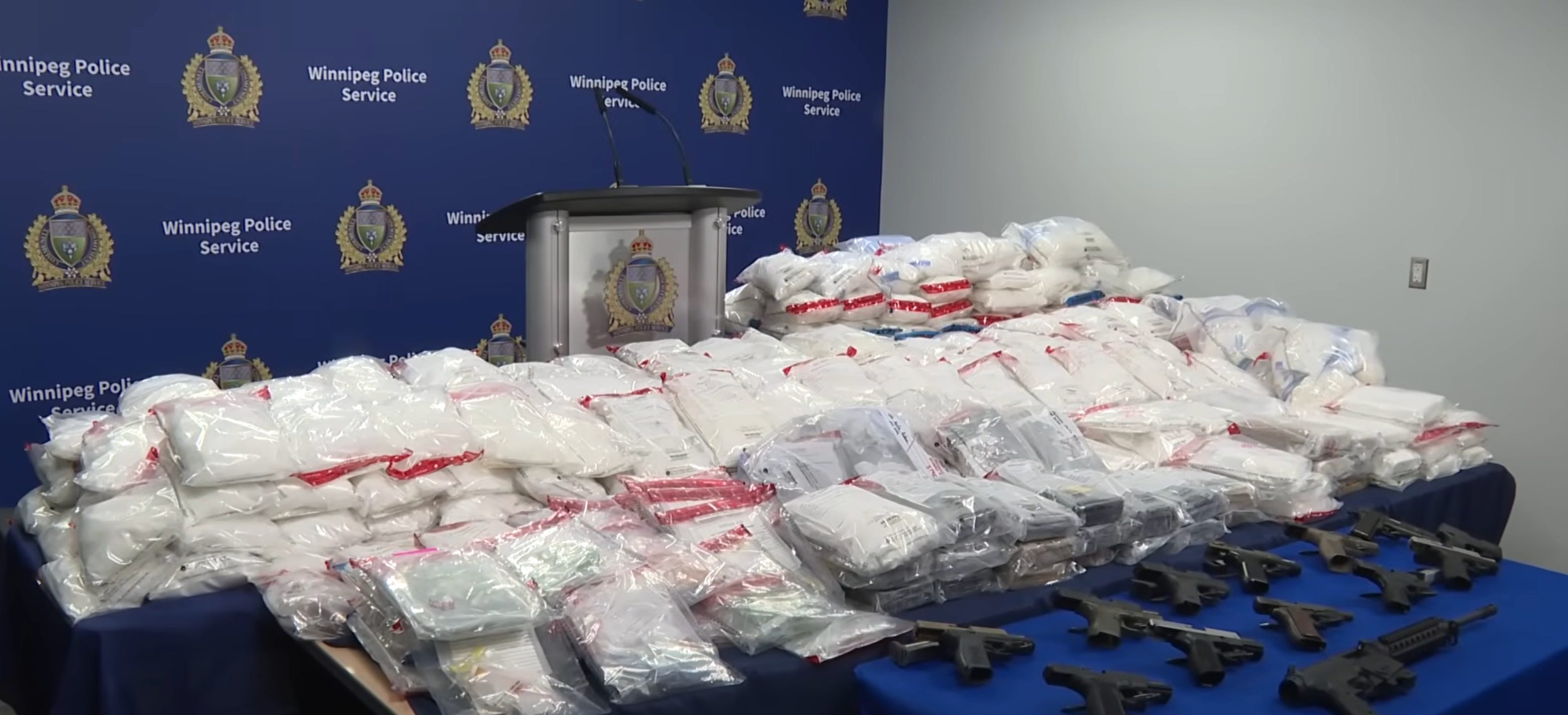
OTTAWA — Winnipeg police announced Wednesday what they called the largest drug bust in Manitoba history: 33 people arrested, 174 criminal charges, more than 525 kilograms of cocaine, methamphetamine, and fentanyl seized, $825,000 in cash recovered, and a two-year investigation — Project Puma — that required 14 partner agencies spanning four provinces. The numbers are staggering. They are also, by the assessment of the lead investigator himself, incomplete.
“It’s a lot more than what you see here,” WPS Inspector Joshua Ewatski told reporters Wednesday — speaking from a podium behind a table buried under hundreds of kilograms of bagged white powder and cocaine bricks, with a row of seized handguns and long guns laid out along the front edge.
That single sentence is the most important thing said at Wednesday’s press conference, and it confirms what The Bureau has been documenting in exclusive reporting throughout 2025. The record seizure, however genuinely significant, demonstrates that the network is far larger and far more deeply embedded than its most recent bust suggests. It is the same network that continued to flood narcotics into Canada aboard long-haul trucks working for Ryan Wedding and Andrew Clark the day after Toronto Police announced their own “largest ever” bust, Project Brisa, in 2023 — a case in which officers posed beside the long-haul trailer seized from Indo-Canadian truckers working for Mexican cartel networks, before the charges, the cash, and the infrastructure seizures evaporated in Canadian courts.
It is the same network — Mexican cartel, Wolfpack Alliance, Hells Angels — implicated in the fentanyl seizures across Canada surveyed at the federal fentanyl czar Kevin Brosseau’s late-2025 Sprint 2.0 conference, including a corridor running through a Mohawk reserve outside Hamilton, Ontario, and near the Buffalo border. As The Bureau reported at the time, the data compiled under Brosseau’s National Fentanyl Sprint 2.0 showed Ontario alone accounting for 263 kilograms of fentanyl seizures, 68 percent of the national total, while British Columbia logged 88 kilograms, or 23 percent. The national figures, however, understated British Columbia’s role as the principal entry point for fentanyl precursors.
Between May 13 and May 15, 2025 — just days before the Sprint 2.0 reporting period began — Canada Border Services Agency officers at the Tsawwassen container examination facility in Delta, British Columbia, inspected marine containers that had arrived from China and were destined for Calgary, Alberta. They discovered more than 4,300 liters of precursor and related chemicals: 500 liters of propionyl chloride, a direct precursor for fentanyl synthesis; 3,600 liters of a precursor for gamma-hydroxybutyric acid, commonly known as the date-rape drug; and 200 liters of gamma-butyrolactone, a controlled substance that converts to gamma-hydroxybutyric acid in the body. Publicly disclosed in late October 2025, the seizure ranks among the largest Chinese-sourced precursor-chemical intercepts in British Columbia in the past decade. Had the chemicals reached clandestine laboratories, by official estimate they could have produced enough product for billions of lethal doses.
The Bureau‘s identification of the Port of Vancouver as the principal precursor entry point, and of finished fentanyl crossing into the United States after Canadian-soil manufacture, predated the corresponding congressional testimony in recent days of the United States government’s senior law-enforcement leadership by months. The Bureau‘s reporting was prescient, and now confirmed.
The network hit in Project Puma is the enduring network exposed in Alberta’s Project Cobra, in Project Pelican out of Peel Regional Police headquarters in Mississauga, and in other recent Canadian probes The Bureau has identified as part of a recurring prosecution-failure pattern across major organized-crime files. And it is the same network whose corruption was named in recent Southern District of New York indictments charging senior Mexican lawmakers and Sinaloa police officials, alleging the systematic capture of state-level institutions in service of cartel supply.
Ryan Wedding has become the public face of that architecture. The architecture is much larger than him. And it is larger than Canada’s justice system has so far shown any capacity to confront — a pattern that extends, as this story will detail, to at least one of the accused now facing charges in Project Puma itself.
Police allege the network imported drugs from the United States inside commercial transport vehicles, warehoused product in Alberta and Ontario, and distributed it into Manitoba and northwestern Ontario through couriers, mail, commercial transport, and private vehicles fitted with hidden compartments. This is precisely the Mexican cartel and “Snow Cartel” proxy method exposed in Toronto’s Project Brisa and Alberta’s Cobra.
Multiple trafficking cells in Winnipeg operated under a single umbrella organization believed to be sourcing from a national-level supplier whose name police would not provide. WPS Inspector Key described an organization that “exerted significant influence over the distribution of illicit drugs across Manitoba and other provinces,” with “international connections to the upper echelons of organized crime groups in Canada” — including, police allege, the Hells Angels, the Wolfpack Alliance, and a Mexican cartel.
All consistent with prior cases attributed to Ryan Wedding’s networks by senior United States enforcement sources.