


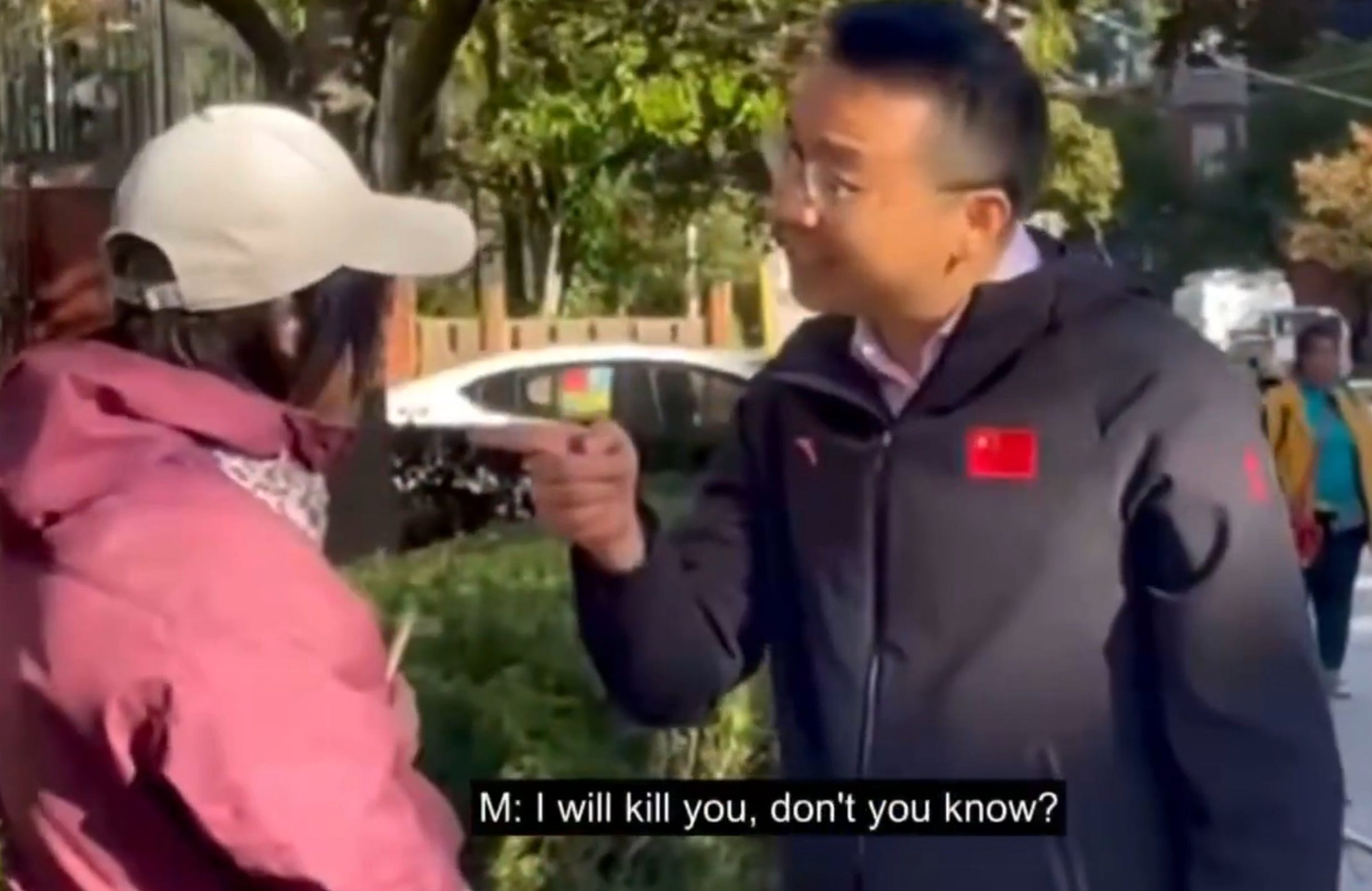
OTTAWA — Toronto police are investigating a September 22 confrontation outside China’s Toronto consulate in which a man wearing a black jacket with a red People’s Republic of China insignia damaged Falun Gong protest displays and threatened a female practitioner with lethal violence, invoking Chinese law, accusing protesters of making trouble and threatening to have her shot.
The incident appears consistent with a broader pattern of intimidation described in a recent submission by University of Toronto Citizen Lab researchers to Canada’s Immigration and Refugee Board. That assessment identifies Falun Gong practitioners among the communities targeted by Chinese authorities and their proxies abroad, and describes efforts to extend Beijing’s control over political expression onto Canadian soil.
Whether the man has an official connection to the consulate remains unconfirmed. His assertion of Chinese authority during the confrontation should make that affiliation a central question for Canadian investigators.
NTD, a news outlet that published an account of the confrontation drawing on video, witness accounts and a Toronto Police response, identified the practitioner as Lina Li. It reported that she suffered a bleeding chin while defending banners calling for an end to the Chinese regime’s persecution of Falun Gong.
The Bureau‘s review of the audio broadly accords with NTD’s account. “This is Chinese territory, you know?” the man says. He also appears to name a Chinese statute, the “Anti-Secession… Law,” before adding, “I’ll have you shot.”
The threats of violence are repeated as the man and woman struggle over the protest banners, with bystanders filming the conflict.
“Get away. I’ll slam you to death, believe it or not? I’ll have you shot, believe it or not?” the man says.
The recording also captures his accusation: “It’s you people making trouble here.”
Video shows the man dragging away a banner, pushing Li as she attempted to retrieve it and kicking at a person filming. A witness interviewed by the Chinese-language Epoch Times described another man filming the confrontation and said the alleged aggressor subsequently left in a vehicle that picked him up.
The footage has circulated widely on social media. Former Toronto independent member of Parliament Kevin Vuong, who has separately alleged that Chinese interference targeted his 2021 election campaign as a Liberal candidate, called for the man’s expulsion if he holds diplomatic status.
“If not, that sounds like a death threat to me,” Vuong wrote on X, citing the Criminal Code provision on uttering threats.
The case appears to illuminate concerns already confronting Mark Carney’s government.
The 33-page Citizen Lab submission, dated September 11 and prepared for the Immigration and Refugee Board’s Research Directorate, describes a system in which Chinese authorities monitor political activity in Canada, pressure critics through relatives in China and collect information that can later be used against people who return. The researchers identify China’s Ministry of Public Security and Ministry of State Security, along with their local and provincial offices, as leading agencies involved in overseas surveillance and transnational repression.
The people targeted in Canada, the authors write, “tend to resemble the groups Chinese authorities monitor inside China.” They include pro-democracy campaigners and dissidents; students, scholars, journalists and social media figures critical of the Party; Tibetans, Uyghurs, Mongolians and Falun Gong practitioners; supporters of Hong Kong’s protest movement; Party members and officials accused of corruption; and the relatives of all of them.
The refugee board’s Research Directorate compiles country evidence used by decision-makers assessing protection claims. The authors say the monitoring dates to the aftermath of the 1989 Tiananmen Square massacre, when officials tied to Chinese diplomatic offices watched Chinese students in North America. It widened under Jiang Zemin and Hu Jintao and has grown “in scope and intensity” under Xi Jinping. They cite Freedom House’s finding that China is currently “the most prolific perpetrator of transnational repression.”
They also point to Chinese laws that claim reach beyond the country’s borders. Hong Kong’s National Security Law and its Article 23 legislation have been used to charge exiles, including people in Canada. Last June, Beijing asserted a right to pursue people abroad under its new Ethnic Unity Law.
The report sets out four online methods, including social-media monitoring and the takeover of private chat groups. According to the lab’s earlier research, WeChat surveillance reaches accounts registered to users in Canada. In 2024, leaked files from the Shanghai contractor I-Soon showed a Ministry of Public Security tool built to monitor accounts on X, phish them, and post from them once they were captured.
Offline, the submission describes people linked to Chinese diplomatic offices reportedly photographing protesters, which could be relevant to the confrontation in front of the Toronto consulate this week, where, according to the Epoch Times witness, a second man filmed the encounter and a vehicle later picked up the alleged aggressor.
The submission says that Hong Kong activists photographed at rallies in Canada later had their “photographs, names, email addresses, and phone numbers” posted “widely in WeChat groups alongside inciting messages.” After that, strangers began “approaching targets in the streets, photographing them, or tailing them in the streets.” The home addresses of Uyghur and Chinese activists in Canada were published online.
The report describes a large security apparatus extending beyond police agencies. Operation Fox Hunt and Operation Sky Net, the overseas arms of Xi’s purported anti-corruption campaign, draw in the Ministry of Public Security, the Supreme People’s Court, the Supreme People’s Procuratorate, the People’s Bank of China and the Party’s Organization Department.
Chinese security services have recruited informants inside dissident groups, the submission adds, saying “police in Xinjiang have offered to provide Uyghurs with passports in exchange for promises that they would act as spies in Canada.”
The Bureau has also reported on concerns that Mark Carney’s government is extending cooperation agreements between the Royal Canadian Mounted Police and the Ministry of Public Security.
The federal government says the agreement is meant to “enhance cooperation on corruption and transnational crimes, including cyber and telecommunications fraud, synthetic drugs, narcotics trafficking, and money laundering.”
Hong Kong diaspora groups countered that “Hong Kongers living overseas have faced surveillance, harassment, intimidation, and pressure directed at themselves and their families by Chinese authorities.” They said Ottawa had “not publicly released the full text of the MoU, nor explained what safeguards, limitations, or oversight mechanisms are in place.”
In 2023, The Bureau reported that a classified June 2019 report by the National Security and Intelligence Committee of Parliamentarians had documented the Ministry of Public Security’s Fox Hunt operations on Canadian soil. “PRC officials have used covert and unauthorized tactics,” the committee wrote, “including unauthorized trips to Canada, threats, intimidation, harassment, arresting relatives in China as a form of leverage, paying Chinese-language journalists to locate and track individuals, and discouraging people from reporting their covert activities to Canadian police.”
Citing the Canadian Security Intelligence Service, the committee warned that “PRC threat actors are covertly and knowingly circumventing Canada’s law enforcement, immigration and judicial authorities.”
Ottawa’s efforts to intervene “waned” after then-prime minister Justin Trudeau was briefed, the report found. Meanwhile, it said, “Chinese Fox Hunt activities have increased in intensity.”
Apparently China can do whatever it wishes, when they have Carney in their pocket
Carney will say Chinese values ae Canadian values.