IRGC Proxy Commander Directed Attack on United States Consulate in Toronto, Plotted to Bomb New York Synagogue, and Paid for Terrorist Strikes Across Europe Through Mafias
Iran Currency Exchanges Key to Cartel-Style Terror Payments, FBI Wiretaps Confirm
WASHINGTON — A senior commander for Kata’ib Hizballah — the Iraqi proxy militia of Iran’s Islamic Revolutionary Guard Corps — directed a sprawling international terrorist campaign that included an attack on the United States consulate in Toronto, paid operatives across Europe and Canada to carry out bombings and arsons against Jewish and American targets, and attempted to hire what he believed was a Mexican cartel operative to set fire to synagogues in New York, Los Angeles, and Arizona, according to a federal criminal complaint unsealed Friday in the Southern District of New York.
Among the attacks the commander directed was the April 29 stabbing of two Jewish men in the Golders Green neighborhood of London — including a dual United States-British citizen — an assault that sent shockwaves through the United Kingdom and, federal prosecutors now allege, was one link in a chain of nearly twenty terrorist strikes orchestrated from abroad in retaliation for the American-Israeli military campaign against Iran.
Mohammad Baqer Saad Dawood Al-Saadi, a 32-year-old Iraqi citizen described by the Federal Bureau of Investigation as a high-level member of Kata’ib Hizballah with direct personal ties to the late Islamic Revolutionary Guard Corps Quds Force commander Qassem Soleimani, faces six federal counts including conspiracy to provide material support to designated foreign terrorist organizations and conspiracy to bomb places of public use.
Al-Saadi was arrested in Turkey, transferred to United States custody, and transported to New York, where he appeared Friday before Magistrate Judge Sarah Netburn in Manhattan federal court and was ordered detained pending trial. FBI Director Kash Patel described Al-Saadi as a “high-value target responsible for mass global terrorism.”
The indictment provides the most detailed public accounting to date of how the Islamic Revolutionary Guard Corps and its proxy networks activated dormant terrorist cells across the Western world following the February 28, 2026 joint American-Israeli military campaign against Iran — a campaign that, according to the complaint, killed Iran’s Supreme Leader Ayatollah Ali Khamenei in its opening strikes.
The complaint alleges that since February 28, Al-Saadi directed and promoted at least 18 terrorist attacks across Europe and two attacks in Canada under the banner of a previously unknown group called Harakat Ashab al-Yamin al-Islamiya — which the FBI identifies as a front organization for Kata’ib Hizballah, designed to provide the Iran-backed network with operational cover by appearing unaffiliated with any designated foreign terrorist organization. The group emerged essentially overnight, activating cells across multiple countries and producing polished propaganda videos of each attack within hours.
Canada at the Center
The most significant disclosure in the complaint for Canadians is Al-Saadi’s recorded admission — captured on a wiretapped call on March 20, 2026, by a FBI source — that his network was directly responsible for two attacks on Canadian soil: a shooting at the United States consulate in Toronto on March 10, 2026, and a separate attack on a Toronto synagogue that Al-Saadi referred to obliquely as hitting “the Knesset.”
Before dawn on March 10, two men emerged from a white Honda CR-V on University Avenue, fired multiple rounds at the heavily fortified consulate building, and fled before police arrived. Ontario Premier Doug Ford publicly raised the possibility of Iranian sleeper cell involvement. The question of who directed that attack has, until now, remained unanswered publicly.
Al-Saadi’s recorded admission on March 20 — that “our people” were behind the consulate shooting and the synagogue attack — provides the first claimed attribution of both incidents to Kata’ib Hizballah’s external network. On that same recorded call, Al-Saadi made clear that Canada remained a live operational priority. “In Canada or America,” he told the source, “if you can do anything . . . that would be . . . very, very important.”
Al-Saadi described a cartel-style payment arrangement for operatives: money routed through exchange houses, with a refund clause built in if an attack failed to materialize.
“We normally have a third par- we always — in Europe we have our guys; even in America, for example the other day, and in Canada we have our guys,” he told the source, according to the complaint’s translation from Arabic. “But if you send the Mafia, they can pick a place of their choosing, at any money exchange. If they hit, then that’s good, but if they don’t, then I get my money back. This is how the deal is.”
Eighteen Attacks in Europe, a Plot to Bomb American Synagogues
The European campaign alleged in the complaint spans six countries and includes some of the most brazen attacks on Jewish and American targets seen in Europe since the Second World War. Beginning March 9, 2026 — the day Al-Saadi posted a Telegram message calling on “warriors of Islam” to engage in jihad — his network carried out attacks in Belgium, the Netherlands, France, the United Kingdom, and North Macedonia.
Among the attacks documented: an explosive attack on a synagogue in Liège, Belgium on March 9; an arson at a synagogue in Rotterdam on March 13; an explosive attack on a Jewish school in Amsterdam on March 14; an explosive attack on the Bank of New York Mellon building in Amsterdam on March 15; arson attacks on four Hatzalah ambulances in London on March 23; an attempted improvised explosive device attack on the Bank of America building in Paris on March 28 — an attack for which Al-Saadi admitted direct operational responsibility on the April 1 recorded call, telling the source that his operative “was placing the IED and as he was activating it, they caught him. Bank of Ameri- that’s the best confrontation”; arson attacks on two London targets on April 15, including a synagogue and a media organization described by Harakat Ashab al-Yamin al-Islamiya as having financial ties to Israel and Saudi Arabia; an arson attack on a synagogue in Skopje, North Macedonia on April 12; and the April 29 Golders Green stabbing.
Harakat Ashab al-Yamin al-Islamiya posted propaganda videos of each attack within hours of their completion — videos the FBI affidavit notes were not publicly available at the time of posting, indicating Al-Saadi’s network had advance knowledge of or direct involvement in each operation. On March 16, following the Bank of New York Mellon bombing in Amsterdam, Al-Saadi posted a video containing an explicit warning to European civilians: “In the name of Allah, the Most Gracious, the Most Merciful. This is the Final Warning. To all the peoples of the world, especially in the European Union. Immediately distance yourselves from all American and Zionist interests, facilities, and what is affiliated with them.”
On April 23, Harakat Ashab al-Yamin al-Islamiya issued a graphic with a 72-hour countdown clock and the message “No Execution = No Second Chance.”
The plot to strike inside the United States followed directly.
After the FBI introduced an undercover law enforcement officer to Al-Saadi through the source — representing the officer as a Mexican cartel member capable of carrying out attacks in New York — Al-Saadi texted photographs and maps showing the precise location of a prominent Jewish synagogue in Manhattan. He simultaneously provided locations of two additional Jewish institutions in Los Angeles and Scottsdale, Arizona, along with Arabic-language documents describing each congregation as a “staunch supporter of Zionism outside Israel” and a “beacon for solidarity and support to Israel and its Zionist objectives.”
On April 3, Al-Saadi asked the undercover officer whether he would use an improvised explosive device or set the targets on fire, adding that he had “no problem starting with fire” but that what was “most important” was that “the incident be recorded.” He proposed three separate teams, one for each location, and agreed to pay $10,000 in total — $3,000 up front in cryptocurrency. On April 4, he transferred the initial payment. By April 6, he was pressing urgently for the attack to proceed that night. When the undercover officer sent a video showing police on the synagogue’s block, Al-Saadi asked for an update, received no response, and followed up again before dawn on April 7, asking what had happened and why the operation had not been completed.
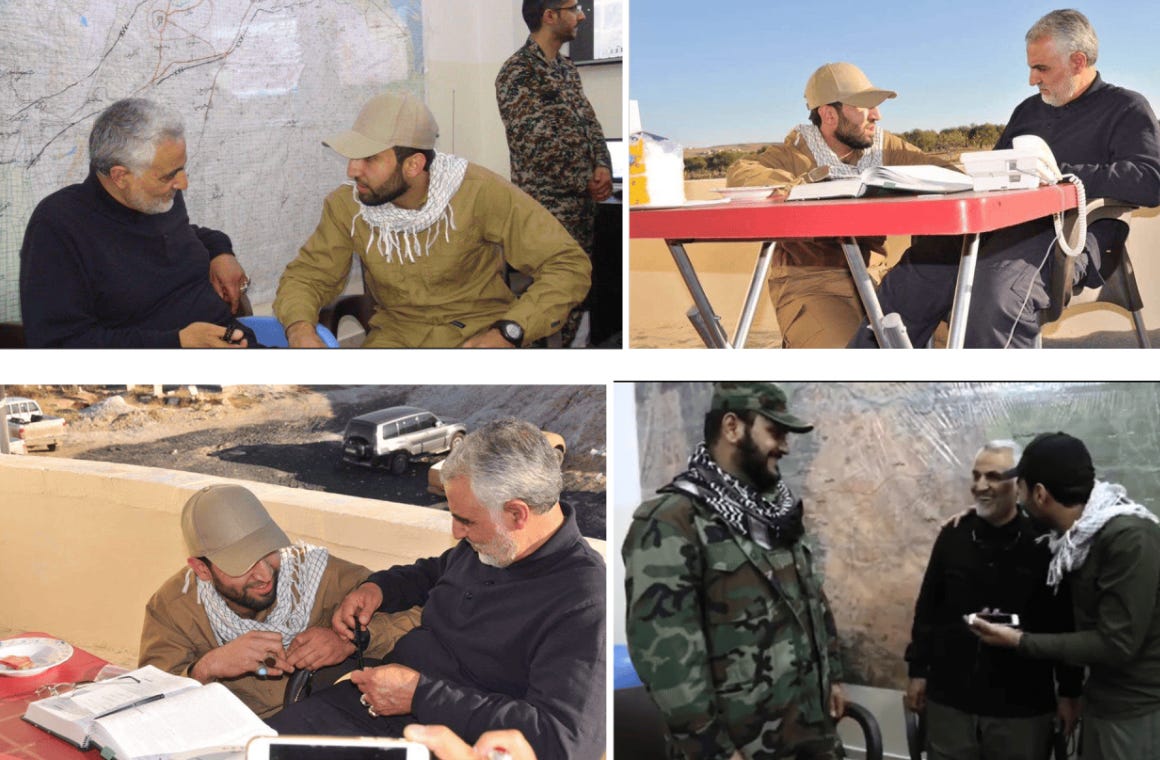
The complaint portrays Al-Saadi not as a peripheral figure but as a commander embedded within the highest levels of Iran’s external terrorist apparatus. He worked directly alongside Soleimani and Abu Mahdi al-Muhandis — the leader of Kata’ib Hizballah killed alongside Soleimani in the January 2020 American airstrike in Baghdad — and maintains relationships with Esmail Qaani, Soleimani’s successor as Quds Force commander, as well as the secretary generals of both Harakat al-Nujaba and Hizballah. His social media accounts, tracked across Snapchat, Telegram, and X, feature photographs of himself alongside Soleimani in apparent military settings, propaganda imagery depicting the United States Capitol in ruins, and years of explicit calls for the killing of Americans and Israelis — including a September 2020 Snapchat image of Donald Trump with a targeting reticle over his face and a January 2023 post depicting a B-2 bomber’s shadow hovering over Trump on a golf course, captioned with a demand for retribution for Soleimani’s death.
On the April 1 recorded call, asked about the trajectory of the conflict, Al-Saadi was direct: “This war will not end. Either they eradicate us or we eradicate them.”
New York City Police Commissioner Jessica Tisch said the case “puts into stark relief the global threats posed by the Iranian regime and its proxies like Kata’ib Hizballah — foreign terrorist organizations that have repeatedly targeted Jewish communities across Europe and the United States since the war began.” United States Attorney Jay Clayton said: “Al-Saadi attempted to disrupt American society through intimidation and violence.”
Al-Saadi faces a maximum sentence of life in prison.


We have an extradition treaty with our American friends. Prez Trump:: Please demand, that we hand this dirtbag over to the US. You can then convict and hopefully execute. Our ccp, hamas loving lieberal government here won't do -anything - unless its arm is twisted. The Canadian readers in these pages will all happily be grateful, I'm sure.
And there are 700 suspected IRGC in Canada. Holy cow. This is scary. Good work by the FBI in getting this guy. How involved was the RCMP or CSIS in any of this arrest?