


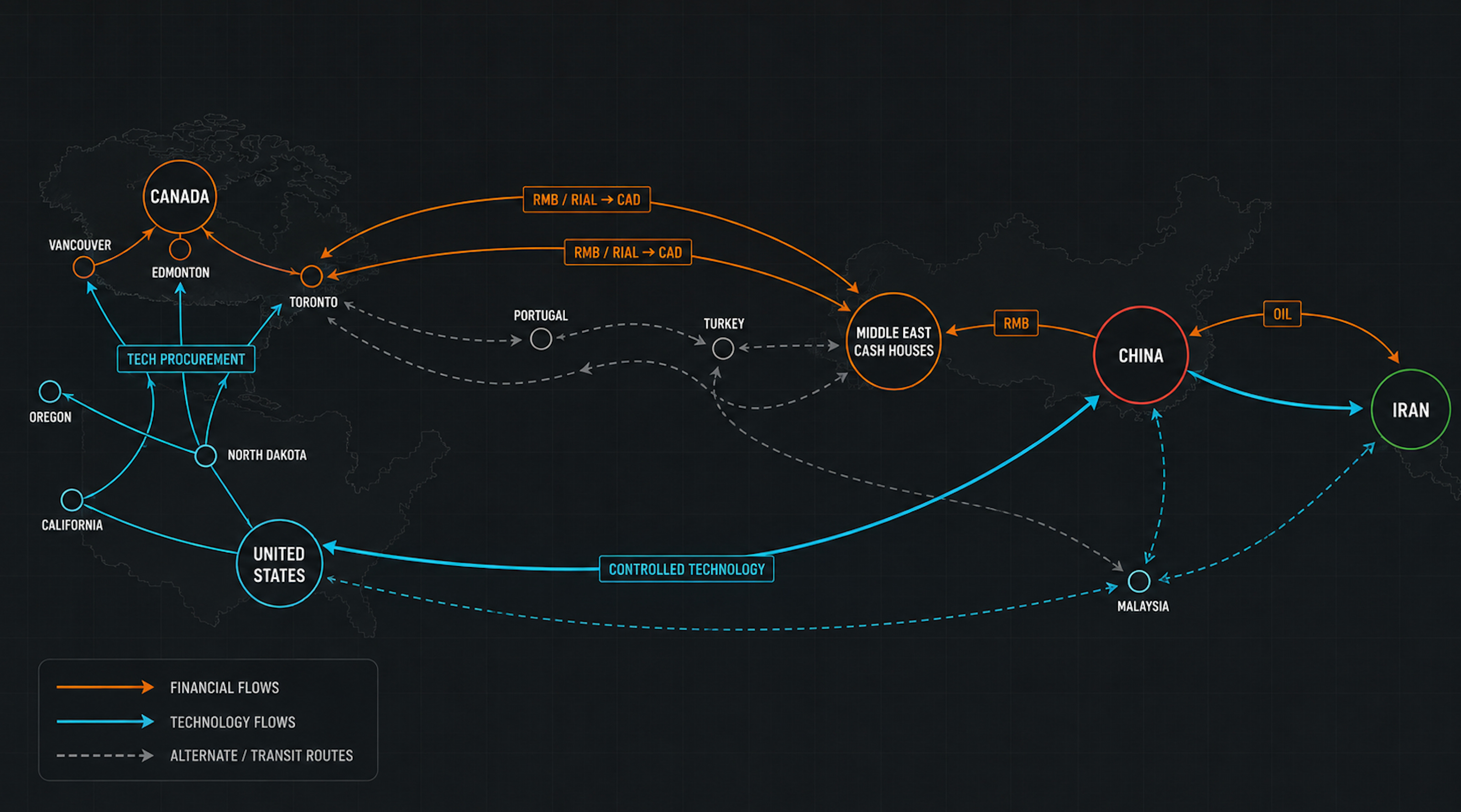
OTTAWA – An Iranian immigrant living in Vancouver spent more than five years buying American missile-testing equipment and drone cameras for Iran’s Department of Defense, routing the goods and the payments through front companies in China. A Seattle court sentenced him to 42 months in prison in 2018. He was arrested not by Canadian police but by an American agent, at the border crossing in Blaine, Washington.
The case is a public record illuminating the Iranian-Chinese procurement system that now sits at the center of Washington’s financial war against Iran, and that Canada has never confronted. Iranian government buyers stand at one end of it, Chinese operators and their front companies at the other end, and hundreds, if not thousands of Canadian residents from Iran serve as its trusted Western face, operating from major Canadian cities, wired into Canadian banks, trade and technology and real estate companies, and Canada’s political system.
The scheme moves sensitive American technology to Tehran through fake import and export firms and transshipment points, and it settles the bills in oil and Chinese currency, often laundering euros and US currency through currency exchange hubs in the Middle East, Canada or Hong Kong.
According to one of The Bureau’s sources, the file also explains the unexamined machinery behind an explosive story by the Canadian national security reporter Stewart Bell.
Bell revealed that the son of a former Iranian vice-president, described by Canadian Security Intelligence Service as a participant in a covert weapons procurement structure for the Islamic Revolutionary Guard Corps, spent a quiet decade in Edmonton winning some $2 million in contracts from the Royal Canadian Mounted Police and the Department of National Defence.
CSIS warnings went nowhere inside Justin Trudeau’s government, and Ottawa’s single attempt to remove him apparently collapsed on a notorious structural error in Canadian law: intelligence gathered by the spy service often cannot be used in court by the border enforcement agency that needs it.
The covert Iranian financing machinery involved is the target of the newest phase of Washington’s war, which Treasury Secretary Scott Bessent calls an economic D-Day.
American military officials say Iran’s ability to close the Strait of Hormuz is degrading, and the pressure has moved to the Revolutionary Guard’s money — the channels that fund its war machine and run the country’s economy. They are the same channels running through the Canadian cases examined here, including Bell’s, which has produced Conservative calls for an inquiry into Canada’s security failures.
Speaking at the Group of 20 finance meeting in Asheville, North Carolina, this week, Bessent described the system. “The Chinese pay the Iranians (for oil) in RMB,” he said. “The RMB comes back to the Gulf Region, and whether it is through neighbors shipping that supplies over, or whether it is through banks — such as the one we put out of business in Dubai on Friday — or whether it is the cash houses, those are being closed down. When that money cannot be converted to dollars, then the regime will starve.”
Fourteen years earlier, a Vancouver man had written the same system down in an email to his partners in China.