The Bureau

The Bureau

Inside China’s New Fentanyl Pipeline: From Mazatlán Through Vancouver to Los Angeles

U.S. officials believe Canada’s prime minister has minimized Canada’s role in global fentanyl markets as China shifts precursor and pill flows from Mexico.

Dec 18, 2025
∙ Paid

BRITISH COLUMBIA — Chinese and Mexican cartel networks have increasingly routed container shipments of fentanyl pills and precursor chemicals through Vancouver as a production and export hub into the western United States and Asia-Pacific markets, a Trump-administration source has alleged, adding that U.S. officials believe Prime Minister Mark Carney has downplayed Canada’s role in fentanyl markets in meetings with senior State Department officials.

A U.S. investigator involved in global fentanyl investigations contacted The Bureau with these claims, citing details of recent seizures that, in their view, point to cartels exploiting Vancouver’s port as a convenient transshipment hub—moving narcotics globally under the cover of Canada’s trusted trade status.

“We are seeing containers going north from Mexico, from the port of Mazatlán, full of fentanyl pills going up to Vancouver and then being shipped down to western ports in the U.S. to make it look like the containers originated in Canada, to spoof our customs inspections,” the U.S. government source informed The Bureau, noting that Ottawa was receiving this sort of information from multiple U.S. sources, in addition to the FBI and Director Kash Patel.

What differentiates these claims from earlier statements by Kash Patel—who said in June that Mexican and Chinese gangs were shifting fentanyl production operations into Canada—is that the senior U.S. investigator interviewed by The Bureau pointed to ongoing probes tied to seizures that did not occur at Canada’s northern border, and to specific intelligence reporting informing those investigations.

Patel’s public comments came several weeks after a massive 4,300-litre seizure of chemical precursors shipped from China was intercepted in the Vancouver port system.

The Bureau has confirmed that the primary source of this story has knowledge of high-level meetings this year involving Canadian officials tasked with responding to increased pressure from President Trump, who has rapidly escalated a war on synthetic narco-traffickers by classifying fentanyl as a weapon of mass destruction and designating a handful of Latin cartels as narco-terrorist entities.

“Another thing is we’re seeing fentanyl precursors going into Vancouver on a very large scale,” the U.S. global fentanyl investigation source added. “Sometimes they stop in Mexico and then get shipped north; a lot of times they just go straight from China.”

The U.S. official interviewed by The Bureau asked not to be named due to sensitivities in ongoing investigations. Broadly, Derek Maltz, who recently retired as acting DEA director for President Trump, confirmed a number of points made by the unidentified senior U.S. official cited in this story.

“A hundred percent, I agree with that assessment,” Maltz told The Bureau. “The criminal networks are always going to shift their operational routes, because the U.S. administration has made unprecedented movement against the supply side of the production of these deadly fentanyl substances.”

Maltz says that means Chinese-linked supply chains will likely adjust, routing more shipments through the Port of Vancouver—the fourth-largest port in North America by cargo tonnage—in part, he argues, because Chinese Communist Party–linked criminal networks have spent decades building a durable base in British Columbia. Yet, as he tells it, Ottawa’s enforcement capacity—and its candour about the scale of the threat—has lagged behind.

“You’re shutting down the southern border, you’re blowing up these fast vessels in the Caribbean, so we’re shutting down their ability to get stuff into America, and they’re just going to go to a different place. And Canada’s prime for that, because people in Canada haven’t been truthful.”

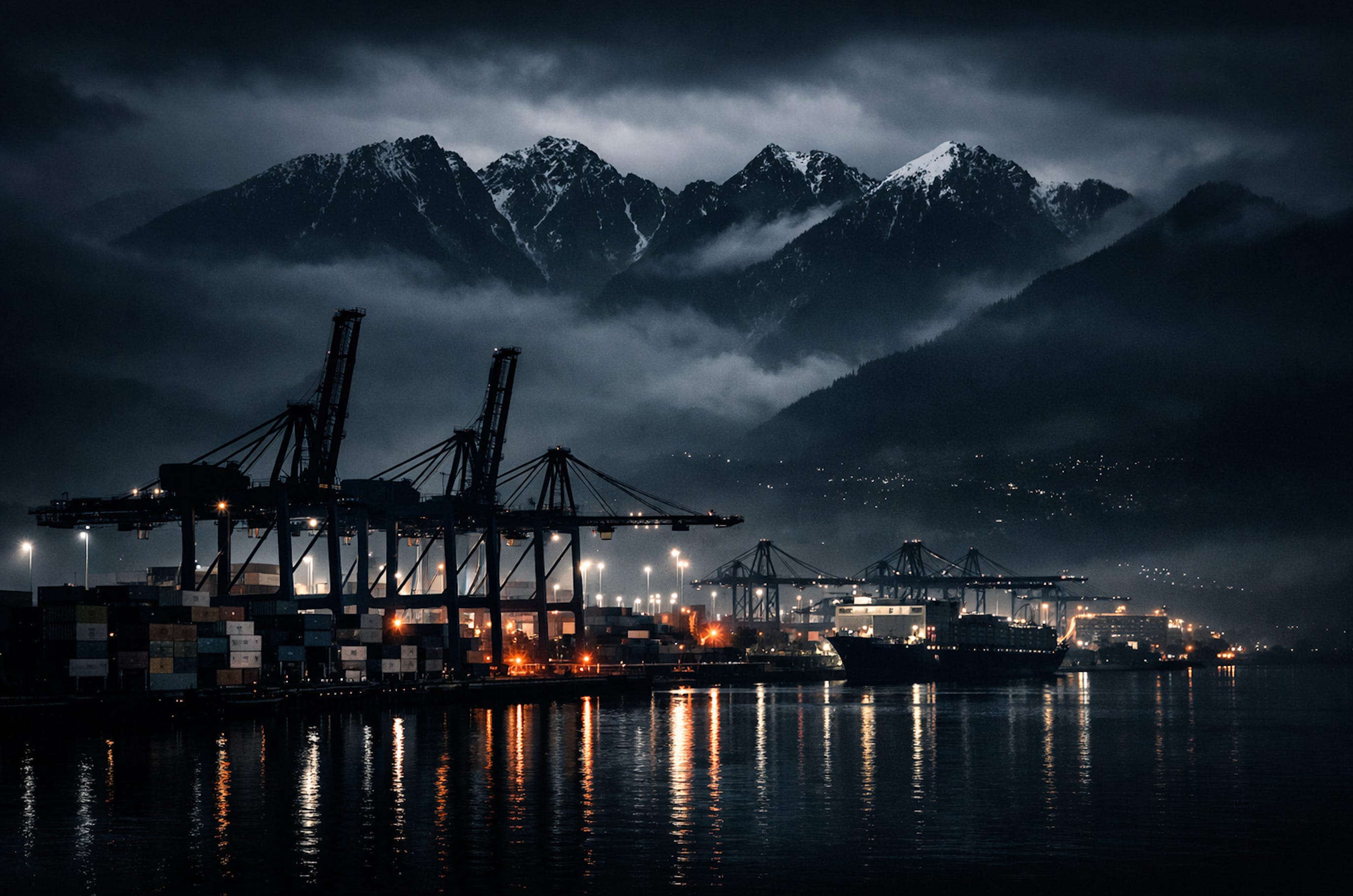
Vancouver’s Deltaport was described in a 2023 port-policing report as vulnerable to organized-crime infiltration—and the report notes that while the Canada Border Services Agency does not disclose inspection rates, it is believed that fewer than two percent of containers are imaged and fewer than one percent are physically opened and searched. U.S. and Canadian sources also pointed to what they described as significant weaknesses in “bonded” warehouses in the Vancouver port ecosystem, which they allege receive only limited inspection.

In late October, the CBSA disclosed that officers seized 4,300 litres of precursor chemicals in May 2025 at the Tsawwassen container examination facility—shipped from China and bound for Calgary. The two containers included 500 litres of propionyl chloride, a core ingredient that criminal fentanyl producers rely on. The CBSA noted the facility sits on Tsawwassen First Nation lands roughly five kilometres from the Deltaport terminal.

The Bureau’s conservative computation is that 500 litres of propionyl chloride could realistically be converted into about half a tonne to one tonne of fentanyl—an output that, by U.S. government dose metrics, would equate to hundreds of millions of doses. That potential volume would be consistent with industrial-level production from sophisticated, cartel-linked clandestine labs identified in western Canada—large enough to supply major portions of North American and Australasian markets for a significant period.

The primary source for this story said U.S. intelligence’s view is that China is increasingly shipping precursors into Canada after the Trump administration’s crackdown in Latin American countries—an assessment, they believe, that points to a larger network of fentanyl labs than Ottawa has openly acknowledged to date.

“So it implies there have got to be several more superlabs in Vancouver that your police either haven’t identified or haven’t publicly identified—because what is the purpose of sending all these precursors if there’s not?” they asked.

“We’re getting pretty good knowledge and insight on precursor shipments now,” the global fentanyl investigations source added. “The Chinese have even recently halted a lot of shipments into Mexico, although there have been a few huge ones recently. They seem to be shifting toward Canada.”

In response to The Bureau’s detailed questions to Canada’s Public Safety Minister and the federal police commissioner, the RCMP said it is “aware that some containers are being transshipped through Canada” and is working with partners, including U.S. Customs and Border Protection, to address the activity.

On the central dispute—whether Canadian production is supplying U.S. markets at meaningful scale—the RCMP pushed back: “Canada is not a major source of fentanyl entering the U.S.,” the force reiterated, adding that Canadian-produced fentanyl is believed to be mainly intended for domestic consumption, with only “sporadic exports” intercepted in “gram-level quantities.”

On one key point, the RCMP response contains an admission that cuts against any attempt to characterize Canada’s fentanyl problem as purely domestic. The force said Canadian-produced fentanyl has been exported to “Australia, New Zealand, and Southeast Asia.”

Separately, two days ago, Bloomberg reported that Canada “wants to work more closely with China to stop the chemicals used to create the deadly synthetic opioid fentanyl from reaching North America,” according to Canada’s new fentanyl czar, Kevin Brosseau.

Brosseau’s reported comments came one day after President Trump classified illicit fentanyl as a weapon of mass destruction.

“We’re looking to collaborate with China, because it’s not an indictment against the Chinese government, per se,” Brosseau said. “It’s companies, chemical companies in China, that are engaged in this kind of conduct.”

Ottawa now acknowledges that Canada has become a major producer and consumer of fentanyl, amid a growing number of clandestine synthetic-narcotics labs. But since President Trump threatened tariff action over fentanyl—and since Prime Minister Mark Carney was elected—public messaging appears to have shifted toward downplaying Canada’s role as an exporter.

It wasn’t always that way.

Keep reading with a 7-day free trial

Subscribe to The Bureau to keep reading this post and get 7 days of free access to the full post archives.

Already a paid subscriber? Sign in
© 2025 Sam Cooper · Privacy ∙ Terms ∙ Collection notice
Start your SubstackGet the app
Substack is the home for great culture