

By Michael Lima
Every October 30, the International Day of Political Prisoners honours those imprisoned for their beliefs and peaceful exercise of fundamental rights. According to the U.S. Department of State, more than one million people worldwide are imprisoned for their beliefs. Political imprisonment seeks not only to silence dissent but also to intimidate entire societies. The commemoration originated in 1974, when Soviet dissidents Kronid Lyubarsky and Oleksii Murzhenko established the Day of Soviet Political Prisoners, inspiring hunger strikes in labour camps.
Soviet political prisoners developed a powerful metaphor for totalitarianism: the “Small Zone” and the “Big Zone.” The former referred to prisons and forced labour camps; the latter to the Soviet Union itself, where citizens lived under varying degrees of “unfreedom.” Yet the idea of an entire nation as a prison has deeper roots. In 1889, José Martí, Cuba’s independence hero and former political prisoner, described the island under Spanish colonial rule as a “prison surrounded by water,” where colonial governors wielded extraordinary powers to suppress dissent and restrict political freedoms.
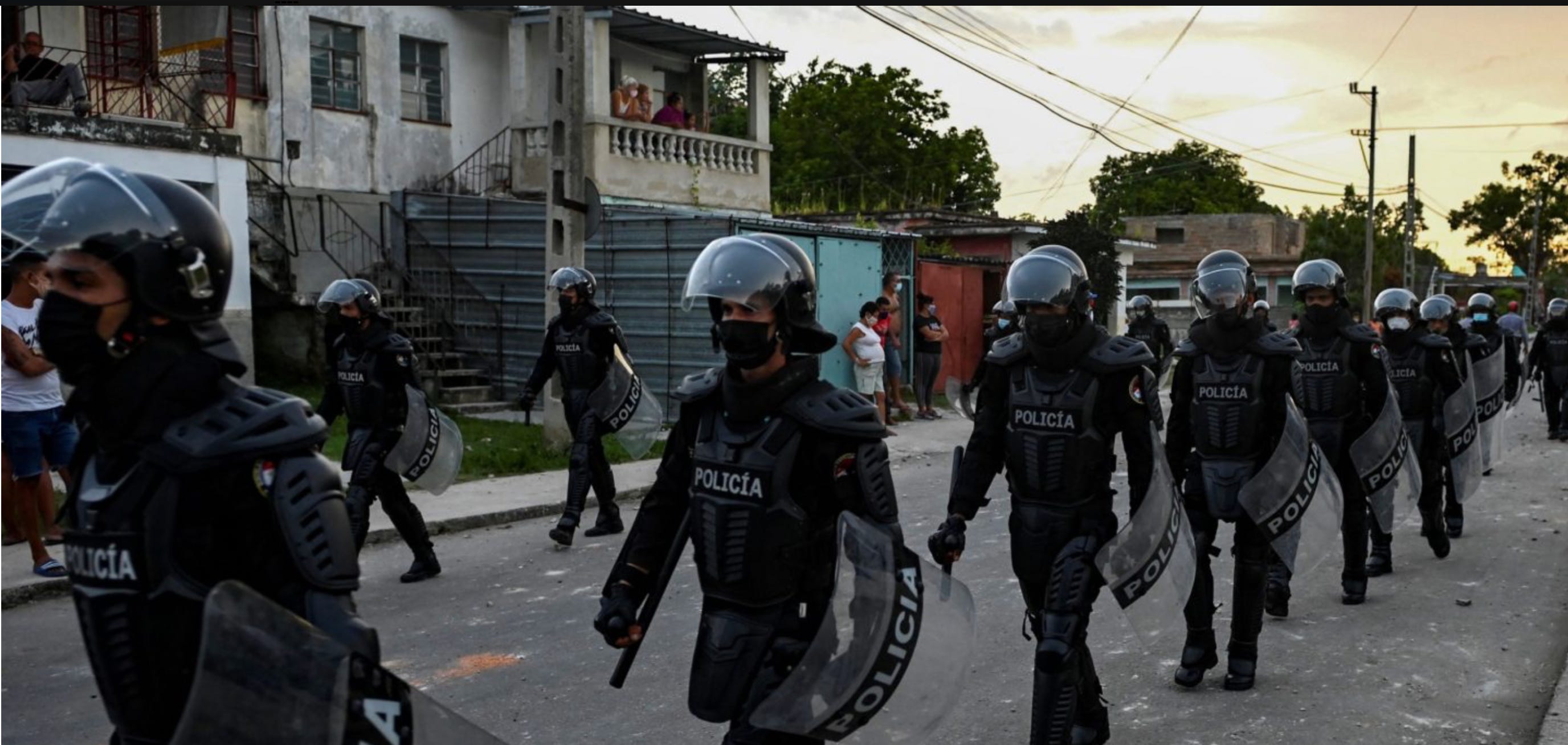
More than a century later, Martí’s description remains hauntingly relevant. Cuba, whose political system was modelled on the Soviet Union, reflects both historical metaphors. Its Small Zone comprises approximately 350 prisons and detention facilities. By September 2026, Prisoners Defenders documented 1,351 political prisoners, more than three times the combined figures reported by Foro Penal in Venezuela (322) and the Asociación Memoria y Justicia por Nicaragua (72). Despite differing documentation methodologies, these figures underscore the scale of political imprisonment in Cuba. Prisoners have faced beatings, prolonged isolation, denial of family visits, inadequate medical care, and other forms of ill treatment.
Political imprisonment also exacts a profound human toll on families, exposing relatives to separation, surveillance, intimidation, and threats. Félix Navarro Rodríguez and his daughter, Saylí Navarro, longtime advocates for democracy, received sentences of nine and eight years, leaving Sonia Álvarez with both her husband and daughter imprisoned. Following the July 2021 protests, Loreto Hernández García was sentenced to seven years in prison and his wife, Donaida Pérez Paseiro, to eight years. Loreto’s daughter, Rosabel Sánchez, reportedly faced threats for defending her father. Brothers Jorge and Nadir Perdomo were also imprisoned for participating in those protests, leaving their wives, children, and parents to endure the anguish of their imprisonment. These cases show how the Small Zone reaches into the lives of families outside prison walls.
But Cuba’s Big Zone extends across the entire island. Security forces station patrol cars outside dissidents’ homes, effectively imposing house arrest. Surveillance cameras have monitored the entrances to the homes of artist Luis Manuel Otero Alcántara and activist José Daniel Ferrer. Others face restrictions on movement or travel abroad. Their homes become prisons, and territorial boundaries become invisible prison walls. Even in exile, activists can be denied the right to return, while other Cubans censor themselves for fear of being unable to visit their families. Thus, the regime’s invisible prison walls extend beyond the island, restricting freedom even in exile.
At the heart of Cuba’s Big Zone lies an apparatus of preventive repression, designed to suppress dissent before it emerges. Since 1961, the Ministry of the Interior has overseen intelligence, policing, and prisons, receiving training and assistance from the Soviet Union and East Germany’s Stasi during the Cold War. The Committees for the Defense of the Revolution extend surveillance into neighbourhoods, creating a network of social control. Historians regard East Germany as one of history’s most heavily surveilled societies. Whether Cuba surpassed its former mentors may only become clear when its security archives open. Together, these institutions extend political surveillance and control into education, employment, communications, and private life.
Cuba’s 2022 Penal Code perpetuates a repressive legal tradition dating to its 1978 and 1987 predecessors. Broadly worded provisions penalize public expressions of dissent through offences such as propaganda against the constitutional order, contempt, and public disorder, enforced by judges subordinated to the interests of the Communist Party. Meanwhile, Decree Laws 35 and 370 have been used to punish criticism on social media. Human rights organizations condemn these measures as violations of fundamental freedoms that provide a legal justification for repression.
Yet repression extends far beyond organized political opposition. Ordinary Cubans face imprisonment for criticizing blackouts, food shortages, failing public services, or abuses of authority. Some have been arrested for posting videos about their inability to feed their families, livestreaming protests, or questioning officials. Even satire can lead to lengthy prison sentences. In Cuba, one need not belong to an opposition movement or openly demand democratic change to become a political prisoner. The regime treats independent thought, public criticism, and unauthorized collective action as threats to its authority.
The intolerance of dissent was on display even at the United Nations on October 27, when Cuban Foreign Minister Bruno Rodríguez Parrilla and his delegation angrily interrupted U.S. Ambassador Mike Waltz as he criticized the privileges enjoyed by Cuba’s ruling elite. Waltz asked what happens to those who raise such questions in Havana, away from diplomats and cameras.
Cuba’s Big Zone also operates through education and employment. Political evaluations can limit educational opportunities, while workplace criticism can lead to dismissal and blacklisting. Amnesty International’s 2017 report, “Your Mind Is in Prison,” documented discrimination through interviews with more than 64 Cuban migrants, including athletes, social workers, and teachers. Those dismissed for expressing critical views faced a vicious cycle: political discrimination deprived them of employment, while unemployment exposed them to imprisonment under the former doctrine of precriminal social dangerousness. Although the 2022 Penal Code abolished this doctrine, official warnings and criminal penalties for disobedience remain. A 2023 Supreme People’s Court opinion reportedly reinforced coercive measures against those who neither work nor study.
This reveals the purpose of Cuba’s Big Zone: repression does not require imprisoning everyone. It requires making everyone aware that punishment is possible.
The prison exists in the classroom, in the employment file, in the home where a dissident is confined under police surveillance, and in laws that can turn a social media complaint into criminal charges. Above all, it exists in the fear that compels citizens to censor themselves. It is a prison without walls, one that extends into the mind of every Cuban.
On this International Day of Political Prisoners, democratic nations must demand both the immediate and unconditional release of Cuba’s political prisoners and the dismantling of the machinery that perpetuates their imprisonment.
History offers a warning. In 1979, Cuba released thousands of political prisoners, including plantados who resisted political rehabilitation and ideological indoctrination at enormous personal cost. Prisoners arrested during the 2003 Black Spring crackdown were released beginning in 2010, many into exile. Yet political prisoners have repeatedly served as bargaining chips while repressive institutions remain intact. The result is a revolving door of repression: some prisoners are released, often under restrictive conditions, while others take their place. Breaking this cycle requires ending impunity for serious human rights abuses, including through targeted sanctions.
The Soviet dissidents’ distinction between the Small Zone and the Big Zone reminds us that a society can be imprisoned without every citizen being behind bars. In Cuba, you don’t have to be in a cell to be a prisoner. You only have to live there as an ordinary Cuban.
Michael Lima is a researcher and the director of Democratic Spaces, a Canadian NGO dedicated to fostering solidarity with human rights defenders and civil society in Cuba. He holds a master’s degree in Latin American history from the University of Toronto.
I’m seeing much of what is going on in Cuba trickling into Canada. If you disagree and question our government you are UnCanadian. If you agree with American policies you are UnCanadian. Our taxpayer funded media villainized hard working Albertans who merely wanted to be left alone to live their lives without Ottawa dictating what you can and cannot do. We also have the example of Tara Lich and Chris Barber who have been vilified and prosecuted thousands of times worst than Paul Bernardo. Canada is criminalizing the bible as Marc Miller proclaimed that certain texts were offensive. We have 2 tier policing, we have people losing their jobs for their political beliefs. Wake up Canada we are rapidly becoming North Korea especially with a Prime minister who doesn’t seem to believe that parliament should be involved in his corporate decisions.
Canadians are prisoners of taxation, authoritarianism and repressive government, Big Zone. Cities and towns are the Small Zones of homeless, drugs, DEI and clown governments.