

By Bob Pickard
I was the global communications chief at the Asian Infrastructure Investment Bank, a Beijing-headquartered multilateral development institution founded in 2016, until I resigned on principle in June 2023 over the undue influence of the Chinese Communist Party in the bank’s everyday operations. I directly experienced the toxic corporate culture that the party’s political contamination created.
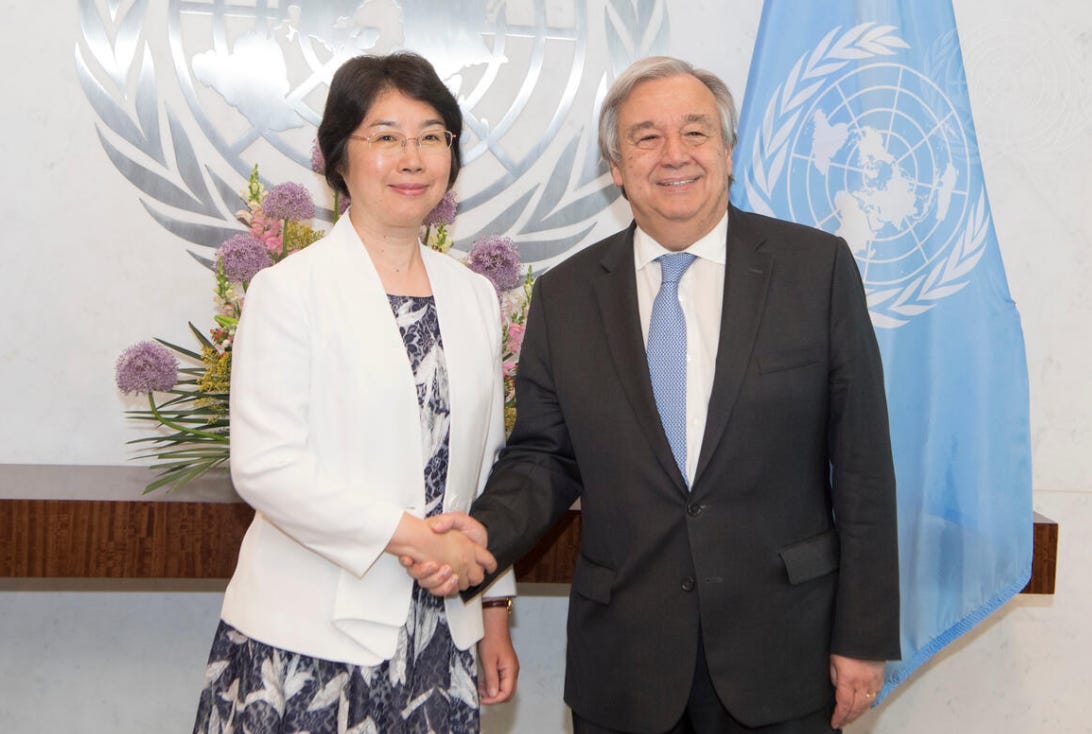
While the bank denied my public allegations about the institution’s true nature, the installation of Zou Jiayi — a longtime Chinese finance official and Communist Party member — as AIIB’s new president this week should dispel any remaining illusions.
I feel completely vindicated, because this is not a technocratic leadership change; it is a political one, designed to entrench Communist Party influence within the bank and extend China’s reach wherever AIIB lends money.
What was once presented as a multilateral development bank operating to international standards is now overtly led by a senior Communist Party official whose career has been shaped by party authority, not institutional independence.
With this decision, the distinction between multilateral governance and party-state influence is no longer blurred. Indeed, a line has been crossed.
AIIB has positioned Zou Jiayi as a technocrat: a former senior Ministry of Finance official, a seasoned economic administrator, even an anti-corruption fighter. I have no quarrel with those descriptors, but they are materially incomplete.
What goes unsaid by AIIB is her senior role within the Communist Party’s political system itself. Beyond ministerial credentials, Zou has held high-level party positions associated with political discipline, ideological alignment, and — critically — external influence work designed to broaden support for the party.
Particularly, Zou has held senior roles inside the Chinese People’s Political Consultative Conference (CPPCC), a top political advisory body that describes itself as part of China’s “patriotic united front.”
As Peter Mattis, a former CIA analyst and now president of the Jamestown Foundation in Washington, has testified to Congress, the CPPCC is “the place where all the relevant united front actors… come together.”
Alex Joske, an Australian researcher who has written extensively on China’s united front system and overseas influence operations, has similarly described the CPPCC as “the peak united front forum.”
As these international experts have explained, senior CPPCC officials such as Zou Jiayi operate within a byzantine party ecosystem of united front organs, part of what Xi Jinping has openly called a Communist Party “magic weapon” of influence: a long-standing framework for shaping, co-opting, and aligning target actors, institutions, and elites — domestically and abroad, including through influence operations and, in some cases, interference — in support of Communist Party objectives. United front work is not diplomacy, and it is not neutral governance. It is explicitly political, designed to foster support for the party.
What better perch from which to advance the United Front’s mission than as president of AIIB, with $100 billion in capital for lending along the Belt and Road Initiative — for which China gets the geopolitical credit.
In theory, AIIB is not supposed to be a party-state institution. It is supposed to be a multilateral development bank, governed by international norms, accountable to a diverse shareholder base, and insulated from Chinese political command structures. Some Western governments — including Australia, Britain, Canada, and New Zealand — joined AIIB a decade ago sincerely believing China’s assurances that apolitical principles would apply, even if imperfectly. Over time, that ideal has been exposed as a delusion.
Consider the patterns of lending and how AIIB buttresses the Belt and Road Initiative, China’s primary strategy to build influence through debt dependency and political control.
From the inside, as I witnessed firsthand in Beijing, the shift toward party influence was unmistakable. Especially during the pandemic, governance mechanisms mattered less than informal authority. Decision-making was concentrated in the hands of Communist Party loyalists in the president’s office. Pervasive security and surveillance poisoned morale. The space for independent judgment narrowed. Freedom of expression was squelched. None of these conditions were imposed by explicit instructions. The system operated implicitly, through incentives, signals, and career logic that most understood.
Seen in that context, Zou Jiayi’s appointment is unsurprising. It is the culmination of a long politicization trend. This is not an argument about personal corruption or individual intent. It is an argument about institutional realities and political design. In the Communist Party system, senior party officials do not “switch off” their political responsibilities when assuming international roles. Party loyalty is not a credential one leaves behind — it is the organizing principle of authority. To suggest otherwise is to misunderstand how the system functions.
Some will respond that all multilateral institutions reflect the interests of their most powerful shareholder. That is true to some extent, but incomplete. In genuinely multilateral institutions, power is mediated by transparency, norms, and counterweights. At AIIB, those mechanisms are just not as robust. Unlike other multilateral development banks, AIIB has no resident board at its headquarters in Beijing to observe what’s really going on inside. That means a multilateral bank in theory, but in practice there is alignment under the party-state’s preferred direction.
Repeated appeals to reform AIIB from within ring hollow. Reform presupposes a shared commitment to institutional autonomy. When the bank’s leadership selection itself reflects Communist Party political priorities, the scope for meaningful change becomes illusory.
The implications extend well beyond AIIB. Western governments continue to struggle with how to engage China while protecting their interests, values, and security. Too often, engagement has been accompanied by self-deception: the belief that participation alone moderates behavior, or that technical cooperation can be insulated from politics. AIIB was a test case for that theory. The results are now clear.
Engagement is not the problem. Wishful thinking is. So too is willful blindness by Western governments.
Under Zou Jiayi, AIIB will increasingly serve as an instrument of Chinese statecraft rather than function as a genuinely multilateral organization. The pretence has ended. Through lending targeted at countries of geopolitical value to Beijing, AIIB will operate as a vehicle for PRC influence projection. It will serve as a force multiplier for Communist Party strategy under a multilateral facade, commanding a formidable war chest capitalized in part by countries either intimidated by potential Chinese retaliation — or enticed by promises of market access.
None of this analysis demands demonization or inflammatory rhetoric. But it does require clarity about what AIIB really is, about how power is actually wielded inside, about the difference between form and substance, and about the limits of institutional pluralism under an authoritarian party-state.
Zou Jiayi’s presidency will make it clear for all to see that AIIB is not evolving toward greater independence. Quite the opposite: under her, the bank will increasingly operate along lines entirely consistent with the Communist Party’s broader governance model — centralized, disciplined, and politically aligned.
AIIB will also provide institutional validation for Beijing’s rhetorical constructs — “win-win cooperation,” “genuine multilateralism,” “community with a shared future for mankind” — lending these propaganda formulations the credibility that only a multilateral institution can confer.
Western policymakers now face a choice. They can continue to treat AIIB as an uncomfortable but manageable anomaly, or they can accept what insiders like me have learned the hard way: some purportedly independent institutions cannot be insulated from the systems that create and control them.
Don’t just take it from me.
Daniel Wagner, another AIIB alumnus, recently wrote: “The installation of Zou Jiayi as the new president of the AIIB should finally put to rest the comforting fiction that the Bank operates as a neutral, apolitical multilateral institution. Although being apolitical is enshrined in the Bank’s founding documents, Zou’s background is not technocratic, reformist, or independent. It is unapologetically political — and firmly embedded in the Chinese Communist Party’s governing machinery.”
Also embedded are Communist Party loyalists inside AIIB, including — or so I am informed by an AIIB insider — the daughter of the PRC Minister of Public Security. She reportedly works in the legal department that produced the whitewash retaliation report finding my allegations about Communist Party influence “unfounded.”
They weren’t unfounded then, and they certainly aren’t unfounded now. With Zou Jiayi now at the helm of AIIB, everyone can see this with their own eyes.
Res ipsa loquitur.
About the author: Bob Pickard is Principal of Leadership Communication Inc., a strategic public relations consultancy advising public figures and senior executives. He has more than 35 years of international experience in professional communications, based in Canada, the United States, Korea, Japan, Singapore, and China. His past roles include North Asia President of Edelman and Asia Pacific CEO of Burson. A battle-hardened geopolitical communicator, Pickard is known for his work addressing complex client challenges. He is an expert on the global communication of Asia-based organizations. Pickard currently serves as an Executive Fellow at the Center for the Future of Organization, a think tank based at the Drucker School in Claremont, California, and as a Senior Fellow of the Macdonald-Laurier Institute, a Canadian public policy think tank.
China attacks, very creatively on as many fronts as possible. According to Peter Schweitzer’s latest book, Invisible Coup, that deals with immigration, for thirteen years, China has set a target of 100,000 ‘anchor babies’ to be born in the US. It’s expected that when they’re of age, they’ll return to the US where they can vote and obtain government jobs and influence policy. One CCP official has had three children born in the US. Canada also gives citizenship to anyone born here.
This begs the question-how closely has Carney previously worked with Chinese bankers, what is his current policy on the AIIB, and what arrangements facilitating enhanced co operation can be expected between China's and Canada's central and commercial banks?