'I Am the Living Proof': The Uyghur Survivor, the Slave Compound, and the Forced Labor System Carney Cannot Escape
In a 2-hour on-camera interview, Sulayman — a Uyghur survivor who arrived in Canada as a refugee eight weeks ago — delivers the witness testimony that Mark Carney's China policy cannot answer.
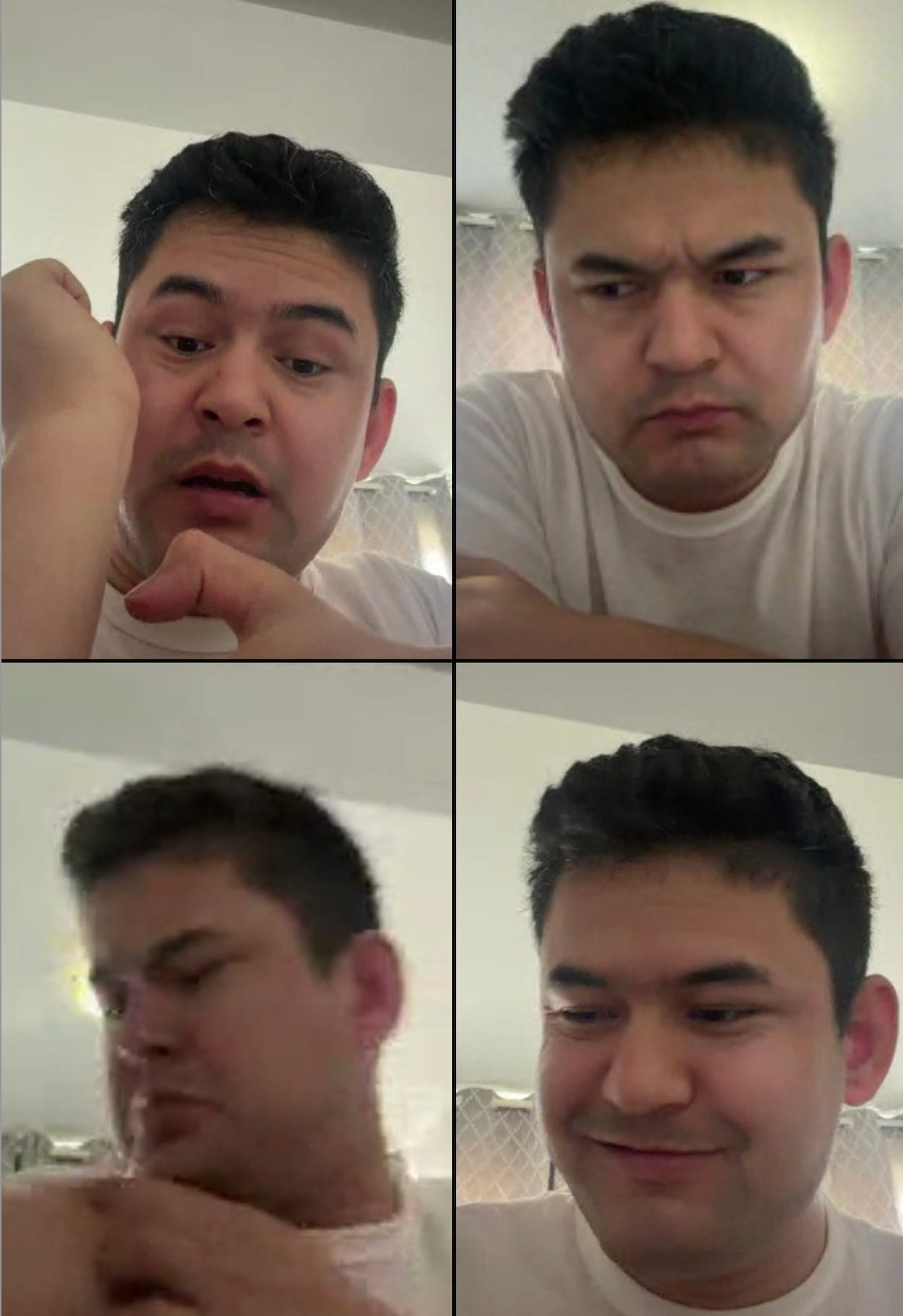
TORONTO — His dark eyebrows bunched in memory of the shocking pain, Sulayman makes a sharp buzzing sound and jabs his inner wrist with a small cup, demonstrating how he was electrocuted by Chinese gangsters in a slave cyber-scam compound in Cambodia. It is a similar expression — pain, disbelief, disgust — that shapes his face when asked to describe to Prime Minister Mark Carney and Liberal Member of Parliament Michael Ma his prior lived experience, and that of his older relatives, and of Uyghurs across Xinjiang, working in forced labor factories and farms under the yoke of China’s police state.
He also has a message for all Canadians to consider — whether, as citizens, they can support the argument at the center of Michael Ma’s stunning cross-examination of a Canadian expert in Parliament, and Mark Carney’s position, that forced labor imposed on Uyghurs is not enough of a concern to bring Carney’s Chinese electric vehicle deal into doubt.
“If you’re driving that car, that car is blended with Uyghur blood,” he said, through his interpreter Rukiye Turdush, the Uyghur community leader who facilitated his miraculous release from the Cambodian slave compound. “How are you going to feel comfortable when you drive that car? How are you going to be happy? These people working to build that car in forced labor — none of them agreed. None of them were happy. They were oppressed. Their blood is in that car.”
Turdush, who conducted the negotiations that freed him, added her own charge to Canadians: “If somebody — a criminal — steals something and brings it to sell you, that is illegal in Canada. But China is doing the same thing. They are killing people, they are using Uyghur forced labor, making these things — and you buy that thing. That is like buying something from the hands of a criminal thief. And when more people buy, you are justifying this thing. China is going to use more forced labor, more Uyghurs are going to work there. So when you buy these things, you are helping forced labor flourish more.”
Of Mark Carney’s current position and Michael Ma’s parliamentary denial that China operates a system of forced labor against Uyghurs, Sulayman was unsparing.
“If the Canadian government accepts those Chinese electric vehicles, and they know that forced labor exists, they know that genocide exists — they have the proof. And I am the living proof, by myself. And still they accept this deal, bring these cars, and drive these cars. This is complicit. So how do they answer their own conscience?”
The timing of Sulayman’s testimony could not be more charged, or more consequential.
On Monday night, at a Liberal Party fundraiser closed to the media, Prime Minister Carney praised Ma by name, saying he “was guided by the values of building up others” and was “a result oriented individual.” “These are fundamental liberal values, fundamental Canadian values,” Carney said, in a video reviewed by The Bureau, “and that’s why Michael Ma has found a home in our party.” The praise came as Ma’s comments dismissing evidence of Uyghur forced labor — comments that critics say were indistinguishable from Beijing’s official position — were generating fierce public controversy across the country.
At that same fundraiser, Ma and Carney mingled with individuals known to national security investigators of China’s alleged federal election interference in Toronto ridings, according to photographs reviewed by The Bureau, including individuals associated with a Toronto-based umbrella organization whose leaders have repeatedly attended senior-level United Front Work Department overseas Chinese affairs events in Beijing.
Carney now faces the sharpest geopolitical test of his young prime ministership, as he has staked out Canada’s trade diversification strategy on deepening economic engagement with Beijing. Washington is watching. And a Uyghur man in a Toronto apartment, who arrived in this country as a refugee eight weeks ago, is watching too — the scars on his body from electric shocks and rubber beatings now healed to slight discoloration, the mental pain still fresh, yet balanced by a joyfulness at his new life of freedom in Canada and outpourings of thankfulness to the Canadian people.
He took considerable personal risk to share his story, concealing his real name and certain details of his case in Xinjiang and Cambodia, in order to enter his witness account into the public forum opened by Ma’s actions in Parliament and Carney’s adherence to the Chinese electric vehicle deal. But he also wanted Canadians to know something more personal — something about what it felt like, after all of it, to walk down a street in Toronto.
In Xinjiang, if an unknown number called your phone and the voice asked: are you Sulayman? — you were immediately terrified. That question meant they were searching for you. People disappeared after calls like that. Walking in the street, if a police officer spotted you from a distance, they stopped you. They searched your phone — every conversation, every photograph — looking for something suspicious.
“Here,” he said, “I don’t know where the police station is. I never think about it. Nobody is going to stop me and check my things.”
He smiled, slightly disbelieving, the kind of smile that makes strangers on the street look twice.
“I saw two Canadian police last time on the street. And I was thinking: are they going to check me? But they just smiled at me. They said hi. And I said hi. And I left. And I said — what kind of country is this?”
He laughed, remembering it.
“I feel so free,” he said. “Canada saved my life.”
He paused, his face approaching anger — then quickly softening.
“And the same time — when they deal with China like that — that is in my heart. That makes me, a little bit, sad.”
Turdush — who has spent years documenting the forced labor system that consumed Sulayman’s life, and who extracted him from captivity through sheer force of will and personal funds — put the political question in terms that cut through every diplomatic abstraction. How does Prime Minister Mark Carney now look at himself in the mirror?
Sulayman and Turdush joined The Bureau for a lengthy on-camera witness interview — testimony they say is necessary to answer what happened inside a parliamentary committee room where Ma’s comments landed like a gift to Beijing. Their account, grounded in a sworn statement signed on March 21, 2026, before the Inquiry on Crimes Against Humanity and Genocide Against the Uyghurs, is one of the most detailed first-person records of the full arc of China’s campaign against the Uyghur people yet heard in Canada: from childhood conscription in Xinjiang, through a state labor transfer program, through a criminal trafficking network, to a Cambodian compound where a former Chinese soldier administered beatings with a thick black rubber whip before the torture escalated to electric shocks for failing to meet a scam quota.
It is also, in the end, a story about Canada — what this country has been and will become.
Sulayman Aziz was born on March 4, 1996, in Makit County, in the Kashgar region of what China calls Xinjiang and what Uyghurs call East Turkistan. He grew up speaking both Uyghur and Chinese. He completed his education at the local high school. He did not belong, he notes in his sworn statement, to any organization.
From childhood, he watched Uyghur farmers compelled to participate in seasonal agricultural labor known as “hashar” — unpaid, mandatory, not for Han Chinese families but for Uyghur ones, each household required to send one member. When Sulayman was a child, it was his mother who went.
The work sites were approximately fifty kilometers from the village. Some workers could return home at night. Many could not — forced to remain at the sites for extended periods, sleeping in open desert conditions for months at a time. There was no sanitation. There was no shelter. There was no payment. His mother, lacking the money to cover transportation back and forth, was often unable to come home at all.
The image that remains most vividly with Sulayman is not drawn from his time in the poultry factory. Before he was conscripted into the state labor transfer program, he had already absorbed the experiences of relatives and neighbors who had gone before him. And when he was sent to do hashar alongside them, it was not his own suffering that stayed with him most. It was the women.
“Things that always linger in my mind — the Taklamakan desert,” he said. “Not myself, not other young people — but especially the elderly women. A lot of elderly women going there too. We were going to plant trees there. These women, they could not come back. They were forced to sleep in open fields for several months. They brought food from home, and they don’t have money to go back and bring more. So sometimes the food is finished and they borrow food, they get food from other people. That is how they are alive.”
He paused. “These women are over 50, over 60. Sometimes they are sick. They don’t have energy to work. I can feel that. I can see that. But these women cannot refuse. They can’t say: I am sick. I’m not feeling well. I can’t go. Whenever they say that, they are never believed. They say: you are lying. You are not cooperating with the government law. You are a problematic person. You have an ideological problem.”
During his own high school years, Sulayman was conscripted into the hashar system himself. The consequences of refusal were unspoken but universally understood.
He explained it this way: “It’s not like sending you to some kind of work, some peaceful thing. This is a kind of threat. A kind of scary thing. Something you can never escape. You’re not able to say no.” He thought about how to explain the psychology of it to someone who had never lived inside it. “In Canada, people are so free. They can say no to anything. They can say no to anyone.
But for us, this is something we can’t say no to. I was thinking: I am created to be forced. I am created into this world to do those kinds of things, to live that kind of life.”
In December 2021, a call came from the Makit County neighborhood office. Sulayman was instructed to return and report to their office. Upon his return, officials directed him into a government labor transfer program — the mechanism by which the Chinese state formally routes Uyghur workers into factories in inland China.
From December 2021 to March 2024, Sulayman was held at a poultry processing plant somewhere in inland China — a province he will not name, to protect people still working there. No salary. No freedom to leave the premises. Constant overtime. Militarized management and surveillance that never slept. The Chinese state called it a labor transfer program. A job opportunity. Sulayman calls it what it was.
Then, in March 2024, a man named Amao appeared with an offer. You don’t have a good life here, Amao told him. This will be better. You will be paid.
They drove over mountains. The landscape changed in ways Sulayman could not place. At some point — he did not notice exactly when — he left China. He realized it only when the road signs appeared in an alphabet he had never seen. He did not know what country he was passing through. He knows now it was Vietnam.
After a night in a house he did not know was a staging point, he was loaded onto a large bus. It stopped again and again along the route, collecting more passengers — young men, mostly, drawn from different places by the same promise of paid work and a better life. The bus filled. Nobody on it knew where they were going. Nobody understood that they were cargo.
Four days after leaving the factory, Sulayman was in Cambodia. It was there that he ultimately learned what Amao had done: sold him to a Chinese criminal organization called the Long Qiang Group for seventeen thousand dollars, to work as a scammer.
One of Sulayman’s first concrete indications that men like Amao were not far removed from the Chinese state came before he even understood where he was. Outside the buildings he was directed into, he saw signs — proclamations of Xi Jinping’s Belt and Road Initiative, China’s flagship global infrastructure and trade project, rendered in the kind of official signage that marks Beijing’s reach across the developing world.
The presence of Belt and Road branding in the same geography as criminal trafficking compounds is not coincidental.
United States Treasury sanctions documents have cited Belt and Road-connected networks in connection with Chinese state-linked organized crime figures — among them Wan Kwok Koi, known as Broken Tooth, and other alleged Chinese transnational criminal operatives functioning inside Cambodia, Myanmar, and across Southeast Asia. The infrastructure of Chinese state capitalism and the infrastructure of Chinese organized crime, in these corridors, share the same roads.
What Sulayman had entered was one node in a vast criminal ecosystem that has reshaped Southeast Asia. According to reporting by the Japan Times, the cyber-scam compound industry now constitutes one of the most significant transnational crime phenomena in the world. The compounds — sprawling, fenced, surveilled complexes typically controlled by Chinese criminal organizations — operate primarily in the lawless border zones of Myanmar and Cambodia, though their reach extends across the region. They are staffed by trafficking victims recruited, as Sulayman was, through false promises of legitimate employment, then held through debt bondage, violence, and the confiscation of documents. A 2023 report by the United States Institute of Peace estimated the annual value of funds stolen by these networks at a conservative sixty-four billion dollars. The Global Anti-Scam Alliance has placed the global figure — across all scam forms — at four hundred and forty-two billion dollars over a twelve-month period. Interpol analysts have warned that workers expelled from one compound in crackdowns are typically re-trafficked directly into another.
Sulayman had no way of knowing any of this yet. He was on a bus. The bus was filling up with young people like him. They all believed their lives were about to improve.
His first day at the compound was ordinary in the way that alien experiences begin ordinarily — almost like a young Canadian might feel arriving at a summer tree-planting gig in the wilds of Alberta or British Columbia. Something new. A sense of arrival, of unfamiliar possibility, and a thread of apprehension underneath. The difference here was a job defined by the complete absence of nature, of open sky, of anything growing — a job that involved planting seeds of corruption, repetitively, over and over, into the phones of strangers who had done nothing wrong.
They gave him a key card for the door. They showed him to a desk with a new computer. They gave him an instruction book — what to say on calls, how to approach targets, the full working procedure. There was also a punishment section. What happened if you were late. What happened if you went to the washroom without permission. What happened if you did not meet your quota.
In Chinese, his new colleagues already had a name for him. Gǒu tuǐ. Dog leg. One new dog leg came, they said to each other — in Chinese, assuming he wouldn’t understand. He did. “I was surprised,” he said, through Turdush. “I didn’t say anything. And that was day one.”
Within two or three days, the picture was complete. “I realized something is not normal,” he said. “When I saw the instruction books, and I was realizing that the people were calling — I saw that this is not normal. That’s scammers. That’s cheating. I realized, little bit, this is not normal work.”
He went to his group leader. When I came here, he said, I came to work — but not this kind of job. He asked for an explanation.
It was the first and last time he protested openly.
The group leader called over a man named Shawbai — a former armed soldier in the Chinese military, Sulayman later learned. Shawbai held a thick piece of black rubber, heavy, like a strip of car tire. He made Sulayman stand in front of his computer, in full view of the entire group. Then he hit him ten times on the backside.
“After that,” Sulayman said, “the attitude toward me changed. They were seeing me like — they have the power, they can do anything. We can beat you like that if we want, anytime. And then I realized: I am the subordinated person. They have the power. But I hated them so much. I really hated that man so much. But I cannot express it. I could not do anything. But inside — I was full of so much hate. And anger.”
Because Sulayman could not bring himself to defraud strangers — it simply would not come from inside him, he said — he never met his quota. The punishment escalated on a fixed schedule. Ten electric shocks the first day of failure. Twenty the next. Every two days, ten more were added. His maximum reached something like eighty.
The electric shocks were administered with a handheld device pressed against the body. There were two ways the guards did it. When they were in a good mood, or when they were shocking one of their fellow Chinese workers, they would press, count to three or four seconds, and release. Painful, but finite. When they were angry — and when the person being shocked was Sulayman, a Uyghur, someone they regarded as less than — they pressed, released, pressed again. Made it last.
“That is the terrible one,” he said, making the buzzing sound again, jabbing the cup against his wrist. “It’s a crazy pain. It’s impossible to tolerate. So I got both. Most of the time I got the worst one.”
He says scars on his arms from the electric shocks have almost faded away. On his backside from the rubber beatings, he said, there are still small black dots.
For a year, Sulayman looked for help. He found Facebook. He contacted every prominent Uyghur figure he could find. Most refused. Some said it was too risky. Some hung up. Some blocked him. After two months of unanswered calls, he said, he lost hope completely.
Then a woman he did not know — a random contact on Facebook, whose name he never learned — told him to try one more person. Rukiye Turdush, she said. Maybe she can help.
Turdush, a Uyghur community leader and researcher based in Canada, received the call. She had no obvious path. She contacted the International Organization for Migration, Canadian immigration authorities, the United Nations High Commissioner for Refugees, and human rights lawyers. Every avenue closed. Canadian immigration did not reply. The United Nations High Commissioner for Refugees had attempted to help a previous Uyghur escapee from a similar compound — and the Chinese government had taken that person from its custody in Cambodia. Then Sulayman called again. They were talking about taking the people who couldn’t work, he said. Taking them out to sea. Taking their organs.
Turdush did not sleep for two days.
“Do you know if you were looking at a rabbit in a cage that is shaking,” she says, “like it is afraid it will die? That is what he looked like. He says he is going to die.”
She went back to Sulayman. She told him to ask his group leader a simple question: how much?
Seventeen thousand dollars, the leader said. I bought you for seventeen thousand dollars. Your debt is growing. You leave when it’s paid.
What followed was a negotiation conducted over three or four days, through a video call in which the compound boss never showed his face, communicating by text that Sulayman read aloud to Turdush. She pressed. She argued. She wore him down. From seventeen thousand dollars to five thousand. One condition: bring Sulayman to the front door. Only if she saw him standing there, ready to leave the compound, would she send the money.
One man brought him.
The transfer went through. The compound boss confirmed receipt. Turdush sent a one-word text: leave.
Sulayman left on a motorcycle and did not look back.
“It’s a miracle that the guy agreed for five thousand dollars,” Turdush said quietly. “I cannot believe it even right now.”
Sulayman hid in Cambodia for several more months. In February 2026, he arrived in Canada as a refugee. Five weeks later, on March 21, 2026, he signed a sworn statement for the Inquiry on Crimes Against Humanity and Genocide Against the Uyghurs. He listed, without embellishment, four relatives whose fates he wanted the world to know:
Memet Imin Kari — detained in 2017 for having a beard. Sentenced to seventeen years in prison. Whereabouts unknown.
Hawagul Abdurehim — detained for refusing to wear a miniskirt. Sentenced to fifteen years. Currently in Makit 7th Prison.
Melikem Ismail — detained for having a prayer mat at home. Sentenced to twelve years. Effectively disappeared.
Amarjan Abdurehim — detained in 2017. Tortured until both eyes went blind. Released severely ill.
He cannot contact his family. The Chinese government considers his departure an illegal border crossing and an attempt to escape forced labor.
It is in this context — while Sulayman attends school in Toronto, healing, living in quiet wonderment at the freedom Canada has given him — that Michael Ma sat in a Canadian parliamentary committee and suggested there was no evidence of China’s forced labor practices.
Turdush, who has spent years studying the legal and historical architecture of what Beijing has done to the Uyghur people, was precise about why Ma’s words were not merely wrong but something worse than wrong.
“The forced labor against Uyghurs is not similar to other forced labor around the world,” she said. “It is specific. It is unique. Because they are using this forced labor against a specific race, a specific ethnicity. They target the Uyghurs. And for something to be genocide, there must be intent. The intention here is very clearly to destroy the Uyghurs.”
The mechanism, she explained, operates on multiple levels simultaneously. Young Uyghur men like Sulayman are separated from young Uyghur women and dispersed across China's interior — different factories, different provinces, different lives — so that they cannot find each other, marry, and have children. Where families already exist, the state finds other ways to fracture them.
She described a young mother she had interviewed — taken to forced labor near Wuhan, her husband imprisoned for fourteen years, her two-month-old daughter left behind. “Right now it is more than two years,” Turdush said, giving the woman’s voice. “My daughter may be two and a half years old. I don’t know where she is.” She paused. “They rip apart families. This is destroying family structure. Destroying the whole Uyghur society. Why are they ripping families apart?”
And Michael Ma, she said, is not an ignorant man. His words carry the same effect as the Chinese state’s. “He is a politician. He should measure each of his words. If he doesn’t measure — he wants to bring some kind of influence to Canadian society. He was doing their propaganda here. Making these things normalized to the world.”
Sulayman was asked what he would say to Michael Ma directly.
He was silent for longer than at any other point in two hours of video testimony — building a bridge between the Chinese officials he had grown up watching on state television and that video of Michael Ma in a Canadian parliamentary committee last Thursday — before he spoke.
He had watched, he said, from Xinjiang, as Chinese officials made the same denials on state television. He remembered coming home from the hashar — exhausted, dirty, back from weeks in the desert — and seeing a Chinese official on screen saying there is no forced labor. We are providing job opportunities. Western governments are lying.
“I was so angry,” he said. “Because I had just come back from that work. But we could not tell them: you are lying. We could not express anything.”
He looked directly into the camera.
“But here — Mr. Ma is saying this in Canada. I cannot believe a Canadian official says that. I don’t see any difference between him and those Chinese officials. I don’t see the difference.”
He put it another way — reaching for the plainest image he could find, a tea cup sitting on a counter beside him.
“It is like this: this cup is white right now. It is white. But they say it is black. In China, I could not say — no, this is white — because the government says it is black. We have to accept it as black, even though it is white. But in Canada, someone is saying the same thing — and now I can say it. Now I have learned that I can speak freely. Even though I put my family back home at risk. I still want to say: this is white. Because it is not black. So I want to tell the truth to the world.”
Sulayman Aziz is a pseudonym. His legal name in Canadian documents differs from the name used in his sworn statement and this interview, a precaution taken to protect family members remaining in Xinjiang. He has consented to the publication of his photograph from on-camera testimony. The Bureau has reviewed his sworn statement, signed March 21, 2026.


Thanks Sam for bringing this into the light. Michael Ma has already shown us who he is, this confirms it even further. He should not be allowed to stay in Canada, and we should not be buying EV’s from China.
A lot of Canadians are not comfortable with the Liberals’ overtures to China and their long term relationship with the CCP.
I hope this man is in a safe place, he has blown the lid off everything for Carney and his government.
Excellent reporting. The Canadian government is an embarrassment.