Human Rights Coalition and Former Diplomatic Hostage Sound Alarm as PM Carney Heads to Beijing — Questions Swirl Around Chrétien’s China Business Ties
BEIJING / OTTAWA — On the eve of Prime Minister Mark Carney’s first official visit to China, a coalition of nine human-rights organizations is elevating an open letter urging Ottawa to put human rights at the center of Canada’s dealings with Beijing, rather than deepen commercial ties that critics say reflect the influence of a powerful Quebec-based business lobby long associated with former Liberal leader Jean Chrétien.
The letter, delivered to Carney ahead of his January 13–17 mission to Beijing, lands as some Canadians question how far he should go in his stated intention of deepening relations with China, as frictions with Washington intensify and the geopolitical risk picture hardens across the Western Hemisphere, the Arctic, the Middle East, Europe, and the Indo-Pacific.
“At a time when Prime Minister Carney has signaled a clear intention to reset Canada’s relationship with China, it is crucial that he put regard for human rights firmly at the centre of that relationship,” the coalition wrote, warning that Ottawa’s default position with Beijing has “far too often… prioritiz[ed] trade and investment over human rights.”
The groups point to a worsening rights climate in China and a surge in transnational repression targeting diaspora communities in Canada. Their open letter highlights the continued imprisonment of Hong Kong publisher Jimmy Lai and Uyghur-Canadian activist Huseyin Celil. It notes dozens of Canadians — including Falun Gong practitioners and pro-democracy advocates — detained in China despite deep family ties to Canada. The disappearance of religious leaders, among them the Panchen Lama and numerous Christian pastors recently taken from their families and congregations, underscores what the coalition describes as systematic persecution.
The coalition further warns that Beijing “continues to devote considerable resources to influence and harassment operations in Canada,” including actions targeting members of the Canadian Coalition on Human Rights in China. It urges the Prime Minister to declare unequivocally that such operations must cease — and that Chinese diplomats found directing illegal activities on Canadian soil will be expelled.
Adding a stark personal dimension to the debate, Michael Kovrig — the former Canadian diplomat detained by China for more than 1,000 days in retaliation for Canada’s arrest of Huawei executive Meng Wanzhou — continues to weigh in publicly on the politics surrounding the Carney visit.
Kovrig’s recent commentaries and media interviews depict complex and overlapping interests shaping the environment ahead of Carney’s trip — dynamics long documented in The Bureau’s reporting since 2023.
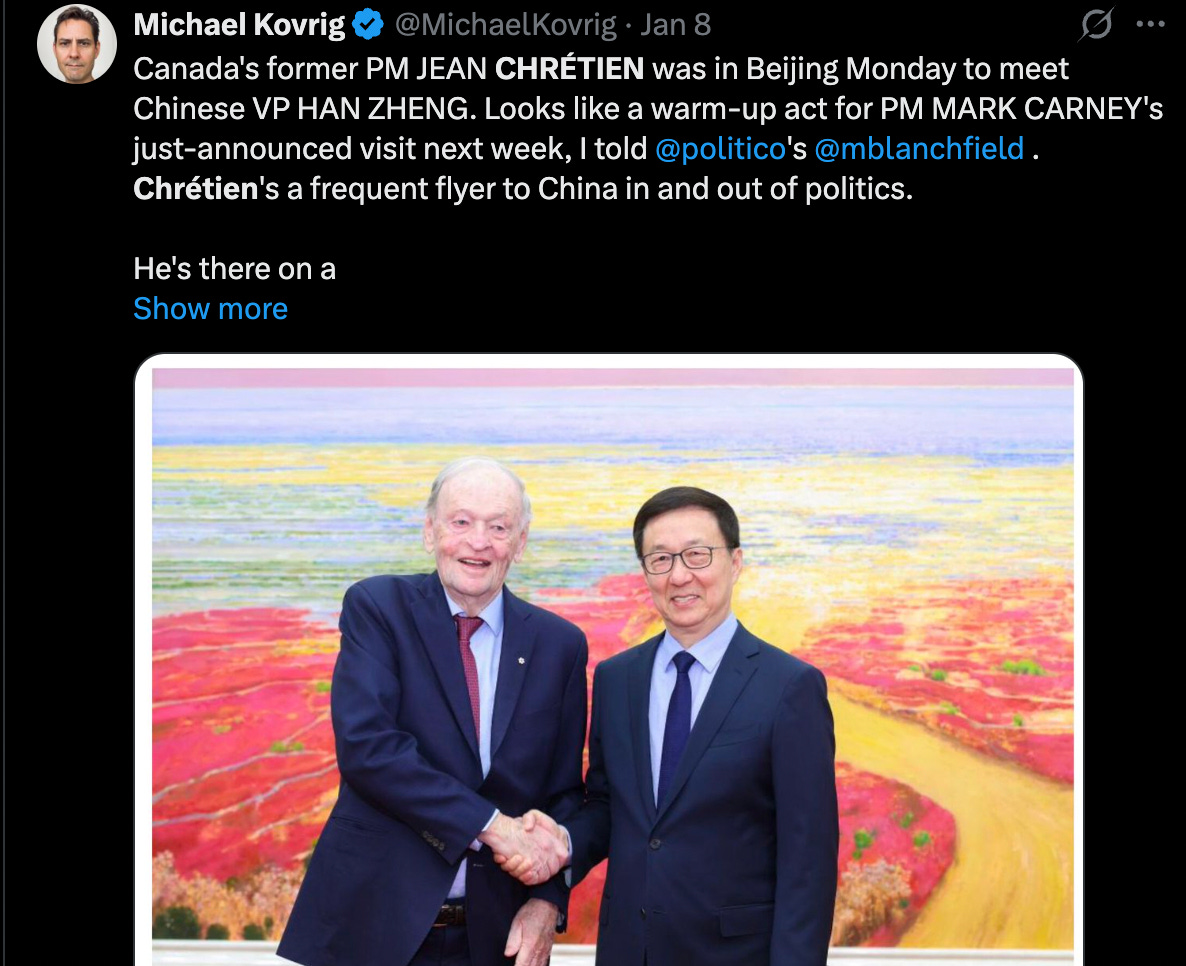
Kovrig notes that former Prime Minister Jean Chrétien was in Beijing to meet Chinese Vice President Han Zheng just days before Carney’s scheduled arrival — in what Kovrig described as a possible “warm-up act” ahead of Ottawa’s official mission.
Chrétien’s presence, Kovrig observes, is private, not official, but supported by longstanding ties to the Canada–China Business Council and elites such as Montreal’s Power Corporation, a firm with deep connections to Canada’s political establishment.
As historian Dennis Molinaro, a former national security analyst, details in his new book Under Assault, Power Corporation and related business networks have been overarching forces of pro-Beijing engagement, exerting influence across generations of Canadian leadership from Pierre Trudeau and Jean Chrétien to Brian Mulroney and Justin Trudeau.
Kovrig suggests that same network now surrounds Carney’s trip to Beijing, adding that “Chrétien’s a frequent flyer to China in and out of politics.”
“One can imagine he’ll try to set the tone for discussions and determine the scope of what may be possible at the official meetings next week,” Kovrig posted to X, urging Canadians to view the circumstances with skepticism, given the former prime minister’s “close ties to Power Corp. and the Canada-China Business Council.”
Kovrig noted that “Chrétien served on the board of Power Corp., which has historic links to the Liberal party, and his daughter is married to André Desmarais, deputy chair of the financial services company.”
“Looks like an effort by certain business interests to deepen trade and investment,” Kovrig assessed, adding that “Canadians should watch closely what sort of dealmaking follows.”
A similar warning was delivered in Toronto by Brian Lee Crowley, head of the Macdonald-Laurier Institute, in a 2025 Toronto Democracy Forum speech titled “Authoritarian Threats to Canada,” in which he argued that Canada’s commercial establishment has repeatedly pushed national-security concerns aside in dealings with Beijing.
He cited a stunning example in a reported directive conveyed to the late David Kilgour upon Kilgour’s appointment as Minister of State for Asia-Pacific.
“Kilgour told me that when he was appointed… his first visit was from a representative of the Prime Minister’s Office who wanted to make sure that Mr. Kilgour, the Minister of State for Asia-Pacific, would not get any ideas above his ministerial station,” Crowley recounted. “Our policy toward China, he was told in no uncertain terms, is not set at the Foreign Ministry, not set in the Prime Minister’s Office, but at the headquarters of Power Corporation in Montreal.”
Crowley added that he faced similar pressure in Western Canada after his institute opposed the Chinese National Overseas Oil Corporation’s bid for Nexen, saying he was told “national-security considerations… were to take a back seat… because we needed to fetch top dollar from Chinese state-controlled buyers.”
Underscoring the same message echoed by the human-rights coalition, Kovrig posted yesterday that Canada’s delegation should also call for changes in the Party-state’s treatment of ethnic minorities such as Uyghurs and Tibetans, dissidents like Wang Bingzhang, lawyers including Xu Zhiyong and Ding Jiaxi, and journalists such as Dong Yuyu — as well as South China Morning Post reporter Minnie Chan.
“Where is Minnie Chan?” Kovrig wrote on X. “The SCMP reporter has been missing since 2023. She may be in the same place I was.”
In a volley of posts, Kovrig argued that the line Prime Minister Carney and his networks now take in Beijing is “not only about defending universal human values,” but also “a matter of national security and sovereignty.”
Expanding on the point, he wrote that human rights “aren’t a separate issue that can be tidily compartmentalized into perfunctory dialogues.” From detaining individuals to oppressing groups to coercing countries, Kovrig said, the PRC’s violations “are an inextricable part of a continuum of geopolitical, geoeconomic, and global security challenges its one-party state increasingly poses.”
“How the CCP behaves toward people it governs, detains, or dislikes,” Kovrig continued, “is a preview for how it’s likely to deal with other citizens and countries it acquires power over. The Party-state interprets silence as acquiescence — emboldening it to grind further into aggression, totalitarianism, and the weaponization of its political-legal system.”
Editor’s note: This story was updated shortly after publishing to include additional remarks from Brian Lee Crowley of the Macdonald-Laurier Institute.


Unfortunately Canadians for the most part do not care. They are not smart enough to understand the overall implications and they want Carney to punish Trump. Carney is a man who is full of himself, he has a love of China and a historical dislike of the USA. The types of deals he makes will be watched and reported. Given that we share the 49th parallel with the states any deal that remotely impacts the sovereignty and security of the USA will not go down well. There can be no strategic partnership with China while we have the United States as our neighbour.
Don't expect a cdn prime minister to stand up & criticize China, China owns them all!