

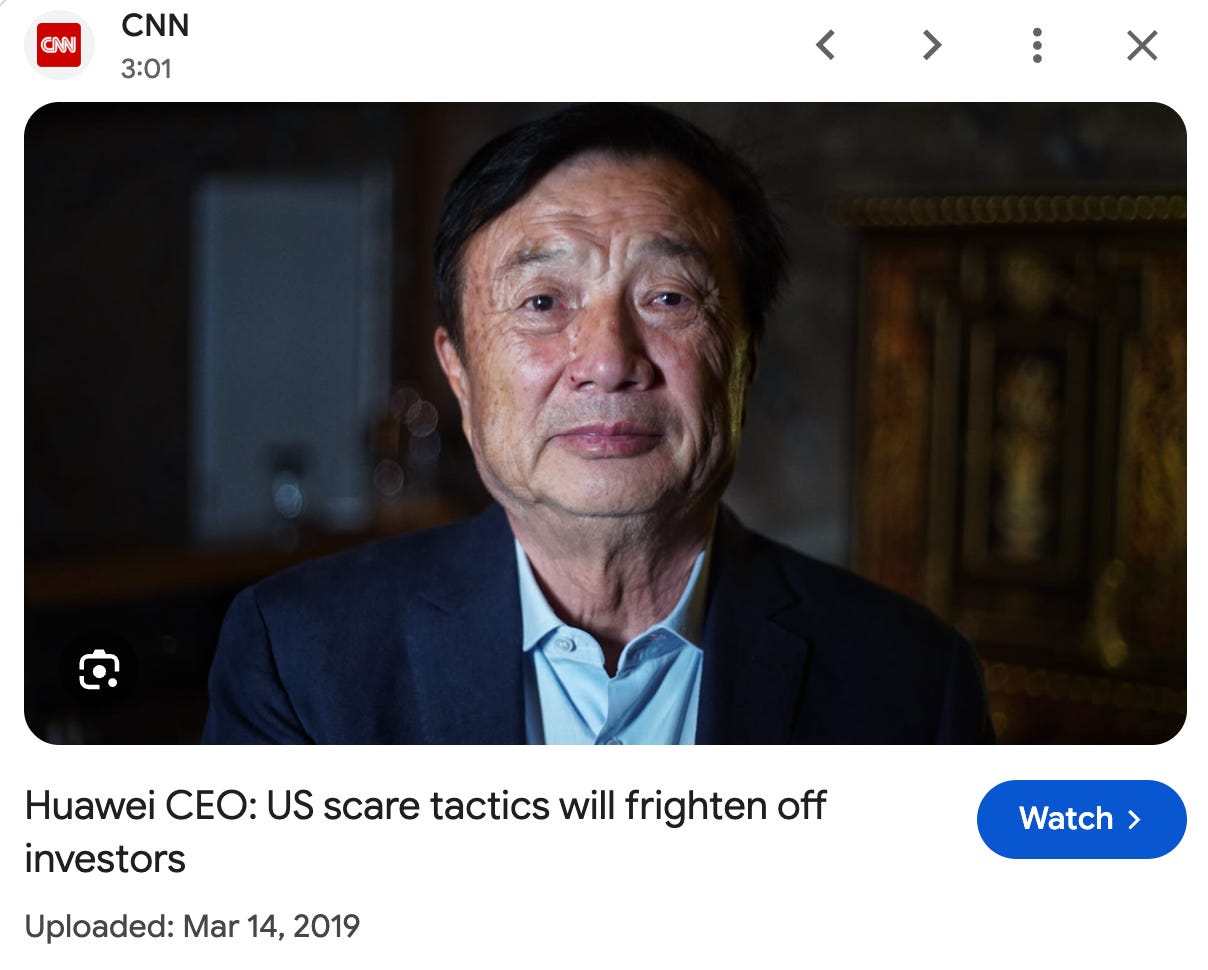
BROOKLYN, New York — The agents had been trying all day to get Ren Zhengfei alone. Every time they approached the founder of Huawei, he was surrounded by a larger group of people.
So, in the early hours of July 11, 2007, they called his room at the St. Regis hotel in Midtown Manhattan and asked him to come downstairs. He told them he had a 6 a.m. flight. But he agreed to meet them, accompanied by two female associates.
“It was late at night, early in the morning,” former Federal Bureau of Investigation agent Timothy Lucey told jurors in Huawei’s racketeering trial on Thursday.
For 45 minutes to an hour, in a seated lounge area of the hotel lobby, Ren answered questions through an FBI Mandarin language specialist. He showed his Chinese passport and handed over a business card identifying him as chief executive and president of Huawei Technologies Co., Ltd.
“He was pleasant. He was cooperative,” Lucey said. His testimony offered no further information about the two women who accompanied Ren during the interview.
Lucey recounted what Ren told them on the central questions.
Asked whether Ren had said whether Huawei dealt directly with any Iranian company, Lucey answered: “He indicated that they did not directly deal with Iranian companies.”
Asked whether Ren had said whether Huawei protects intellectual property rights, he said: “He indicated that they protect intellectual property rights, yes.”
Then Lucey described a moment the agents had not planned. They had intended to ask Ren about a Huawei employee caught photographing a competitor’s equipment at a trade show a few years earlier. Ren brought it up first.
“When we were speaking with Mr. Ren, he actually voluntarily provided the information that an employee of Huawei was at a trade show in Texas and was taking photographs, was caught taking photographs of technology that he shouldn’t have been taking pictures of,” Lucey testified. “He broached the subject before we had the opportunity to get to that series of questions.”
Ren was “relaxed,” Lucey said. “He was conversational, agreeable.”
“Mr. Ren indicated that he knew it was unlawful to be taking pictures in those instances and, in part, voiced that he didn’t necessarily agree with those laws,” Lucey told jurors. “He essentially indicated that simply taking a picture of the exterior parts, superficial, didn’t really reveal anything of a sensitive nature, that you really would need to get within the component to be able to see that, the restricted or sensitive technology.”
Asked whether Ren acknowledged that the inside components could be proprietary to a competitor, Lucey said: “Yes, he did.”
The employee was fired, Ren told the agents. “He discussed the fact that there was negative publicity revolving around this incident and he was ultimately fired,” Lucey said. Asked whether Ren offered any proof, he said: “No, I don’t recall so.”
Prosecutor Meredith Arfa then asked about details Ren had not mentioned. Did he say the employee had tried to photograph the inside parts of the competitor’s device?
“I don’t remember him telling us that either,” Lucey said.
Arfa pressed on, to what the employee had been wearing. “Did Mr. Ren tell you that the Huawei employee who took the photos was not wearing a Huawei badge?” she asked. Huawei’s lawyer objected, and the judge sustained it. Arfa tried again: “Did Mr. Ren tell you that the employee was wearing a badge that said ‘Wei Hua’?” Huawei’s lawyer objected again, and the judge again sustained.
Lucey answered neither question. “Wei Hua” reverses the two syllables of Huawei’s name.
Lucey spent a little more than 22 years with the FBI.
He started in foreign counterintelligence and retired in June as a supervisory special agent and chief division counsel of the bureau’s New York office. He was not the lead agent on the Huawei case in 2007. He assisted with the interview and interviewed Ren only once.
The government’s superseding indictment alleges that in that interview, Huawei’s founder, identified as “Individual-1,” “falsely stated” that Huawei “did not conduct any activity in violation of U.S. export laws” and “had not dealt directly with any Iranian company.” It also alleges that he falsely claimed Huawei had “won” a lawsuit with a company identified only as Company 1, whose chief executive, he said, would “testify” that Huawei “did not engage in intellectual property rights violations.” Huawei has pleaded not guilty and denies the allegations.
On cross-examination, Huawei lawyer Katya Jestin took the jury back through the night. Lucey agreed the interview was “almost twenty years ago.” He had not spoken to Ren since. Prosecutors had not contacted him until August of this year.
The agents had no appointment, Lucey agreed. They called Ren’s room after midnight. He came down voluntarily and “could have refused.” He had no advance notice of the topics, consulted no colleagues and reviewed no documents.
The interview was not recorded, videotaped or taken down by a court reporter. Lucey’s partner, not Lucey, drafted the FBI report, which Lucey agreed was “not a verbatim transcript of the interview and the responses.” Asked whether it was fair to call it a general summary, he said: “That’s fair.”
Ren’s daughter, Meng Wanzhou, Huawei’s chief financial officer, is not appearing at the trial.
As The Bureau has reported separately, a classified Canadian Security Intelligence Service assessment described a pressure campaign by China’s Ministry of State Security to prevent Meng’s extradition from Canada, driven in part by Beijing’s concern that she could cooperate with American authorities.
In 2022, the Justice Department charged two suspected Chinese intelligence officers with trying to obstruct the Huawei prosecution, the Associated Press reported. They sought confidential information about witnesses, trial evidence and potential new charges from a U.S. government employee who was working as a double agent under FBI supervision.
Parts of the trial have been closed to the public. U.S. District Judge Ann M. Donnelly ordered the courtroom closed for three witnesses in September, with redacted transcripts to follow.
Companies and industries cooperating in the theft of intellectual property with the CCP? I don't believe it! Mark Carney, Canada's own Lord Farquaad, would NEVER suggest increasing trade with a country that spies, steals and cheats, now would he? WOULD he? Nah....I don't believe it for a second. The CBC and CTV and the Globe And Mail would tell us if Farquaad was in cahoots with the communists. Wouldn't they? LOL!