


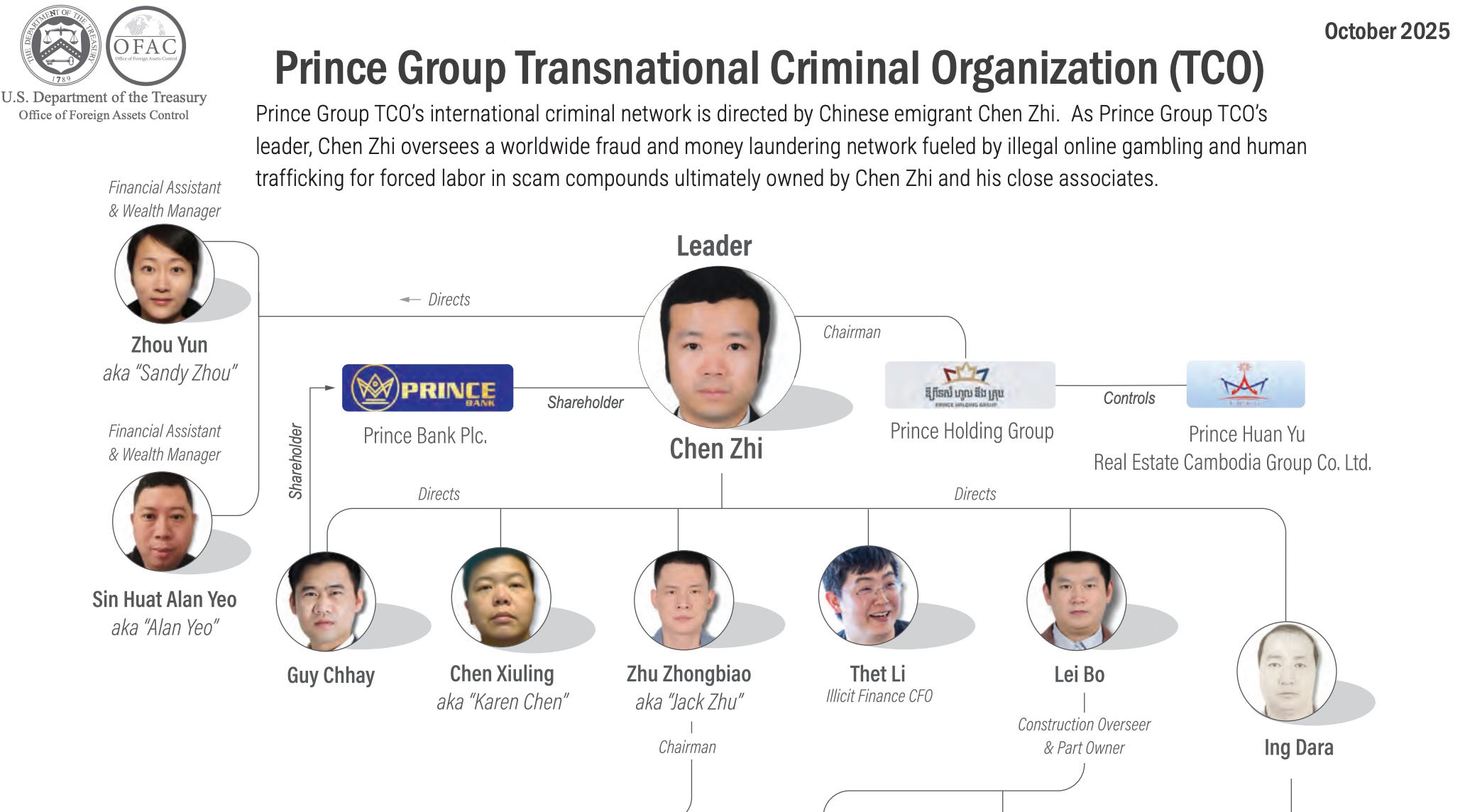
WASHINGTON — When United States prosecutors moved last October to seize roughly 127,271 bitcoin — about $15 billion, the largest forfeiture in American history — the headlines fixed on the number. But The Bureau’s investigation into Chinese-run Cambodian scam compounds — operations that prey on Western citizens — finds something more explosive buried in hundreds of case records.
These allegations, outlined in a 68-page complaint, implicate elements of Beijing’s national security apparatus in protecting one of Asia’s largest criminal organizations, a network that bought its safety from inside China’s two most powerful security ministries and built its fortune in a place the United States could not reach.
Similarly, a scan of more than 400 filings raises claims that part of Chen Zhi’s global enterprise included a bitcoin-mining operation, backed by Chinese investors, in the geostrategically consequential theater of Iran — one that, according to some litigants, implicates Iran’s terror networks.
On the night Chinese state television broadcast his return to China this past January, Chen Zhi was already in the custody of the Ministry of Public Security — the very police force the United States says he had paid to look away.
It is a contradiction — a politically connected Chinese criminal allegedly paying Chinese police for protection, then being returned by that same police force beyond U.S. reach — that echoes through criminal cases and sanctions actions brought across multiple agencies in Washington, where lawmakers have focused extraordinary attention on Chen Zhi’s case.

Washington’s allegations are made still more sensitive by the controversial cooperation agreement signed between Canada’s federal police, the RCMP, and the MPS under Prime Minister Mark Carney’s January 2026 “strategic” partnership with Beijing — several months after the Chen Zhi case was filed in the United States.
Meanwhile, French media reported Wednesday that nine clandestine police stations operated by China's Ministry of Public Security were shut down on French soil in early 2026, following a year-long national security investigation. MPS proxies were "tasked with monitoring the Chinese diaspora and tracking down regime opponents to forcibly return them to China," Le Monde reported.
According to the complaint filed in the Eastern District of New York, Chen Zhi, the Chinese-born chairman of Cambodia’s Prince Holding Group, and his co-conspirators “used their political influence to protect the scam operations from law enforcement in multiple countries, including from the Chinese Ministry of Public Security (’MPS’) and Ministry of State Security (’MSS’).” Prince Group executives, the same paragraph alleges, “bribed public officials for information in advance of law enforcement raids” on the company’s forced-labor scam compounds.
That detail alone appears to speak to the reach of China’s security apparatus into Cambodian police operations.
The inference follows from the U.S. government’s contention that the Ministry of State Security — widely described as the world’s largest civilian intelligence agency — and the Ministry of Public Security, the Beijing-controlled police agency accused of running secret police stations in New York City and across the West, including Canada and France, had the power to protect Chen Zhi from enforcement raids in Cambodia.
For some time, flags of Chinese-state involvement with Chen Zhi’s transnational network have surfaced in sanctions and in a Radio-Canada investigation citing a defected officer of China’s Ministry of Public Security who placed that ministry — tied to transnational repression — within the tentacles of Prince Group operations.
But The Bureau‘s review of hundreds of filings in the U.S. government crypto-seizure case makes these ultra-sensitive Chinese state ties explicit.
The amounts of scam proceeds extracted from Western victims and allegedly flowing back to government officials were massive, too.
“Chen maintained ledgers of bribes to public officials, including a ledger that tracked hundreds of millions of dollars in reimbursements to Prince Group associates for bribes and luxury purchases,” U.S. government filings allege.
That ledger showed, in the prosecutors’ telling, that in 2019 a Chen associate described only as “Co-Conspirator-2” — a citizen of Cambodia and Cyprus who resided in Singapore and the United States, and who was said to be in contact with MPS officials — “purchased a yacht for a senior official of a foreign government worth more than $3 million.”
The arrangement, as the government describes it, effectively wired the managers of a global fraud and money-laundering enterprise — one preying on American citizens — directly into elements of the Chinese state.
Chen had tasked that same deputy with running what the filing calls a “risk control” function, built to “monitor investigations and engage in corrupt bargaining with foreign law enforcement officials.”
In May 2023, prosecutors say, he spoke with a Ministry of Public Security official who could get Prince Group associates “off the hook”; in return, he offered to “take care of” the official’s son.
Two months later, the complaint alleges, the same lieutenant told a Chinese law enforcement official to turn the police on Prince Group’s commercial rivals: “Tell the police to rob places, and then go to talk to them about protection, in my company’s and my name. Rob them first and then protect them.”
Whenever crackdowns reached his own scam compounds, he boasted, nothing ever happened to “us.”
Chen himself, the filing says, “boasted to others of his arrangements with the MSS to be informed of law enforcement actions in exchange for bribe payments.”
