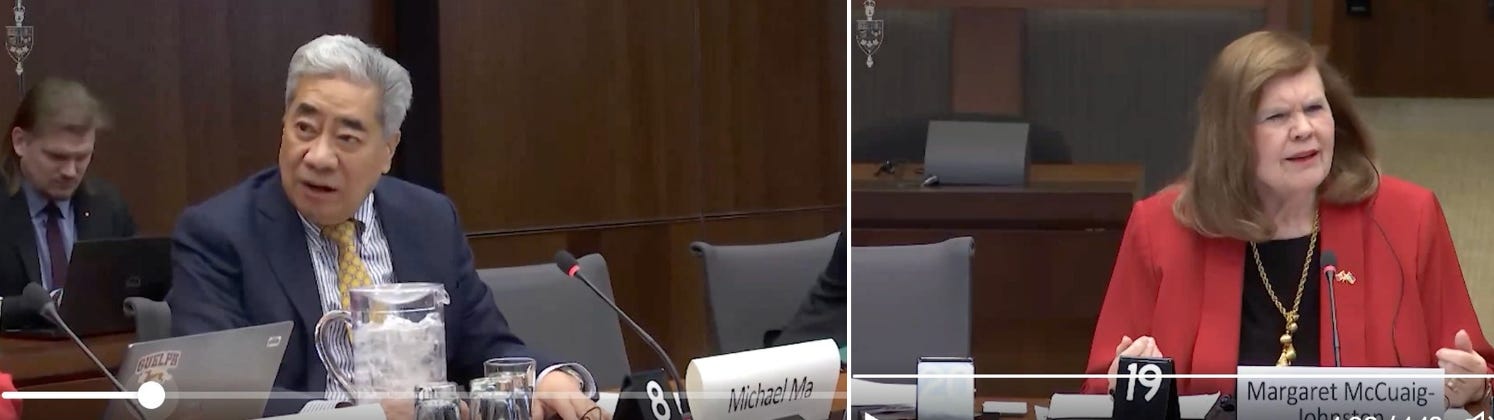
'Have You Witnessed Forced Labour?' Floor-Crossing Liberal MP Michael Ma Challenges Former Senior Canadian Official and China Expert
OTTAWA — A Liberal member of Parliament who crossed the floor from the Conservative Party to support Prime Minister Mark Carney’s government — and whom Carney subsequently chose to accompany him on a trade mission to Beijing — used his time at the Industry Committee on Thursday to abruptly challenge a senior former federal official’s credibility on China and demand she confirm whether she had personally witnessed forced labour in Xinjiang.
The broader context surrounding Michael Ma’s political trajectory has been the subject of sustained investigative reporting by The Bureau.
The Chinese Canadian Conservative Association — of which Ma was listed as a director in 2019 — is identified in the Jamestown Foundation’s landmark study published this year as part of the Chinese Communist Party’s overseas United Front influence network.
The report names the organization explicitly among political party-focused United Front groups designed, in the study’s words, to ensure Beijing can address all sides of the political spectrum regardless of which party holds power. The same association orchestrated pressure campaigns calling for the resignation of two successive Conservative leaders — Erin O’Toole and Pierre Poilievre — over their stances toward Beijing.
Ma’s floor crossing in December 2025 came directly in the wake of the Paul Chiang scandal: Chiang, the Liberal incumbent in the Markham riding that Ma won as a Conservative, had been forced to step down as a candidate after acknowledging he had suggested Joe Tay — the Conservative candidate targeted during the 2025 federal election by Hong Kong national security authorities with online “wanted-style” campaigns and safety threats — could be handed over to Chinese diplomats in connection with a Hong Kong bounty.
Ma was then elected as a Conservative in the subsequent contest, replacing the Liberal incumbent Paul Chiang, before crossing to become a Liberal months later.
The exchange on Thursday struck some online observers as extraordinary, in part due to the standing of the witness: Margaret McCuaig-Johnston, a 37-year veteran of the federal public service who served on the Canada-China Joint Committee on Science and Technology for the final seven years of her government career, holds a master's degree in International Relations with a focus on China, and has visited China multiple times since 1979.
Michael Ma, the member of Parliament for Markham-Unionville, opened his questioning by asking McCuaig-Johnston whether she held an advanced degree in cybersecurity — framing it as a yes-or-no question. She replied that she did not, but added: “I have spent 37 years in that business. Ok.”
Ma interjected repeatedly, pressing her for “short answers.” He noted that she is affiliated with the China Strategic Risk Institute, a line of questioning that appeared designed to suggest the witness was professionally predisposed to identify threats emanating from Beijing.
He then asked: “This question then, is — you claim about forced labour in Xinjiang. Have you witnessed this yourself? Have you been there ever?”
McCuaig-Johnston replied that she had been to China many times, since 1979. Speaking over her answer, Ma pressed again: “Have you witnessed forced labour? Just a short answer. Have you witnessed forced labour in Xinjiang?”
Visibly taken aback, McCuaig-Johnston said: “I work closely with Human Rights Watch, where researchers did witness it.”
Ma spoke over her, saying “so did you get that from hearsay” — and ended with a curt “Thank you.”
The technique — demanding that a witness confirm personal firsthand observation of an atrocity as a threshold condition for the credibility of documented evidence — is not a standard of proof applied in any parliamentary inquiry or human rights investigative framework. Human Rights Watch, the United Nations, the United States government, and multiple allied democracies have each independently documented the forced labour system in Xinjiang through researcher testimony, satellite imagery, leaked internal documents, and survivor accounts.
Commenting later on social media, McCuaig-Johnston wrote: “Mr. Ma says he doesn’t believe it because it was written in a report. He has to see it with his own eyes. I told him the Chinese would never show him forced labour but @hrw has people on the ground. I gave him their very rigorous report Asleep at the Wheel.”
As reported by The Bureau in September 2024, Canada’s lack of diligence in blocking forced labour products from Xinjiang had already become a sticking point in relations with Washington.
Then Trade Minister Mary Ng, who also held a Markham-area riding, found herself at the center of growing concerns from U.S. lawmakers, who were raising alarms about Canada becoming a backdoor for goods produced with forced labor in Xinjiang region, according to a letter from a bipartisan group of U.S. congressional leaders.
The letter, signed by Senators Marco Rubio and Jeff Merkley, hinted at consequences for Ottawa ahead of the 2026 review of North American trade agreements.
Responding to the Ma controversy later Thursday, Conservative Member of Parliament Michael Chong demanded the government clarify whether it still assesses that Uyghur forced labor is taking place in China’s Xinjiang province — the finding that underpins sanctions on a Chinese entity and four officials, imposed after Parliament’s 2021 vote to recognize the Uyghur genocide. The government’s answer, Chong warned, carries consequences for the validity of those sanctions, for Xinjiang imports under the free trade agreement’s forced labor ban, for the Canada-United States-Mexico Agreement review, and for bilateral trade at a moment when Washington continues to assess that the forced labor is ongoing.
Meanwhile, regarding Ma’s questions on the matter in Ottawa Thursday, Michael Guglielmin, a Conservative MP, wrote on social media that Ma had used his committee time “to attack a witness and cast doubt on well-documented human rights and forced labour abuses in Xinjiang,” adding that it was “unacceptable from any Canadian member of Parliament” and that “Canadians expect MPs to stand up for human rights, not run cover for the Chinese regime.”
Jason Kenney, the former federal cabinet minister and Alberta premier who has known Ma personally for two decades, wrote that the exchange explained “a lot,” and urged journalists to ask Ma whether he had discussed the hearing with anyone at the People’s Republic of China Embassy.
The committee hearing unfolded on the same day that Hong Kong Watch’s advocacy officer, Landson Chan, testified before the Subcommittee on International Human Rights on transnational repression targeting Hong Kong diaspora communities in Canada. Chan’s testimony named Joe Tay as a documented case of Beijing-directed transnational repression on Canadian soil, noting his campaign had been targeted with online threats and “wanted-style” imagery during the 2025 election.


It was an incredible line of questioning designed to discredit Ms. Johnson who is personal friend and colleague. Ma carrying water for the PM and China seems to either me naive, stupid or is acting as an agent for the CCP in parliament.
You choose
CCP agent.