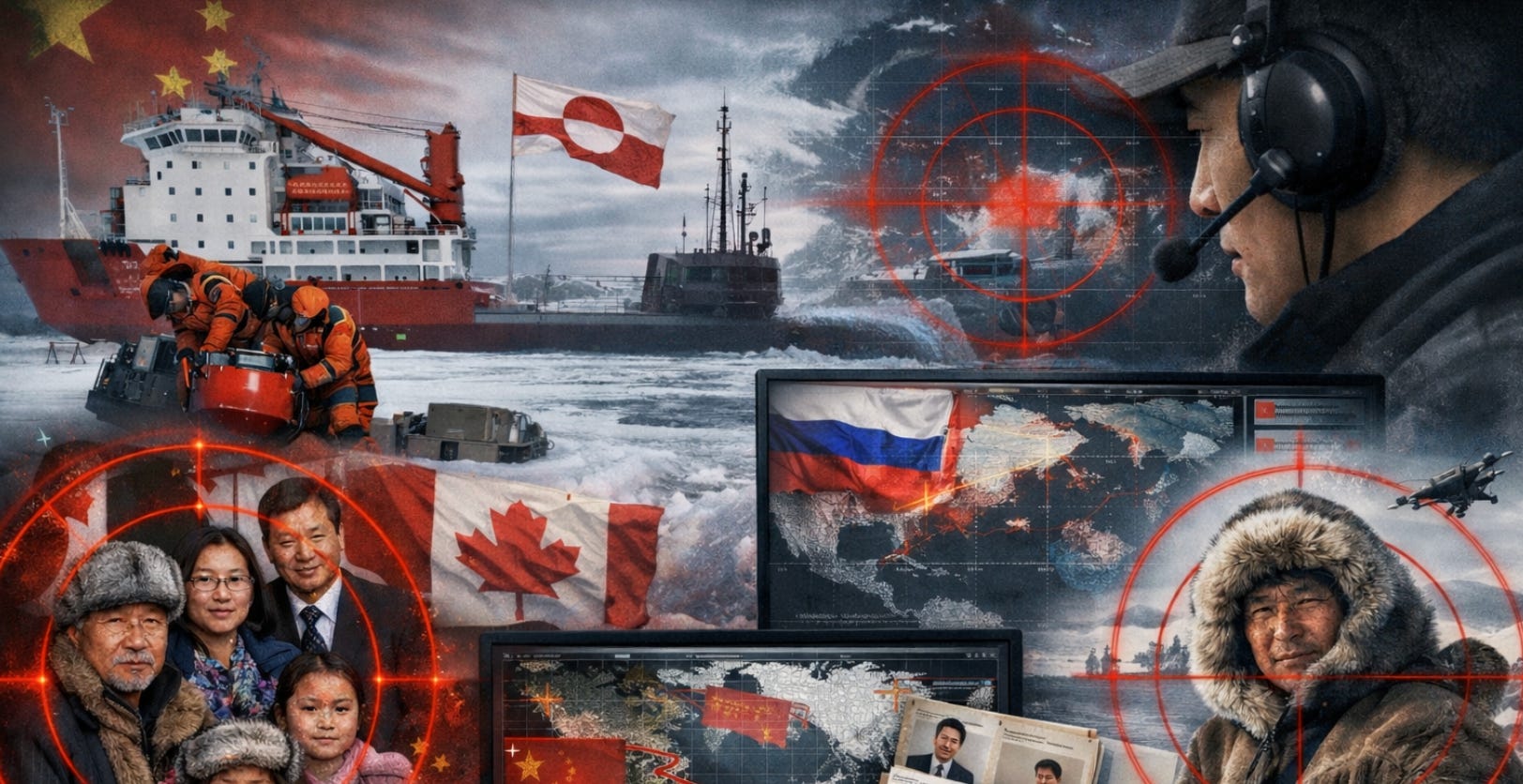
Greenland Is the Flashpoint: China and Russia Test NATO, Canada, and Indigenous Arctic Jurisdictions
Op-Ed: Security consultant Ian Bradbury argues NATO’s Arctic posture is performative, while Russia operates below the ice and China probes the gray-zones.
OTTAWA — The Arctic is no longer a margin. It is a hinge. It anchors nuclear deterrence, opens future maritime routes, and holds resources vital to global economies.
Over time, NATO Arctic countries have deployed forces, conducted exercises, and invested in infrastructure, but these measures have not kept pace with Russian and Chinese activity, evolving operational risks, and shifting environmental dynamics. Russian under-ice submarine operations, Chinese dual-use activity, and growing pressure on Arctic infrastructure are expanding as ice coverage shifts and navigable waters increase.
NATO’s actions remain reactive and episodic; structural lag, political friction, and uneven capability prevent a truly forward-leaning, integrated presence. In a region where NATO should already dominate, adversaries are increasingly shaping the operating environment on their terms.
These challenges became more visible in recent weeks when the United States again raised the prospect of unilateral action regarding Greenland, citing Russian and Chinese threats and vulnerabilities in the Arctic as affecting U.S. security interests.
Denmark and Greenland rejected the proposal, reaffirming sovereign defense arrangements within NATO. Other Arctic allies responded differently. Germany and Norway expressed alignment with the U.S. assessment that Arctic security now requires stronger and more persistent allied capabilities.
Canada, Iceland, the Netherlands, and the United Kingdom emphasized coordinated NATO approaches rather than unilateral action. Some former senior leaders expressed direct support for the U.S. administration’s strategic assessment.
The reactions were mixed, but the underlying reality was not. Greenland may be the immediate focal point, but the strategic problem spans the entire Arctic, from northern Canada to Svalbard and Norway’s Arctic territories. NATO’s responsibility covers the whole region, and protective measures must be meaningfully strengthened. Political hesitation and episodic initiatives across time have left gaps adversaries are actively exploiting for surveillance, mapping, and operational familiarization.
Russia and China are not waiting for allied consensus or timetables.
Russia maintains extensive Arctic bases, under-ice submarine operations, long-range strike capabilities, and layered air and missile defenses. Russian forces routinely probe NATO Arctic air, maritime, and undersea spaces, integrating exercises, electronic surveillance, and mapping to accelerate operational familiarity.
Russia also integrates Arctic posture into its broader nuclear escalation planning. China, while lacking an overt permanent military presence in the Arctic, actively conducts dual-use operations and research, ice-class shipping, illegal and unsustainable commercial fishing, technology and investment leveraging—often through proxy entities—and coordinated activity with Russia across military and civilian domains, including cyber and gray-zone operations. These activities create persistent presence, intelligence collection, operational advantage, and economic leverage while reshaping operational and political thresholds in the region.
China is already a structural Arctic actor, not merely a future threat.
Environmental shifts are no longer background conditions. Shorter ice seasons and longer navigable periods act as operational and risk accelerants. Maritime and commercial traffic is expanding through under-monitored and lightly governed waters. Sea lanes and resources become more accessible, but so do opportunities for interference, coercion, and sabotage.
Undersea cables, natural resources, Arctic infrastructure, and territorial integrity remain exposed. Disruption is no longer hypothetical. Adversary activities—including hybrid interference, infrastructure sabotage, illegal fishing, and economic coercion—can cascade quickly, producing civilian, military, and economic consequences across NATO Arctic states.
Escalation in the Arctic is deliberate, deliberately ambiguous, and cumulative. Routine presence, exercises, and civilian-flagged activity are used by NATO adversaries to probe coverage, test thresholds, and impose operational friction. Dual-use platforms, shadow fleets, illegal fishing operations, and cyber activity combine to compress NATO warning and decision timelines. Escalation is increasingly mechanistic: a routine operation or civilian venture can trigger cascading responses across military, economic, and political domains, reducing NATO options and increasing costs.
The Arctic favors those who act continuously, not those who signal episodically.
NATO’s posture has yet to catch up. Periodic exercises and symbolic presence do not deter adversaries operating year-round, nor do they adequately protect the territorial integrity of Arctic spaces under NATO responsibility.
Credible and dominant deterrence in the Arctic requires persistent and resilient presence: continuous air, maritime, and undersea awareness; new and expanded permanent infrastructure capable of sustaining forces year-round; new and expanded Arctic-trained and equipped units; new and expanded integrated conventional, hybrid, and civilian capabilities; and regular, large-scale allied operations across the full NATO Arctic region.
Political alignment alone is insufficient.
Exercises that temporarily expand presence are also insufficient. Operational visibility, increased Arctic defense capacity, and sustained capability are what determine who controls outcomes. No NATO Arctic country can deliver this alone; gaps must be actively, meaningfully, and collectively closed.
Russia remains the most immediate conventional military threat. China is shaping access, dependencies, and norms while building Arctic-relevant capabilities for leverage today and tomorrow.
Both closely observe and exploit coverage gaps, insufficient safeguards, and allied hesitation. The Greenland episode illustrates the political complexity of Arctic security, but also the operational cost of delay. Even senior Western security figures outside government, including a former head of MI6, have publicly supported the strategic logic behind stronger U.S. Arctic engagement. While such views do not constitute allied policy, they reflect a clear understanding that Arctic threats and vulnerabilities are real, balance is shifting, and existing measures remain insufficient.
The Arctic is no longer peripheral. It is a live test of whether NATO can establish and sustain dominant deterrence in extreme environments, manage compressed timelines, contend with multiple critical fronts simultaneously, and counter competition that rarely presents itself as overt conflict. Continued under-investment, half-measures, and uneven coverage do not preserve stability. They risk turning the initiative to adversaries and ensure that when NATO decisions are required, they are made under pressure, with fewer options and higher costs.
The NATO Arctic region demands sustained, integrated, and operationally credible attention now. Not episodic exercises, nor measures designed merely to manage internal political friction. The window for shaping outcomes and establishing durable and dominant deterrence is narrowing.
Ian Bradbury, a global security specialist with over 25 years experience, transitioned from Defence and NatSec roles to found Terra Nova Strategic Management (2009) and 1NAEF (2014). A TEDx, UN, NATO, and Parliament speaker, he focuses on terrorism, hybrid warfare, conflict aid, stability operations, and geo-strategy.


Great summary article of why we need to wake up. The funny thing is Canada and other NATO countries wanting a unified Approach on Greenland. That is a joke- they want the benefits and to be involved but wont pay their NATO costs
The sooner the west realizes that the us is nato
The better off we will be .
All the far left wef Marxist want to be governments in the west absolutely need to go , they are weak cowards in my view .