

By Mehmet Tohti
Ottawa has been continuously warned that Canada is inextricably linked to forced labor within China’s seafood industry, yet a profound silence persists from the federal government. For years, the troubling narrative surrounding forced labor in China’s seafood sector was understood as a coastal issue. Investigators followed vulnerable Uyghur workers who were systematically transported thousands of kilometers away from their ancestral homes to fish-processing plants in Shandong, where they cleaned, cut, and packed seafood bound for North American and European supermarkets. While that reporting was shocking, it did not tell the whole story.
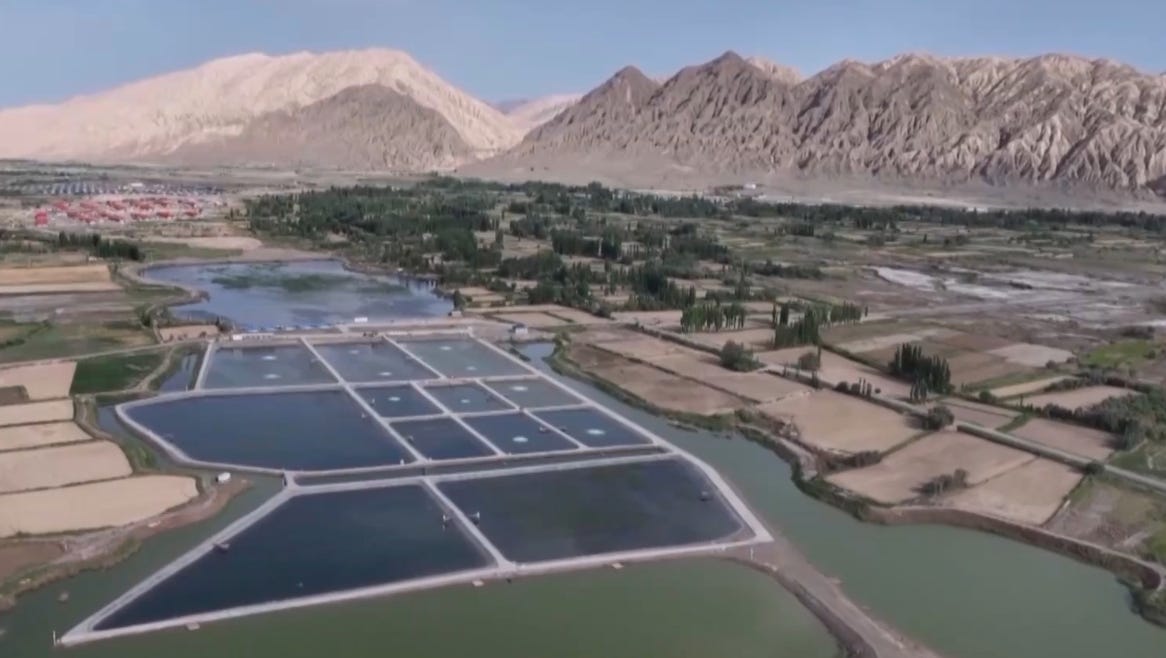
A report published by The Globe and Mail, stemming from a broader investigation by The Outlaw Ocean Project, reveals that the Uyghur homeland itself has become a center of this exploitative practice. Beijing calls the region Xinjiang, meaning “new frontier,” while Uyghurs call it their ancestral homeland. Deep within its deserts, a company called Xinjiang Tianyun Organic Agriculture raises fish for export, and Chinese state media praises the enterprise as proof that technology can conquer nature and distance.
A close look at public photographs reveals a harshly different reality. Villagers, who appear to be mostly settlers, are called on stage to receive trays piled with cash beneath a banner declaring Xinjiang a good place, a motto that has been consistently used to attract more Han settlers. Propaganda films document a local man opposing the fish farm who is arrested, sentenced, and then “saved” only after learning to support the facility, implying the total submission the government expects. These are not pictures of free workers; they depict an authoritarian system that rewards obedience and punishes resistance. This mirrors the same apparatus that has forced more than one million Uyghurs into camps, prisons, and forced-labor transfers since 2017—the same year Tianyun’s cash ceremonies began.
The company claims its workers are protected and dismisses U.S. forced-labor laws as politically motivated, but independent verification is impossible. China refuses to allow surprise inspections, while journalists and researchers are watched, blocked, or expelled. This year, China’s Ministry of Commerce blacklisted the Responsible Business Alliance, a major standards and audit organization. When facts cannot be independently checked, a company denial is merely a press release. Furthermore, China’s new State Council Decrees 834 and 835 allow Beijing to punish companies that cooperate with foreign supply-chain investigations, meaning scrutiny of forced labor, rather than forced labor itself, is treated as the offense.
Despite these barriers, the fish keeps moving. The Outlaw Ocean Project tracked Tianyun’s exports to more than a dozen countries, with executives bragging about global sales while some Chinese companies fraudulently sell rainbow trout as salmon. The path to Canada is clear. In 2022, Tianyun signed a US$140-million deal to sell salmon to Dalian Rich, a Chinese seafood company primarily serving foreign buyers. Trade records show that between 2022 and 2025, Dalian Rich sent at least seven shipments of salmon products to an importer in Vaughan, Ontario, supplying Canadian grocery stores, meaning Canadians may be unknowingly eating fish from the Uyghur region under different labels. The United States banned Tianyun’s products in August 2026, but Canada has done nothing.
Canada already possesses the tools to act. Since 2020, the Customs Tariff has banned imports made with forced labor. The Fighting Against Forced Labour and Child Labour in Supply Chains Act requires large companies to report these risks. Under the Special Economic Measures Act and the Justice for Victims of Corrupt Foreign Officials Act, Ottawa can sanction specific individuals and groups responsible for human rights abuses. Canada used the first of these in 2021 against Xinjiang officials.
Using these findings, the Uyghur Rights Advocacy Project and the Human Rights Action Group submitted two detailed sanctions requests to Global Affairs Canada under the Special Economic Measures Act, in December 2023 and September 2024. The requests named seafood-processing companies, squid-fishing vessels, and multiple individuals. Aside from a note that a review is underway, no answer has been received.
Silence is a choice. Every month without action means Canadian importers and shoppers may unknowingly participate in forced labor, sending Beijing the message that Canada’s import ban exists only on paper. The Canada Border Services Agency has blocked no more than two shipments over forced labor since 2020, and one of those decisions was overturned on appeal. Meanwhile, Uyghur families in Canada watch the world buy products made from their people’s suffering.
In 2021, the House of Commons voted unanimously to recognize China’s treatment of Uyghurs as genocide. Ottawa must now back up Parliament’s words with three vital steps.
First, finish reviewing our sanctions requests, impose the recommended sanctions, and closely examine Tianyun, Dalian Rich, and other linked producers.
Second, instruct the Canada Border Services Agency to treat seafood from the Uyghur region and seafood processed by transferred Uyghur workers as tainted unless proven otherwise, just as the United States requires.
Third, require seafood importers to clearly state the fish type, country of catch or farming, and processing location to prevent trout from being sold as salmon and Xinjiang fish from hiding behind middleman labels.
Beijing presents desert-farmed fish as a triumph, but it merely highlights unchecked authoritarian power. Canada has been asked to act, and it is time to answer.
Mehmet Tohti is executive director of the Uyghur Rights Advocacy Project in Ottawa and was sanctioned by the Chinese government in December 2024 for his human rights work.