From Montreal Labs to Tampa Streets: How a Canadian Synthetic Opioid Network Tied Chinese Precursor Suppliers to Mexican Cartel-Linked Indo-Canadian Gangs
TAMPA/MONTREAL — Almost two years after Canadian federal police raided two synthetic opioid labs in Quebec and seized millions of deadly pills, a 49-year-old Montreal-area man has been indicted on charges of importing a narcotic three times more lethal than fentanyl into the United States — a case that connects, through prior federal filings, to a Chinese fentanyl precursor supplier and Mexican cartel-linked trafficking network operating out of Vancouver.
Sebastien Rollin, a Quebec national known by the street alias “Stix,” was charged by federal grand jury indictment in the Middle District of Florida. If convicted on all counts, he faces a maximum penalty of 120 years in federal prison.
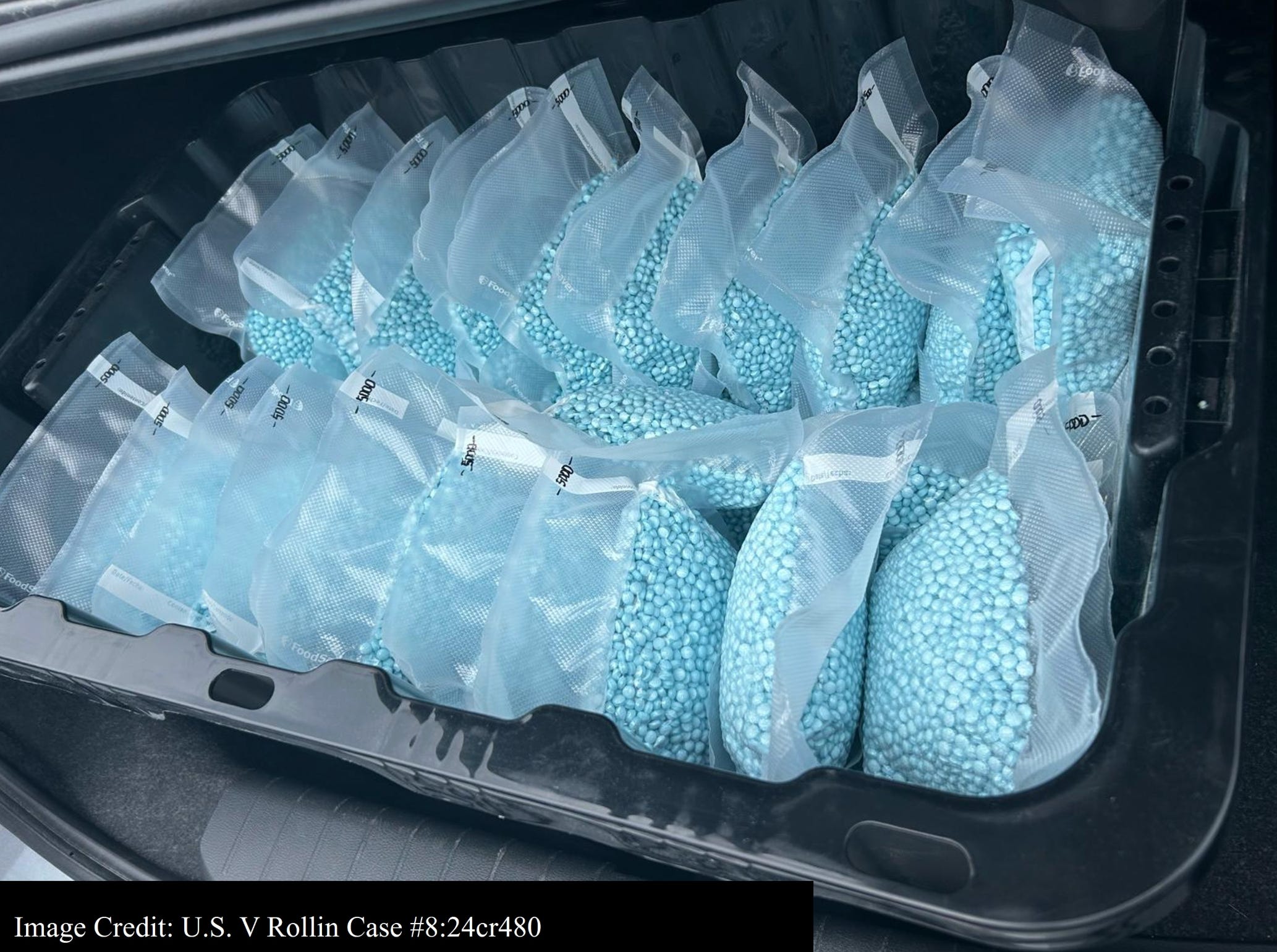
According to the indictment, Rollin began arranging the sale of synthetic opioid pills disguised as oxycodone, knowing the pills were destined for Tampa. On May 13, 2024, he sold more than 10,000 such pills to an undercover officer. On July 9, 2024, he sold 25,000 more. He accepted payment via cryptocurrency sent from an undercover wallet in the Middle District of Florida to Canada.
In mid-July 2024, Rollin negotiated the sale of 300,000 pills to buyers in the United States. The Royal Canadian Mounted Police stopped a courier vehicle and seized the shipment. That same day, the Mounties executed search warrants at two clandestine laboratories in Quebec used for manufacturing synthetic opioids, resulting in the seizure of millions of synthetic opioid pills, recipes for synthetic drugs, and a firearm.
Rollin was not in Canada when the labs were seized. He had fled, eventually making his way to Spain. The Spanish National Police located and arrested him, and on February 20, 2026, the Justice Department’s Office of International Affairs secured his extradition.
The drug at the center of the indictment — protonitazene — was identified in American toxicology samples in May 2021. Researchers estimate it is approximately three times more potent than fentanyl, and it has been linked to overdose deaths due to respiratory depression and, in documented cases, cardiac arrest.
The pills Rollin is alleged to have sold were disguised as M30 oxycodone tablets — the same counterfeit format that has driven mass overdose deaths across North America as fentanyl infiltrated the illicit pill supply.
The Rollin indictment carries an additional dimension in connection to a sweeping Drug Enforcement Administration arrest warrant affidavit filed in California in February 2024.
That document places Rollin inside the orbit of Opinder Singh Sian — a Surrey, British Columbia gangster whom the DEA described as a central node in a narcotics web. When The Bureau reported on the Sian affidavit in detail, the picture that emerged was of a single DEA investigation threading through Australia, Turkey, Mexico City, Dubai, Toronto, Vancouver, Montreal, Hong Kong, and Los Angeles.
In the affidavit, DEA special agent Al Polito identified Rollin as one of Sian’s co-conspirators during the summer of 2023, when Sian’s network was arranging large methamphetamine drops to a DEA confidential source in Southern California. According to the affidavit, it was Rollin who told the source that his people would be dropping off 30 pounds of methamphetamine in Los Angeles — a delivery that took place on June 22, 2023, with the seized material testing at 97 percent pure methamphetamine.
During a February 2023 meeting in Vancouver, Sian told the DEA source that in Canada he worked with Irish organized crime — specifically the Kinahan family — as well as Italian organized crime and other Canadian organized crime groups, and that he sourced narcotics through contacts with drug cartels in Mexico and South America.
What followed was among the most consequential moments in the DEA’s three-year investigation. In August 2023, the undercover source known in the affidavit as “Queen” sat across from a man in Vancouver speaking with a thick Chinese accent. The man, later identified as Peng Zhou, explained calmly how he could receive fentanyl precursor chemicals from China into Vancouver and move 100 kilograms per month to Los Angeles via a British Columbia trucking company run by an Indo-Canadian associate. He had been doing it, he said, for about ten years. He knew how to synthesize fentanyl and methamphetamine from the precursors himself. He required payment upfront.
The affidavit’s framing of that meeting is telling in its details.
Sian had first taken the undercover source to dinner at a downtown Vancouver restaurant — his wife and child at the table — before walking the source to a nearby coffee house to meet his chemical suppliers. The domestic tableau giving way to a narco procurement meeting captures something essential about how Vancouver’s transnational drug infrastructure operates.
Not in shadows, but in plain sight.
That encounter provided prosecutors with among the most granular pictures yet of a direct pipeline from Chinese chemical suppliers into North American distribution networks, routed through Vancouver’s port and trucking corridors — precisely the architecture The Bureau has documented across years of investigation into Chinese Communist Party-linked precursor networks operating in Canada.
Sian, 38, was arrested in July 2025 and pleaded guilty in November 2025 in United States District Court for the Central District of California, admitting to conspiring to export methamphetamine from the Port of Long Beach to Sydney, Australia.
Commenting on the case previously, former Canadian intelligence analyst Scott McGregor posted to X: “Local gangs like Brothers Keepers aren’t just street crews — they’re frontline proxies in transnational narcoterror networks. Ignoring them as low-level threats misses their role in laundering, logistics, and hybrid warfare.”


“ Sebastien Rollin, a Quebec national …”
That may be possible in a few years, but for now I think he’s a Canadian citizen from Quebec.
It’s no wonder crime has become so rampant. We all know China, Iran, India and Russia are not sending their best citizens to Canada. The more I hear and see of this corruption destroying our communities and children’s lives the more I believe in El Salvador’s prison system. Time to focus on victims and not criminals, if you commit the crime you deserve the punishment otherwise there are absolutely no deterrents in Canada we’re simple an international joke!