By Phil Gurski
OTTAWA — Twenty-five years ago, many of us witnessed an event that changed the world — and us — irrevocably. To label anything “world-changing” is fraught with danger. What exactly changed? Were these changes truly global in nature? Why does an occurrence in one country — the United States — qualify as such?
Given the enormity of the 9/11 attacks — the deadliest single terrorist attack in history — and their aftermath, I believe it is fair to call this an event whose impacts and implications reached the four corners of the planet. More narrowly, it led to the so-called “War on Terror,” which involved dozens of countries on every continent except Antarctica, but also spawned a whole industry of actors engaged in various aspects of counter-terrorism, ranging from military operations to programmes designed to prevent radicalization. Few countries were immune to its effects.
So, where are we now, a generation after 9/11?
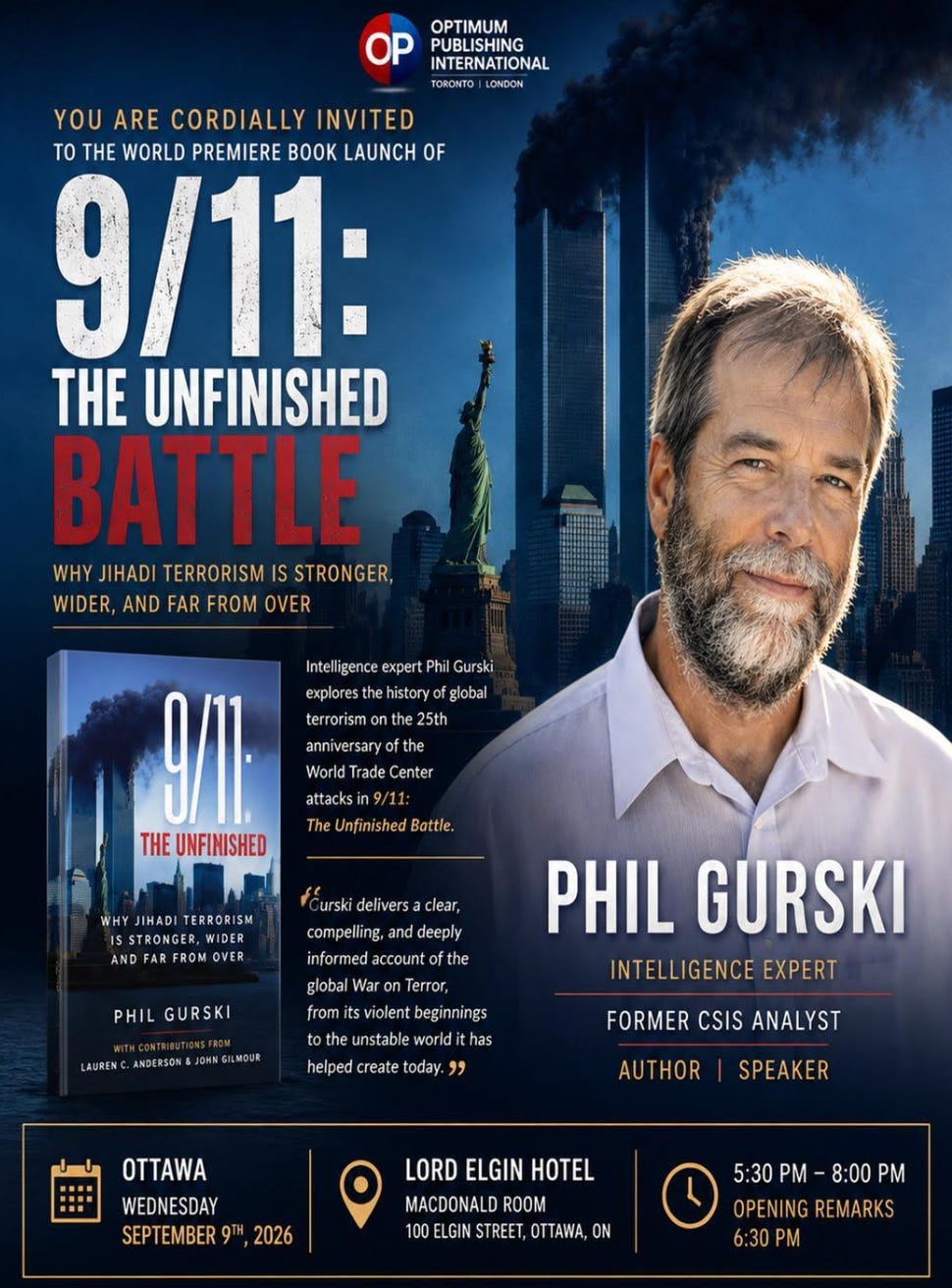
In much the same straits, as I discuss in my new book, 9/11 — The Unfinished Battle: Why Jihadi Terrorism Is Stronger, Wider, and Far From Over.
How so?
On the terrorism front, the same ideology that led 19 Al Qaeda members to hijack four airliners and cause the deaths of nearly 3,000 people is still by far the leading driver of violent extremism around the world.
Groups do come and go, and some are more effective than others, but statistics from reliable sources confirm that more countries suffer more jihadi attacks than attacks driven by any other form of terrorism. Yes, other motivations are present — far right, far left and nationalist — but violence driven by these ideologies is minimal compared with jihadism.
And while some counter-terrorism successes have been achieved — the death of Al Qaeda leader Usama bin Laden in 2011 is perhaps the best example — there have been far more “failures”: the rise of the Islamic State, which is not dead by any stretch of the imagination; the Taliban seizure of power in Afghanistan; the emergence of Africa as the new centre of global jihadist activity; and continued attacks in many Western nations, Canada included.
Despite these obvious facts, there are some who pretend that jihadi terrorism is somehow “yesterday’s news,” displaced by “nihilists” or “violent incels.” These claims fly in the face of actual data and may stem, at least here in Canada, from efforts to portray counter-terrorism focused on Islamist extremism as “Islamophobic” or “systemically racist.”
This practice must stop.
The other major development that arose from our response to 9/11 was the reallocation of finite intelligence and law-enforcement resources away from other equally dangerous threats and towards counter-terrorism. It must be underscored that this initial move was both understandable and necessary: thousands of attacks attributed to jihadis have taken place since 9/11.
But other hostile states and groups never stopped trying to infiltrate and undermine our societies.
Russia, seen initially as a counter-terrorism ally after 9/11, continued to conduct espionage in the West and expanded its use of transnational repression — the monitoring, intimidation and silencing of critics abroad. It has also carried out other hostile acts, including drone incursions and sabotage, to punish the West for its support of Ukraine. In addition, Russian online influence operations push out millions of fake posts and content created with artificial intelligence to influence Western populations. Even the upcoming Alberta referendum has been targeted.
The People’s Republic of China, acting through the Chinese Communist Party and its United Front Work Department — a key arm for influence and interference — is responsible for a wide range of hostile activity in the West. This includes campaigns to monitor, intimidate and silence Tibetans, Uyghurs and others who publicly challenge Xi Jinping’s worldview; interference in elections; the establishment of overseas “police stations” to monitor and threaten people of Chinese origin living abroad; and the theft of sensitive technology, to name but a few.
More recently, states have sent “hit squads” abroad to take out those they do not like — India’s alleged involvement in the assassination of a Sikh activist in British Columbia a few years ago is a prime example — or recruited “criminals for hire” online to carry out attacks. The shootings at the United States consulate in Toronto, allegedly tied to Iran’s Islamic Revolutionary Guard Corps, illustrate this new trend.
The challenge we face now is multifaceted. Do we have enough resources to deal with this broad range of threats? Probably not. Does the West take national security seriously? Canada’s government clearly does not. Are we willing to name threats accurately rather than describe them in woke terms that mean nothing? The use of the term “ideologically motivated violent extremism” is ludicrous: All terrorism is “ideological” at some level.
These threats are not going away.
Some are old — espionage has often been called the world’s oldest profession for good reason — while others are tied to current events. The wars in Gaza and Iran have spawned a new generation of activists, some of whom will see violence as a legitimate response to their perceptions of injustice.
In the Old Testament book of Ecclesiastes, we find the phrase “there is nothing new under the sun.” Yesterday’s threats remain with us today, and we ignore them at our collective peril.
Phil Gurski served for more than 30 years as an analyst in the Canadian intelligence community. In 2001 he joined CSIS where he was a strategic analyst, specializing in homegrown Al Qaeda-inspired terrorism and radicalization to violence. His new book is available for pre-order.


Thank you for this, Phil. As a woman, I am EXTREMELY concerned with the rise of Jihadism.
I have a question. I wasn't sure what (or who) state is being referred to here, "More recently, states have sent “hit squads” abroad to take out those they do not like...."