


OTTAWA — Canada’s foreign-influence commissioner told MPs on Tuesday that the only early registry filing involving a Chinese principal was taken down because it exposed information that should never have been published. A Conservative MP said that account was inconsistent with what the commissioner’s office told The Bureau last month.
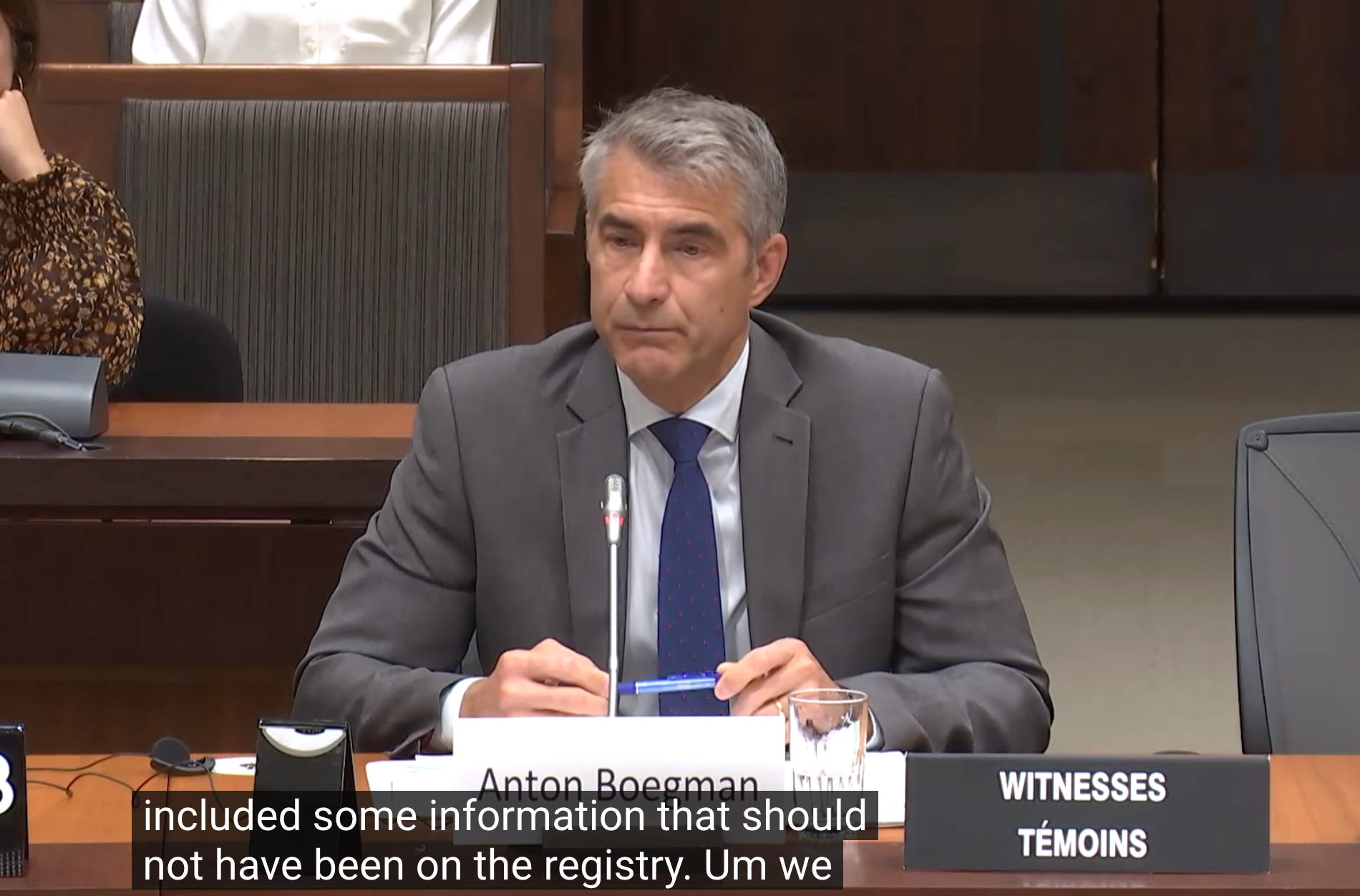
Anton Boegman, the Foreign Influence Transparency Commissioner, made the disclosure before the House of Commons procedure and House affairs committee. The questioning came from Conservative MP Michael Cooper, who used The Bureau‘s reporting to press the commissioner on a privacy breach involving China expert Charles Burton, a series of technical failures, and an information-technology system estimated to cost more than $29 million.
Asked whether his office had suffered any privacy breaches beyond the one involving Burton, Boegman said it had. His office, he said, had published a registration “that included some information that should not have been on the registry,” and had pulled it.
Cooper asked whether that was the filing involving a principal from the People’s Republic of China.
“That’s correct, yes,” Boegman said.
The filing was submitted by The Canada Files Media, an Ontario-based company. It named CGTN Français, the French-language service of China Global Television Network, as its foreign principal. It vanished from the public registry on September 15.
When The Bureau asked about the missing record, the commissioner’s office attributed the outage to a problem transferring data from submission forms to the public database.
“Technical issues with registry will need to be resolved before the third submission can be published,” the office said at the time. Its statement made no mention of a privacy breach.
“That actually is inconsistent, by the way, with what your office said,” Cooper told Boegman. “Your office, according to a Bureau article, said that due to technical issues, it had been taken down and would not be put back up until those technical issues are resolved.”
“I don’t believe so,” Boegman replied. “The reason why the incorrect information was displayed on the registry was because of some technical limitations on the current registry system.”
He said the filing would be republished “when it’s possible.” He did not say what information had been wrongly displayed.
The exchange came as Boegman disclosed that his office had received about 30 submissions by the October 3 deadline for registering pre-existing arrangements. A Public Safety Canada analysis published in January, modeled on Australia’s experience, estimated that 2,422 individuals and businesses would be required to register. Two entries currently appear on the public registry.
Cooper then turned to Burton, a sinologist and former Canadian diplomat who says he warned the registry’s leadership before it opened that Canadian Security Intelligence Service had told him the Chinese government had monitored his unencrypted communications since 2012, heightening the security concerns raised by the breach. The intelligence service has declined to confirm or deny Burton’s account.
The Bureau reported on September 15 that the commissioner’s office had mistakenly emailed a response concerning Burton’s registration submission to another person. That email exposed his name, an administrative submission number and the office’s determination that his registration was ineligible. Boegman told the committee no other emails had been sent to third parties in error.
Cooper said a telephone call scheduled with Burton to discuss the breach never took place because of a “major technical outage” that kept officers from accessing the system.
“I believe so, yes,” Boegman said.
Cooper said that during the week of September 7, Burton and several Chinese diaspora democracy activists tried to join an online information session about the registry. They received a message: “Sorry, but you do not have access to this event.”
“I would not say that they were blocked,” Boegman said.
“That’s called being blocked,” Cooper replied.
Boegman acknowledged that “there have been a number of technical problems with the registry.” Later he added: “Whatever technology is used to facilitate communications, there is a risk that there can be an issue with that.”
Cooper cited Public Safety’s estimate that the registry’s information-technology system would cost $29.41 million. “Is this what 29.41 million of tax dollars gets Canadians a completely botched IT system?” he asked.
Boegman said the registry runs on what officials call the MVP. “The MVP stands not for the most valuable player, but for the minimum viable product,” he said. It was put in place so the registry could launch on August 4, and it is “built on existing systems that are at play, but it’s also reliant on manual processes.”
“You can’t even make a phone call. You can’t even set up a conference call,” Cooper said. “Have you thought about calling in GC Strategies?”
GC Strategies, a small Ottawa information-technology firm, was the primary contractor on ArriveCAN, the pandemic-era border app. The app wrongly ordered thousands of vaccinated travelers into quarantine in 2022.
But the scandal turned on its contracting. The firm won the work without competition, raising questions about award processes under the Trudeau government. Auditor General Karen Hogan estimated the error-plagued app cost about $60 million and found GC Strategies received an estimated $19.1 million. The company has disputed that figure, saying it was paid about $11 million.