Foreign Gun Squads Rock Toronto Suburbs: 17 Arrests in Peel Expose Canada's Diaspora Extortion Pipeline, From Student Visas to Shootings-for-Hire
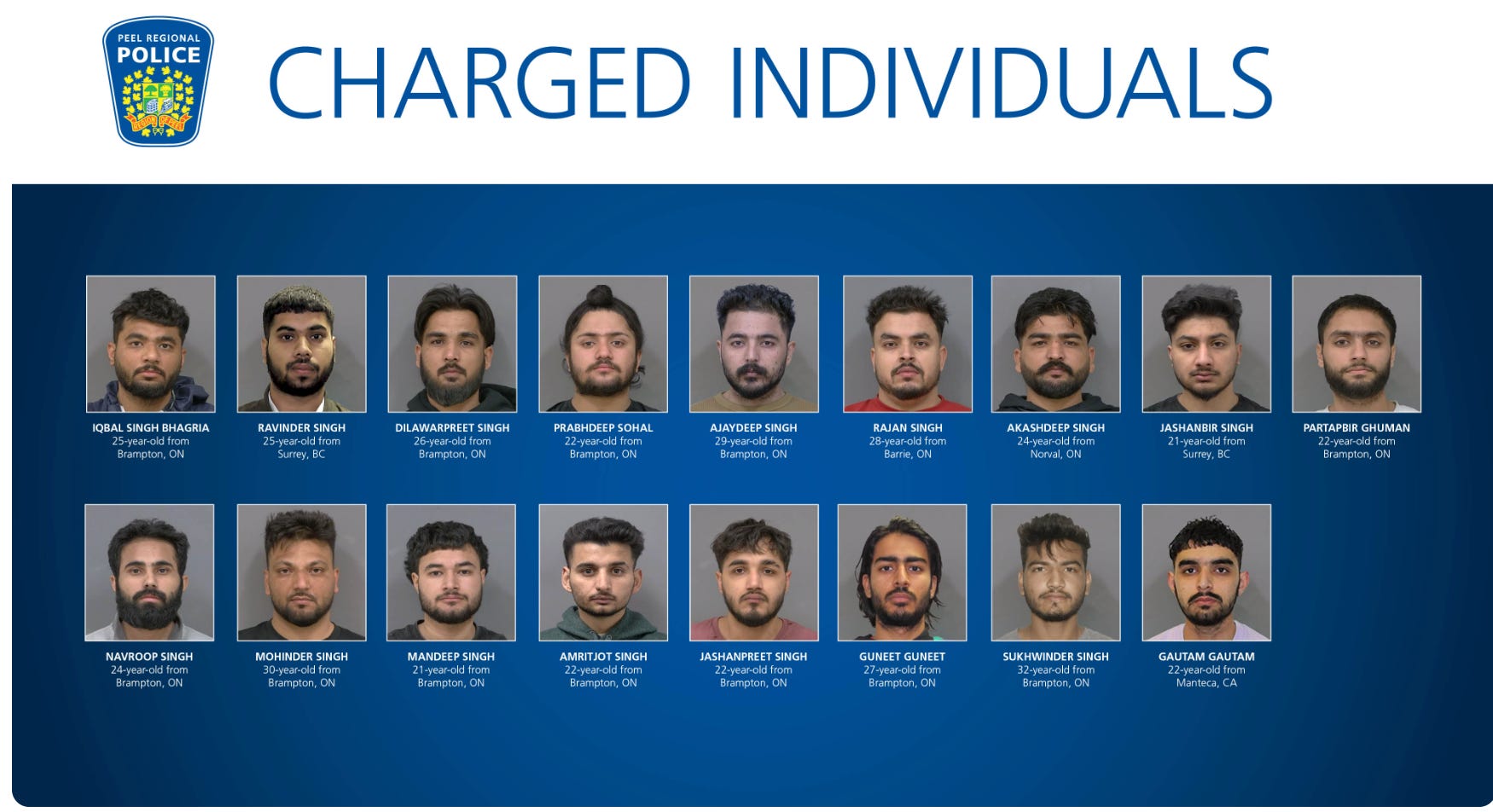
BRAMPTON — Peel Regional Police have arrested 17 men tied to an international criminal network known as For Brothers, targeting what investigators describe as a coordinated campaign of intimidation, threats, and escalating violence aimed at South Asian business owners across Canada and the United States — in what police called one of the largest extortion cases the region has ever seen, and the latest enforcement strike against a crisis that The Bureau‘s investigations have traced to the wholesale exploitation of Canada’s immigration and international-education systems.
The network operated mainly out of Brampton, Caledon, and Mississauga, touching Surrey, British Columbia, with ties extending well beyond Ontario into India and California.
At a news conference Monday, Peel Regional Police Chief Nishan Duraiappah said the investigation was international in scope. “This investigation is far beyond Peel; it has ties to British Columbia, as well as the United States and India,” he said, noting that one of the accused has been linked to an attempted homicide in India. The violence, he reiterated, was deliberate: “(Victims) were specifically targeted and escalated over time.”
In all, the 17 accused are connected to 24 incidents. Investigators linked 16 of those — including arson and multiple shootings — to For Brothers, accounting for 324 rounds discharged. Deputy Chief Nick Milonovich said members of the network are believed to be responsible for roughly half of the 620 rounds fired from illegal firearms in Peel Region this year.
At Monday’s news conference, police underscored the brazenness of the campaign by sharing surveillance footage of the attacks. In one nighttime clip, set against snowbanked suburban driveways, figures move between parked vehicles firing multiple shots at a home; in another, recorded on a residential street, a person in a red hooded sweatshirt is seen with an arm extended toward a home, a flash visible in the dark.
The investigation, led by Peel Regional Police’s Extortion Task Force, began in December 2025 as a Joint Forces Operation drawing in the Ontario Provincial Police, the Canada Border Services Agency, the Surrey Police Service, the Federal Bureau of Investigation, and the Financial Transactions and Reports Analysis Centre of Canada. Several businesses — among them restaurants and trucking companies — were repeatedly targeted after refusing to meet extortion demands. In one incident, two of the accused are alleged to have carried out a shooting and arson at a residential address in Caledon, followed minutes later by a second shooting targeting a business in Brampton.
The network's reach extended into the drug trade.
Police seized illicit drugs alongside six firearms, cell phones, SIM cards, and fraudulent identification cards — a haul that places For Brothers within the same currents of narcotics and violence The Bureau has traced across Indian transnational smuggling networks linking Canada, the United States, and India, with alleged ties to Mexican cartel proxies in Canada. The Bureau has reported how Ryan Wedding, an alleged Canadian cartel proxy indicted in major U.S. prosecutions, exploited Indian long-haul trucking networks running out of Peel Region and across Greater Toronto to move cartel narcotics.
Brampton Mayor Patrick Brown said none of the 17 accused are Canadian citizens.
Six individuals charged by Peel Regional Police may face immigration action, including possible removal from Canada, once their criminal proceedings conclude, police reported. Separately, the CBSA arrested and detained six individuals on grounds of immigration inadmissibility; of those, three have been removed from the country, two remain in CBSA custody, and one has been released by the Immigration and Refugee Board on conditions. The investigation remains ongoing, and police say further arrests are anticipated.
The Peel operation is the most concrete strike yet against a phenomenon that has saturated Surrey, British Columbia, even further than the networks active in Ontario, according to one law enforcement source.
Over recent months, The Bureau has reported that Canada’s extortion crisis targeting Indo-Canadian communities is being driven by international organized crime that has exploited an entire industry of designated learning institutes and immigration consultant shops through massive fraud, coercing vulnerable student migrants into serving in extortion squads — with brazen shootings now occurring on a near-daily basis in Surrey, the epicenter of a threat now spreading through Toronto, Edmonton, and Winnipeg.
The systemic vulnerabilities at the heart of The Bureau‘s reporting are now surfacing in British Columbia politics. In a campaign platform released May 24, Kerry-Lynne Findlay, a contender for the British Columbia Conservative leadership, framed money laundering as “the engine driving drug trafficking, fentanyl deaths, gang violence, and extortion across our province,” and argued that British Columbia “has become a major hub for transnational organized crime, and far too little has been done to stop it” — a diagnosis that closely tracks years of Bureau investigations into the Lower Mainland’s role as a North American laundering hub.
Drawing on accounts from multiple sources — predominantly from British Columbia’s multi-agency anti-extortion task force — along with documentary and data analysis, The Bureau‘s findings suggested that Ottawa lost control of its borders during a massive increase in immigration under the Trudeau Liberals, and now lacks the capacity to counter rampant scams tainting sectors of the economy tied to immigration, foreign-student education, and the job placements that lead to citizenship. It is a pattern long documented in Chinese diaspora communities, where human smugglers known as snakeheads built underground parallel economies; the same phenomenon, government sources confirm, is now proliferating across Indian communities in Canada.
“We just have no capacity to police this, and now we’re just living it out on the streets every day in Surrey and in Brampton,” the task-force investigator, who came forward as a whistleblower and asked not to be identified due to the sensitivities of ongoing investigations, told The Bureau. “We’ve got an immigration and designated learning institute problem that’s way out of control. We’ve got these kids walking the streets, shooting up houses.”
At the center of The Bureau‘s reporting is what the investigator described as an end-to-end pipeline — an assembly line of gatekeepers, fixers, and exploiters in which each step of a newcomer’s life becomes a profit center for the same network. A would-be immigrant is routed through a consultant’s firm into a designated learning institute, handed “a garbage English course that gets you a work permit,” then funneled into a relative’s trucking company and into controlled housing.
From there the ecosystem can slide into coercion: “They basically social-engineer target these folks and then they just extort them,” recruiting vulnerable students into money laundering, black-market labour, and the sharp end of the crisis — videotaped shootings at businesses. The fraud is industrialized down to the paperwork: Labour Market Impact Assessments meant to certify genuine job offers are trafficked as high-value instruments, the source said, commonly priced around $10,000 and reaching as high as $45,000.
Students vanish from campuses within months, the source said, feeding a pool of 47,175 missing international students nationwide — a figure the source tied to recruitment into criminality. “In that pool of missing students, we know that we’ve had people that have been coerced into—or have been brought into Canada—to do some of this national security stuff that Canadians are reading about.”
The Bureau‘s source connected the crisis to its most internationally consequential case: the assassination of Hardeep Singh Nijjar, executed outside a Surrey Sikh temple on June 18, 2023, by a team allegedly working ultimately for the Indian government. The four alleged hitmen broadly fit the profile the source described — all in their 20s, all Indian nationals who arrived in Canada years earlier, some on student visas.
A 15-page U.S. indictment lays out an Indian state-directed murder-for-hire scheme reaching into North America, alleging that an Indian intelligence official used pending criminal charges to recruit trafficker Nick Gupta against Sikh activists, including at least four targets in Canada, and that hours after Nijjar’s murder the official sent Gupta a video of the body, then the New York address of the next intended target.
Speaking to the crisis the day before Monday's announcement, Findlay said that as Premier she would "immediately appoint an Independent Officer of Anti-Money Laundering," an officer of the legislature able to "investigate and publicly report without any political interference," and would press Ottawa for "a federal racketeering law, full data sharing from Fintrac to our police, and immediate improvements to security at Delta Port where less than one percent of containers are currently searched." She also pledged to target "crypto-enabled money laundering networks that allow criminals to move dirty money with ease."
The call for a federal racketeering statute echoes a remedy The Bureau has repeatedly advanced: that Canada’s lack of a RICO-style law leaves prosecutors unable to dismantle organized-crime networks as integrated enterprises, forcing piecemeal cases that rarely reach the figures directing the violence.
Findlay’s platform makes the point directly, singling out the Lawrence Bishnoi organization — the India-based mafia that a classified RCMP assessment has described as a tool of state operations for the Government of India — and arguing the group “operate[s] with impunity in British Columbia” because Canada lacks the legal tools available in the United States.


Keep up the great work Sam. Only problem I see is how NOT the MSN is reporting on this stuff??
Has any MSN reporter even attempted doing some digging in on this file??
more reason to believe that Canaduh has gone completely rogue by corporation design