


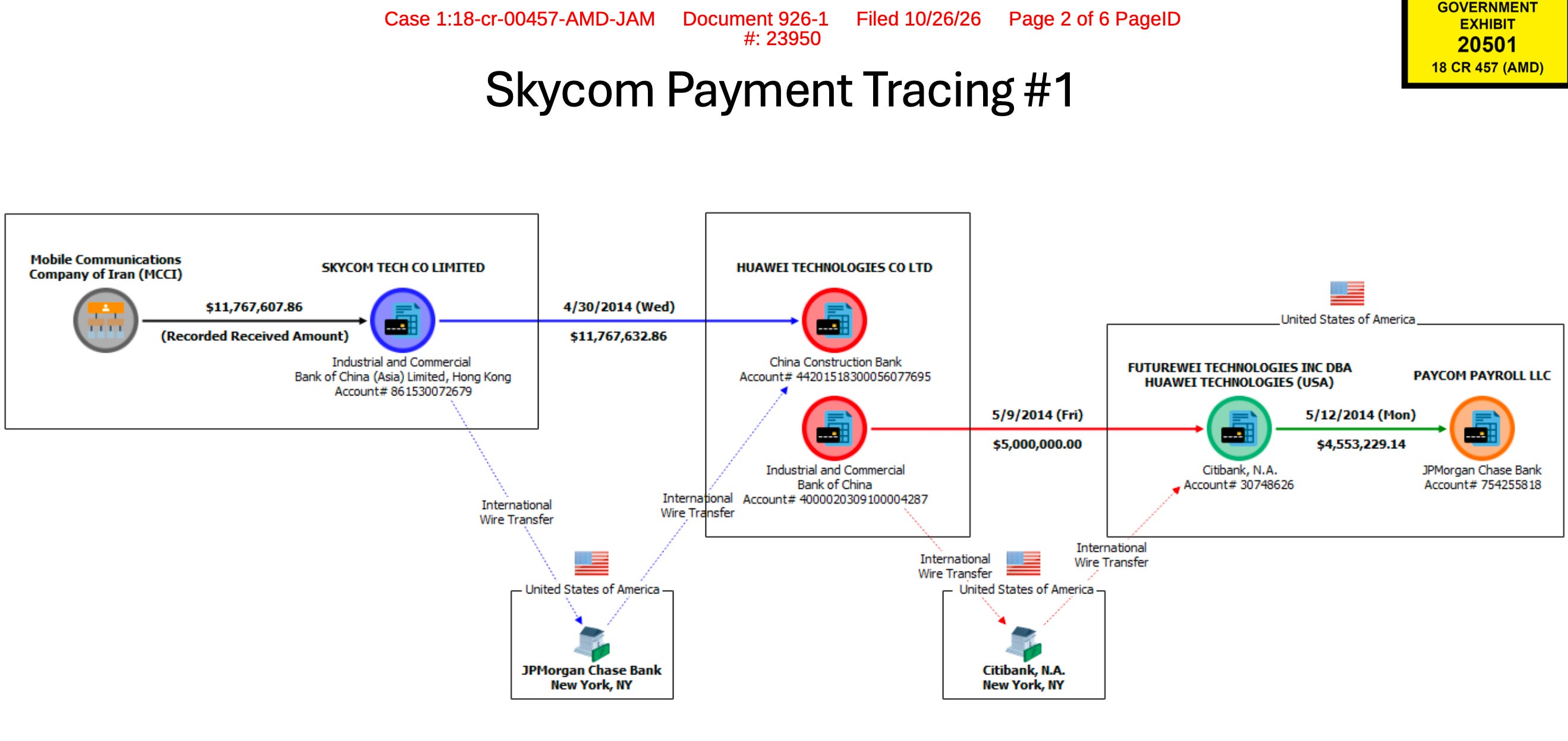
BROOKLYN, New York — An Iranian telecom payment of nearly $12 million sits at one end of a Federal Bureau of Investigation financial chart. At the other is a $4.55 million payment to the payroll processor for Huawei’s American subsidiary. Between them, government exhibits obtained by The Bureau map transfers through Skycom, the company prosecutors say Huawei secretly controlled in Iran, where the indictment alleges Huawei supplied surveillance technology used against protesters, and through accounts in China and major banks in New York.
The charts and an FBI analyst’s testimony depict a web of Chinese, Iranian and American financial institutions that prosecutors use to connect the company’s deception over its Iranian business with the funding of its U.S. operations.
Huawei attempted on October 26 to strike five of those exhibits from its criminal trial, arguing that the FBI accountant who prepared them applied inconsistent tracing methods to create a misleading impression of connected payments.
The dispute goes to a central question in the racketeering case: whether proceeds of Huawei’s alleged crimes, including its concealed business in Iran, were invested in its American operations. The charts put dates, amounts, corporate names and banking routes before the jury.
Three of the charts depict payments from Skycom through Huawei entities to Futurewei, the American subsidiary, and onward to Paycom Payroll. Two others depict routes beginning with international bank financing and a Turkish telecom customer.
The government exhibit titled “Skycom Payment Tracing #1” begins with a recorded receipt of $11,767,607 from the Mobile Communications Company of Iran into Skycom.
It then depicts Skycom transferring the amount to Huawei Technologies on April 30, 2014, through JPMorgan Chase in New York. Nine days later, Huawei transferred $5 million to its American company Futurewei, through Citibank in New York. On May 12, Futurewei paid $4,553,229 to Huawei’s American payment processor, Paycom Payroll.
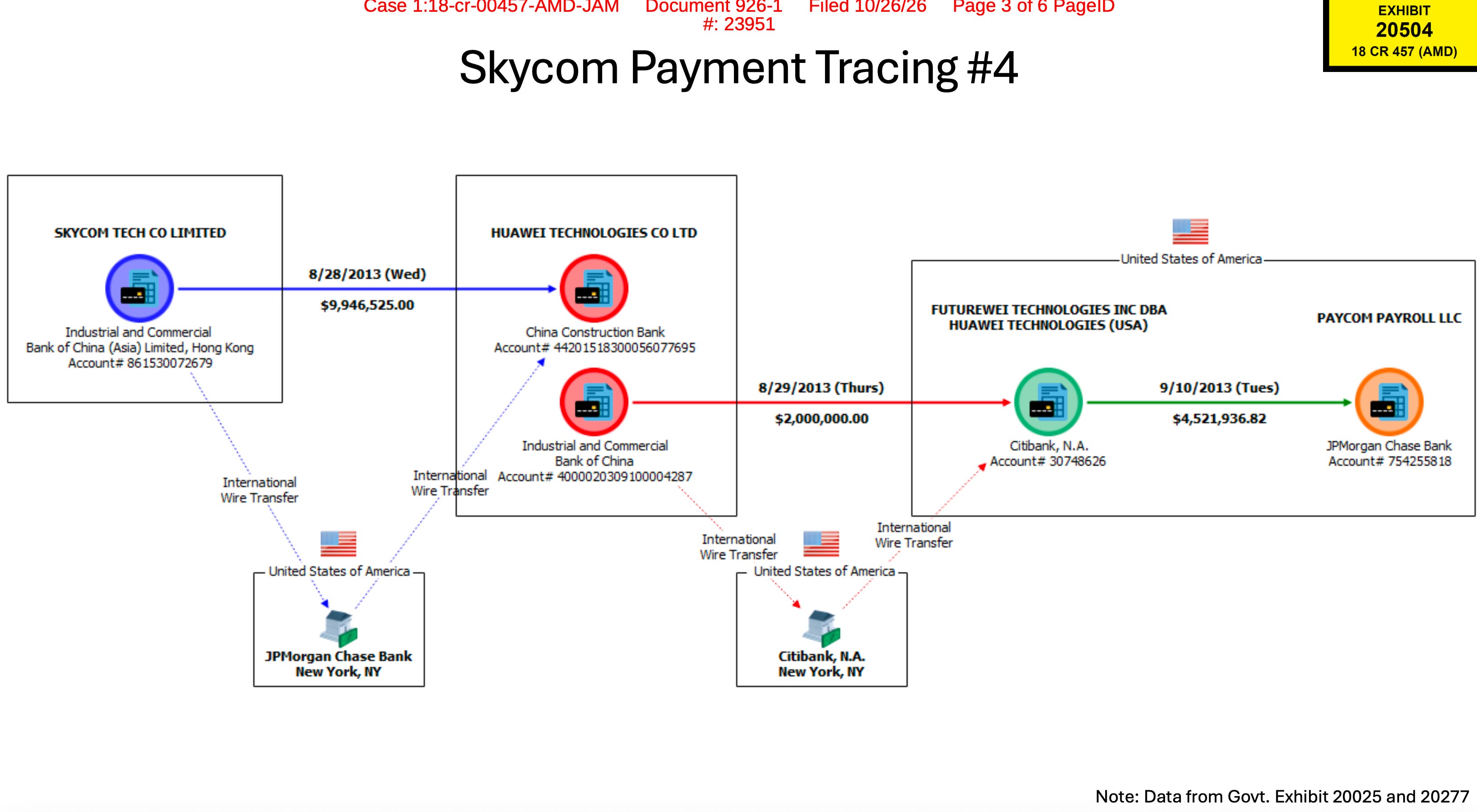
Two additional Skycom charts end at the same payroll processor.
Exhibit 20504 depicts $9,946,525 moving from Skycom to Huawei on August 28, 2013, followed by $2 million from Huawei to the American subsidiary Futurewei the next day. Futurewei then paid $4,521,936.82 to its American payment processor, Paycom on September 10.
Exhibit 20505 depicts Skycom transferring $5,425,935.97 to Huawei Tech Investment on February 5, 2013. Two days later, that company sent $3 million to Futurewei, which paid $4,264,328.98 to Paycom on February 12. In that example, the same Standard Chartered account in Singapore receives and sends the funds, with HSBC Bank USA and Standard Chartered in New York serving as correspondent banks.
FBI forensic accountant Boram “Jennifer” Moon walked jurors through the tracing in testimony beginning October 20, Jonathan Landreth reported for Strategic Narratives. The publication is run by Michael Kovrig, the former Canadian diplomat whom China’s Ministry of State Security detained after Meng Wanzhou’s arrest in Canada.
Landreth also reported that prosecutors introduced an internal Huawei presentation describing how Skycom accepted rials from its customer Irancell, with dollars reaching Huawei in China through intermediaries in Dubai. One slide read: “There is currently no legal channel to exchange local currency.”
A separate memorandum of understanding involved Skycom, the Iranian company Arya Hamrah Samanah and the Chinese companies CMEC and Panda. Huawei objected that the payments dated from 2009 and 2010, before Washington tightened Iran sanctions, and that the document “says nothing about sanctions evasion.” Judge Donnelly overruled the objection.
The government’s broader allegation is that Huawei concealed its control of Skycom while assuring banks that the company was an independent business partner and that Huawei complied with applicable sanctions. The indictment also alleges that Huawei’s Iranian business supplied surveillance technology used to “monitor, identify and detain protestors” during Tehran’s 2009 demonstrations.
The five challenged charts extend beyond Skycom.
