Fauci Declines to Answer Under the Fifth Amendment as Senators Press on Wuhan, Gain-of-Function Money and Deleted Emails
WASHINGTON — Anthony Fauci had declined to answer everything put to him. Then his attorney tried to speak for him, and a remarkable conflict erupted.
Fauci’s lead lawyer, one of six with him, according to Chairman Rand Paul, the Kentucky senator who has pursued Fauci for six years, had taken a seat at the witness table, where committee staff had told him not to sit. When he attempted to address the room, Senator Paul cut him off.
“You were told not to sit at the table. You insist on sitting at the table, and we told you you would not be recognized. You are not invited here for testimony, sir. You are being disruptive.” He told him to sit quietly, then told him again. “Another word and you’re gone.”
Senator Gary Peters of Michigan, the committee’s ranking Democrat, objected. “So Mr. Chairman, I’d like to hear what the attorney has to say.”
Paul refused. “This testimony is from Anthony Fauci. This is not a game with his lawyers.”
“Security, please remove him from the room.”
As the lawyer was escorted out, Paul noted for the record that Fauci still had the advice of the other half-dozen attorneys he had brought with him.
Earlier, Paul had worked through the case he has spent six years assembling, question by question, and Fauci had answered each one with the same 22 words.
Paul began not with Wuhan but with Washington. Had the National Institutes of Health, or NIH, ever conducted research for, or in coordination with, any element of the intelligence community — the Central Intelligence Agency, the Office of the Director of National Intelligence?
“On the advice of counsel, I respectfully decline to answer based upon my rights under the Fifth Amendment to the Constitution,” Fauci said.
Had Fauci been read into any classified Department of Homeland Security program, or any prospective special access program, concerning gain-of-function research?
The same answer.
Paul then turned to the molecular question that has sat at the center of the origins dispute since the first weeks of 2020. When scientists examined the sequence of the new virus, he said, what startled them was a furin cleavage site — a feature never before seen in that family of coronaviruses. What startled them further was how it was coded. Of 36 possible codon combinations, the one used was the combination commonly employed by scientists performing genetic manipulation.
Were the scientists at the Wuhan Institute of Virology capable of inserting a furin cleavage site into a coronavirus?
Fauci invoked the Fifth.
The chairman described the experimental method itself, in plain terms.
Researchers would take the backbone of a SARS virus that was not itself especially dangerous. They would collect unknown viruses from bat guano hundreds of feet underground. They would remove the spike protein from an unknown virus and attach it to the backbone. Then they would infect mice engineered to carry humanized cells, to learn whether the resulting virus could infect people.
Many people would say that creating viruses that do not exist in nature, specifically to infect human cells, does not sound like a good idea, Paul said. What if one escaped. What if serial passage adapted it to humans. Could combining a spike protein from one virus with the backbone of another produce viruses that gained function, and could that lead to a pandemic?
Fauci declined.
Paul moved to oversight. In his House testimony, the chairman said, Fauci had stated he never traveled to China and was unaware of anyone from the NIH examining the laboratories, and that he trusted the Chinese scientists — a position Paul said Fauci has maintained recently. The problem, Paul said, is that Americans trust American scientists too, and still conduct oversight and investigate the laboratories. He noted that Fort Detrick, one of the country’s principal facilities, was shut down after a dangerous incident. How could Fauci approve dangerous research in China, say he trusted the Chinese scientists, and ultimately concede that neither he nor any of his inspectors had ever been there? At any of the laboratories where the research was occurring, did any American oversight officials or investigators ever appear to confirm the laboratories were safe?
Fauci declined.
Then Paul asked about Shi Zhengli. One of the principal theories advanced by those examining a laboratory origin holds that the pandemic virus came from a virus never published. Was Fauci aware, Paul asked, that Shi, of the Wuhan Institute of Virology, was said — in her own words, he added — to hold more than 100 unpublished viruses that could have been close enough relatives to produce Covid-19?
Fauci declined.
Paul observed that when Fauci previously denied funding gain-of-function work in China, the denial was so absolute as to be striking, leaving no room for interpretation. Had he funded gain-of-function research at other biological laboratories elsewhere?
Fauci declined.
The chairman’s final question concerned the experiment nobody disputes the NIH funded. Ron Fouchier’s avian influenza work, Paul said, was where the gain-of-function debate began — a debate Paul noted he had no part in a decade ago, and one driven by more than 200 scientists of the Cambridge Working Group who protested the funding and argued the results should not even be published, because they amounted to a roadmap for building a biological weapon.
Fouchier, with money Paul said Fauci provided, introduced deliberate mutations producing a virus that spread efficiently between mammals, ferret to ferret, through the air. Fauci had defended the work publicly at the time, Paul said, arguing in the Washington Post that the knowledge gained was worth the risk even if an accident or a pandemic followed. Did he still stand by that? Given that 15 million people have since died worldwide, and that many believe the pandemic came from a laboratory, did he still believe the benefits of gain-of-function research outweigh the risks?
“On the advice of counsel, I respectfully decline to answer based upon my rights under the Fifth Amendment to the Constitution,” Fauci said.
Democratic senators, including Peters, used their time to argue that the Republican members were looking backward and running what amounted to a witch hunt aimed at Fauci.
Senator Richard Blumenthal of Connecticut went furthest, calling the proceeding a “show trial” and likening the atmosphere in the room to the era of Joseph McCarthy. Blumenthal has for years characterized the Republican-led inquiries into pandemic origins as a personal vendetta against Fauci.
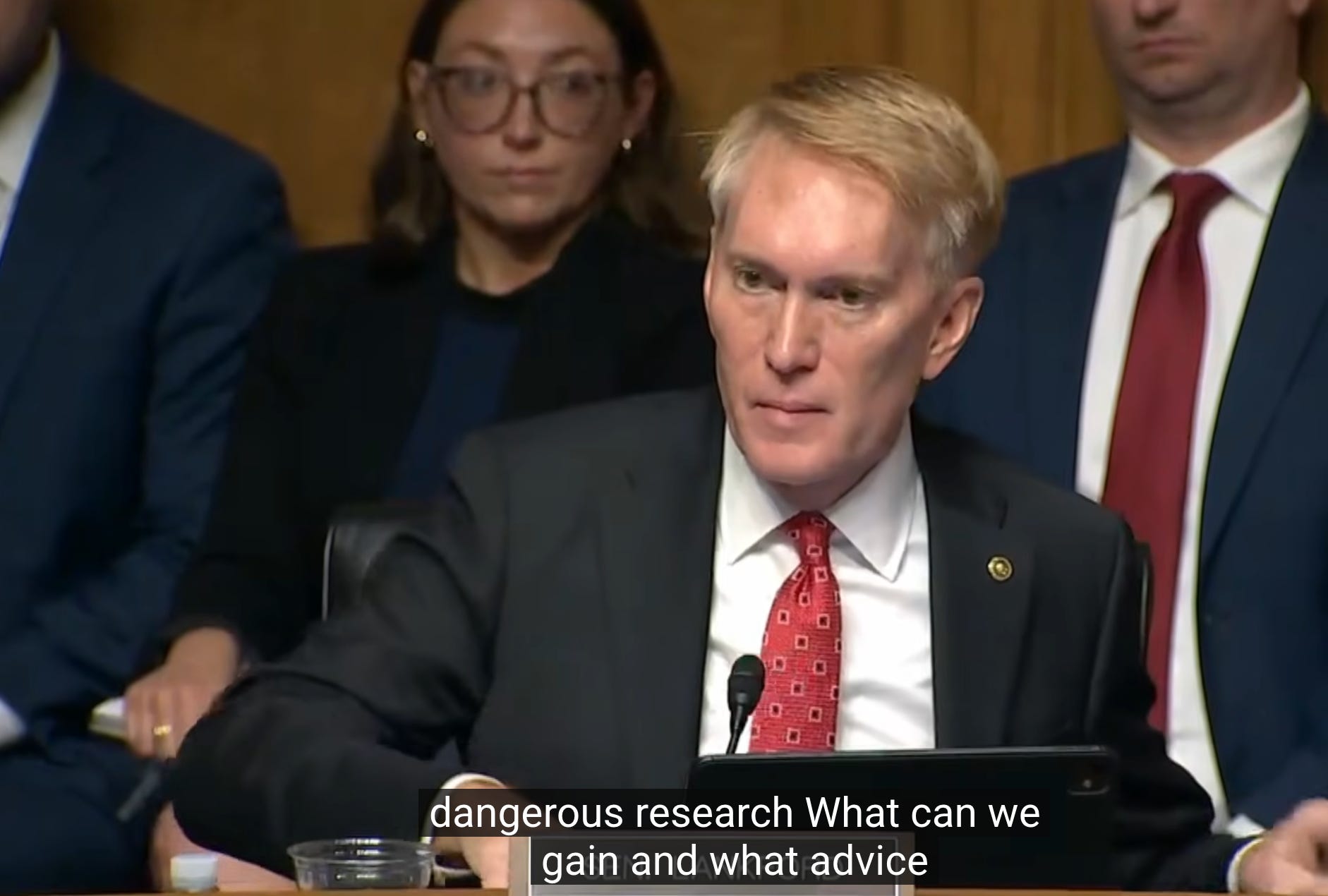
Senator James Lankford, Republican of Oklahoma, took a different approach. He said plainly that he understood Fauci intended to assert the privilege, and that it was his right to do so. Then he read the man his own words and asked him about a document Lankford has read and Fauci may not have been permitted to.
He began with a note Fauci made on February 1, 2020 — before the first American death from the virus.
In it, Fauci recorded that scientists had identified an evolutionary jump found nowhere in bat isolates, and had raised the possibility that it had been deliberately inserted and then either accidentally or deliberately released, with the accidental scenario considered likelier. There was not total agreement on the call, the note said. Ron Fouchier was certain it could have occurred naturally and thought pursuing the question a waste of effort, which Fauci wrote was to be expected of him as the original gain-of-function researcher alongside Yoshihiro Kawaoka. Kristian Andersen, the note said, had withdrawn. The rest believed deliberate insertion was possible. And because Shi Zhengli in Wuhan had spent years on gain-of-function work adapting the spike protein to bind the human ACE2 receptor, Fauci wrote, they could not let it go.
“That’s a remarkable statement,” Lankford said.
On February 1, 2020 — before most Americans had heard of the Wuhan laboratory — Fauci had named in his own notes not only the laboratory but the lead scientist working there.
Lankford turned to a document.
In May 2020, Lawrence Livermore National Laboratory produced a classified assessment, declassified only recently, stating that all the necessary conditions for an accidental release of a laboratory-modified coronavirus — specifically, a coronavirus adapted to recognize human cell receptors — were present at the Wuhan Institute of Virology in mid to late 2019. The assessment is dated May 27, 2020.
Lankford said he holds a clearance, serves on the Senate intelligence committee, and has read the complete document unredacted. Most people, he said, see only the conclusion at the front of it. His question was not what the document said. It was whether Fauci, in the position he held, had been given access to it in full.
“Is there any way you could answer that question?” Lankford asked. “Were you able to get access to this data?”
“On the advice of counsel, I respectfully decline to answer based upon my rights under the Fifth Amendment to the Constitution,” Fauci said.
Lankford pressed on with the record. On January 26, 2020, he said, Fauci wrote that American epidemiologists from the Centers for Disease Control and Prevention should be permitted to go to China and see the data firsthand. On February 12, Fauci wrote that he had serious concerns about the World Health Organization because it depends heavily on China and, in Fauci’s own phrasing, often bows to it.
If the United States is going to fund research abroad and cooperate with foreign scientists, Lankford said, it has to secure certain guarantees in advance: that when something goes sideways, American investigators get access to all information in all places.
What, he asked, could Fauci advise the committee, so that in a future arrangement the United States could be guaranteed that insight?
“On the advice of counsel, I respectfully decline to answer based upon my rights under the Fifth Amendment to the Constitution,” Fauci said.
Senator Rick Scott, Republican of Florida, pressed Fauci on whether records had been withheld from the public, and on his relationship with David Morens, his senior adviser at the National Institute of Allergy and Infectious Diseases from 2006 to 2022.
Scott read into the record an email Morens sent to Peter Daszak, president of EcoHealth Alliance: “I forgot to say that there’s no worry about FOIAs. I can either send stuff to Tony on his private Gmail, or hand it to him at work or at his house.” Fauci, Morens added, was too smart to let colleagues send him anything that could cause trouble.
Did that relationship concern him? Had Morens ever brought documents to his house? Had he kept a personal email account while serving as director? Had he received work communications there from Morens? Did texts about his work at the institute ever enter the federal record?
Fauci declined each time.
A federal grand jury in Maryland indicted Morens in April on five counts, including conspiracy against the United States and the concealment and falsification of federal records. Fauci is not named in the indictment and is not accused of wrongdoing in it.


If the United States is going to fund research abroad and cooperate with foreign scientists, Lankford said, it has to secure certain guarantees in advance: that when something goes sideways, American investigators get access to all information in all places.
Based on this part of the write up here , I think the words GOF will be changed legally to allow for even more experimentation under new rules - much like the definition of a vaccine being changed to suit the narrative. There is too much $$$$ to be made by the bio pharmaceutical industry to let this viral manipulation go in my opinion . Like the first time around with this "pandemic" of fear - think those nudge units canada used - it will be up to us individually to make decisions that might require some thought / research/ about who gains the $$$ , and what we are prepared to lose by not going along with the hive minded mentality .
It's like watching a horror movie....