

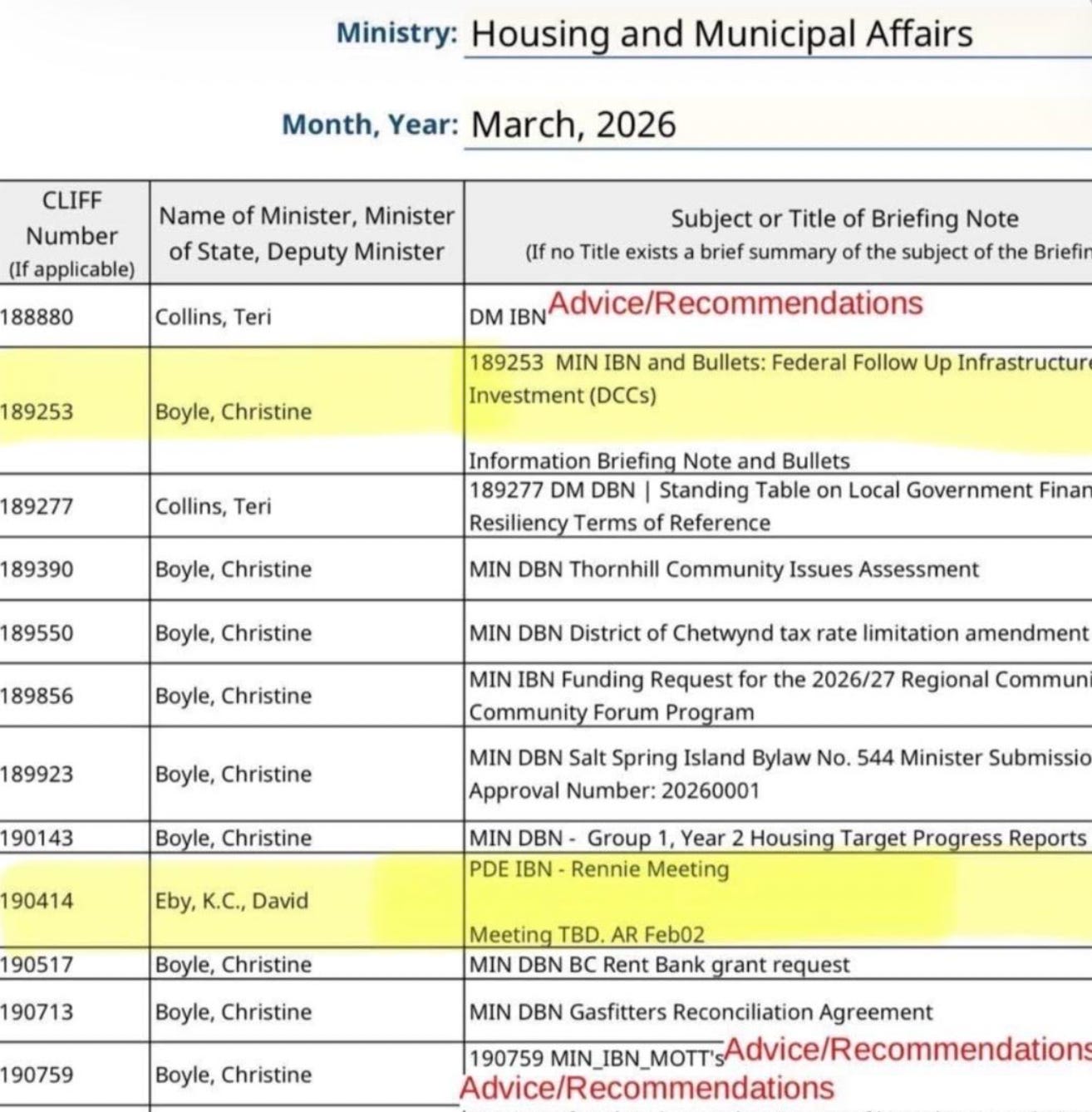
VANCOUVER – BC Housing records for March 2026 say that Premier David Eby was briefed for a meeting with Vancouver condo marketer Bob Rennie, the industry leader who hosted a February 2026 fundraiser for Prime Minister Mark Carney — attended by at least 17 leading developers — that has now been cited in Conservative leader Pierre Poilievre’s call for an ethics investigation into the controversial multi-billion-dollar developer bailout that was announced four months after Eby’s planned meeting with Rennie was documented, The Bureau has learned.
The briefing note is logged in Eby’s premier’s office correspondence stream under the heading “Rennie Meeting.” It was opened in February 2026, the month Bob Rennie — the marketer the development industry calls its condo king — held “An Evening with Mark Carney” at his offices. The Elections Canada filing for that fundraiser lists 146 attendees who paid up to $1,775 each, among them at least 17 of the province’s leading developers and condo marketers, along with former BC Premier Christy Clark.
A number of the prominent developers in attendance hold unsold inventory in the Vancouver region’s glut — the same distressed stock Carney and Eby plan to address by purchasing condos with up to several billion in public funds.
On June 18, Carney and Eby announced that the federal Build Canada Homes agency and the provincial agency BC Housing would acquire more than 2,200 unsold condominium units and convert them to affordable housing, inside a package the governments valued at up to $3.2 billion. Carney stated the purpose with brevity: “Developers are stuck. They don’t want to sell at a loss.”
Eight days later, Conservative leader Pierre Poilievre wrote to the chair of the House of Commons ethics committee demanding an urgent investigation, naming the Rennie fundraiser and asking whom the program was built to benefit. The committee has not yet scheduled a meeting.
What the briefing note establishes is not a record of what was discussed, or even whether the meeting actually occurred. It shows that as the bailout program took shape under David Eby, the premier’s office was preparing Eby for time with Rennie in the same weeks Rennie was raising money for the Prime Minister. The note records that a meeting was being arranged; it lists the date as undetermined.
What happened in that planned encounter between Eby and Rennie — like what was said at the fundraiser held in the same month — is the question at the center of the opposition’s inquiry, and of this piece of journalism.
The program’s origination is now disputed by the two governments that share it. Carney has said “no developer asked for this from me directly” — a denial bounded carefully enough to leave open every channel that is not direct.
Carney’s answer to Ottawa media is certain to be a subject of interest for Conservative members of the ethics committee, which has already filed a report that drew on reporting from The Bureau concerning Mr. Carney’s involvement with Brookfield Asset Management — including a $276-million loan from the Bank of China that helped refinance Brookfield’s multi-billion-dollar Shanghai real-estate investments. More on that deal, and The Bureau‘s assessment of its market-structure link to the Vancouver condo bailout plan, below.
Eby has acknowledged the plan as his government’s own, even as key stakeholders scramble away from responsibility in the face of a public backlash. The Urban Development Institute, the registered lobby for the development industry, says it neither sought the condo purchase nor wanted it. Housing Minister Christine Boyle, who met repeatedly with the same institute according to records reviewed by The Bureau, has said the program will not benefit developers — though asked repeatedly which condos the government would buy, and which developers were involved, she has said the details remain under design.
A March 2026 briefing note prepared for Housing Minister Christine Boyle, logged under "Federal Follow Up Infrastructure Investment" and concerning development cost charges, moved through her office in the weeks before the June 2026 bailout announcement — as Ontario advanced its own parallel plan to convert unsold Greater Toronto condos into rental housing. The note signals that the federal housing-funding track feeding the BC package was active at the ministerial level months ahead of the public unveiling.
Ironically, the David Eby of a decade ago would almost certainly be asking the same sharp questions that Pierre Poilievre and BC Conservative leader Kerry-Lynne Findlay are now asking of his and Carney’s government.
On March 8, 2017, from the opposition benches, Eby rose in the British Columbia legislature to interrogate Premier Christy Clark about her relationship with the very same Bob Rennie. Rennie, he reminded the House, was “chair of the Premier’s fundraising committee,” a man who had “pledged to raise $10 million for the Premier through private dinner parties.”
Eby, at that time, would have been aware of this writer’s reporting for the Vancouver Province in 2014, which established Rennie’s acknowledgment of hosting a private fundraiser that year for then–Vancouver Mayor Gregor Robertson, where leading Vancouver developers paid $25,000 a plate to spend private time with Robertson.
In Victoria, in 2017, Eby laid out the sequence.
Rennie, he said, had met the premier’s senior adviser “in April of 2016 and again in June of 2016, just weeks before the foreign buyer tax was announced.” And when that tax arrived — the wall meant to cool a market inflated beyond what Canadian residents could pay — it carried an exemption for the pre-sale condo trade, the very business, Eby noted, that was Rennie’s “core competency.”
Eby also told the House that Rennie had reached directly into the premier’s office with his own prescription for Vancouver’s market.
Rennie, he said, forwarded a proposal to Carole Taylor, the premier’s special adviser, urging “a very visible approach to curbing speculation and the optics of working towards affordability.”
And Rennie’s communications, Eby said, went to the BC Housing minister directly. “The Housing Minister exchanged multiple emails with Mr. Rennie in which he and Mr. Rennie discussed budget measures related to real estate and the environmental approval process in relation to a major housing development near Squamish that Mr. Rennie surely hoped to market,” Eby said.
Eby alleged a pattern of proximity and access.
“How can the premier defend giving her chief fundraiser access to the most senior policy members in her office, weeks before the foreign buyer tax was introduced, and then exempting his core business from that same foreign buyer tax?”
That question, put by David Eby to Christy Clark, is the question this article puts to David Eby and Mark Carney.
