“Developers Don’t Want to Sell at a Loss”: PM Carney on Vancouver Condo Bailout
Op-Ed: Ottawa and Victoria want the public to absorb Vancouver's unsold condos. Evidence suggests that unsold inventory was never built on local incomes.
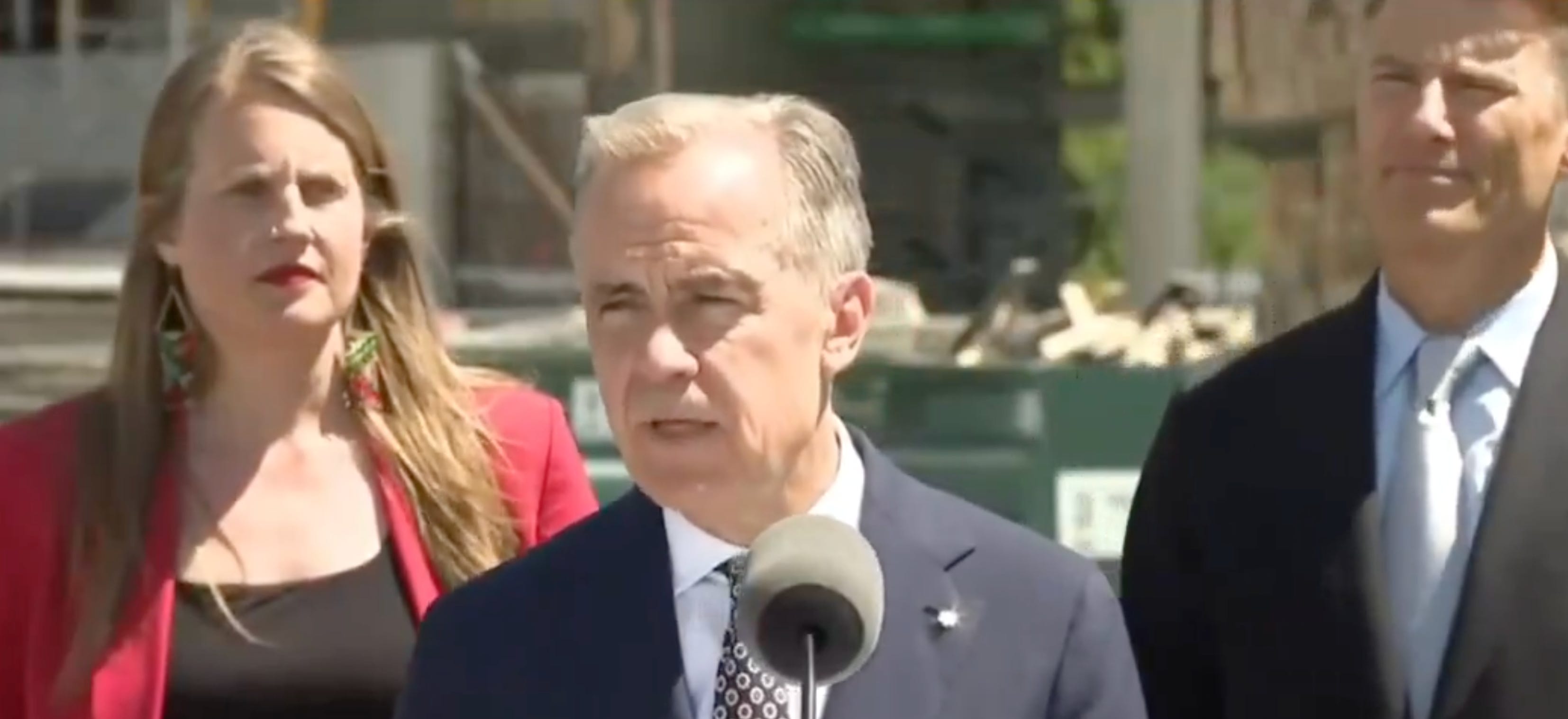
VANCOUVER — When Mark Carney and David Eby and Gregor Robertson stood together in South Vancouver’s River District this month, a short drive from the Richmond casino that gave the world the phrase “Vancouver Model,” they did so flanked by condo towers where empty two-bedroom units are marketed at close to $1.1 million.
It was a fitting backdrop.
The Prime Minister and the Premier had come to announce up to $3.2 billion in measures to lower developers’ costs and, in the plan’s most striking provision, to convert more than 2,200 vacant condominium units into affordable homes. Many of the unsold units sit in this corridor of South Vancouver, Richmond and Burnaby — markets shaped for decades by offshore demand from China and Hong Kong. Within hours the word for Carney’s “innovative” plan had been chosen, and it has stuck: a bailout.
Carney did not dispute the core of it. “Developers are stuck,” he said at the announcement. “They don’t want to sell at a loss.” Pierre Poilievre flew to the city, after a social-media firestorm led by market analysts, to say the government wants to “privatize the profit and socialize the losses.” But the most damaging questions are not partisan.
British Columbia is facing a glut of empty condos, with some developers sliding toward insolvency, and even sympathetic experts are uneasy. Andy Yan, the urban planner who directs Simon Fraser University’s City Program, asked aloud whether the plan was really “a bailout in terms of bad business decisions by some of these developers.” The Canada Mortgage and Housing Corporation counts 4,376 completed condos sitting empty in Metro Vancouver, a 76 percent jump in a year, and Yan’s own analysis finds a third of them priced above $1 million — which sharpens his central question, how deep a discount the governments could possibly negotiate to make such units affordable.
Strip away the political noise and a more interesting question surfaces. If the public is being asked to clear thousands of unsold condos off developers’ books, what exactly are Canadian taxpayers preserving, and who built it?
Asked directly by Business in Vancouver whether he would like to see Metro Vancouver prices fall further, Carney declined to answer the question he was asked, pivoting instead to housing “that works relative to what people’s incomes are.”
He has been consistent in this evasion.
When he made Gregor Robertson his housing minister in May 2025 — Robertson having presided as Vancouver’s mayor over a near-doubling of home prices — a reporter asked whether the appointment signaled that the government did not want prices to come down. “You would be very hard-pressed to make that conclusion,” Carney replied. The plan’s own language gives the game away. The Prime Minister described it as a way to “clear off on the books, this overhang.” This is not a program built to let an inflated market fall toward what Canadians earn. It is a program built to hold a price level in place by moving developers’ unsold inventory onto the public balance sheet.
To understand whose price level it is, follow the connective figure in Vancouver’s real-estate politics for the past two decades: the condo marketer Bob Rennie, the man the industry called its king. Rennie sold the pre-sale towers that define the skyline. He was the British Columbia Liberals’ top fundraiser, the broker who made property developers the party’s leading donors. In 2012 he was appointed to the board of BC Housing, the very Crown agency now being used to absorb unsold condos. And in 2014, as the affordability crisis deepened, I reported in The Province that Rennie had organized an exclusive $25,000-a-plate lunch giving developers a private audience with Mayor Robertson.
Rennie’s role is not confined to the past. In March 2025, weeks before the federal election, he told an industry panel that he was “working with Carney” on a plan to use federal housing-agency financing to bring foreign buyers back into the condo market — “let’s allow foreign buyers to buy it,” he said, so as to “show the world we are open for business.” The condo king lobbied, by his own account, to reopen Vancouver’s towers to offshore capital; when that capital did not return and the towers sat empty, the same Carney government he named is now buying the inventory at public expense.
Rennie was not alone in pressing to reopen the door. During the same campaign, a Vancouver Liberal candidate — a realtor who had spent years marketing British Columbia homes to luxury buyers at property shows in China — also reportedly called for weakening the foreign-buyer ban. Confronted by Global News with the charge that his China marketing made local housing less affordable, he was unrepentant: “I don’t think I’m creating a problem at all. I think I’m creating solutions.”
Which returns us to the market structure.
In 2015, Andy Yan analyzed six months of sales in three of the city’s most expensive west-side neighborhoods and found that two-thirds of buyers were signing with non-anglicized Chinese names. Gregor Robertson — now Mark Carney’s housing minister, who stood beside Eby and Carney at the South Vancouver bailout announcement last week — was then Vancouver’s mayor. Robertson, like a number of Vancouver developers, suggested that Yan’s study of the dominance of mortgages from mainland China in Vancouver real estate was racist. “This can’t be about race, it can’t be about dividing people,” he said. Yan, who is Chinese-Canadian, answered that it was never about the messenger but about the message.
What Yan had glimpsed was not a caricature of buyers arriving with suitcases of cash. It was quieter and more consequential. The money was not bypassing the banking system; it was flowing through it. “It wasn’t bags of cash that were being used to purchase Vancouver homes outright,” Yan told me when we revisited his work. “They were loans being used.”
How those loans were approved is the part of the story I have spent years documenting. In a 2024 investigation for The Bureau, a Toronto-area bank whistleblower described mortgage files in which casino workers and part-time hairdressers were recorded as earning several hundred thousand dollars a year from remote jobs in China, incomes that secured seven-figure loans. Canada’s financial-intelligence agency, studying some 48,000 diaspora transactions in 2023, found professional launderers routing wire transfers through Hong Kong, with mortgage payments, in its words, “sourced from incoming funds from China.” This is the casino-and-real-estate apparatus that British Columbia’s Cullen Commission spent years examining — the same system through which $1.2 billion in cash moved through provincial casinos in a single year, the Vancouver Model that gave a decade of inquiry its name.
What the evidence supports — from Yan’s land titles to the bank documents to the laundering apparatus the Cullen Commission mapped — is not that any one developer’s tower was intentionally built on dirty money. It is that murky offshore flows were part of Vancouver’s substrate; they were its real-estate structure, amplifying the prices that everyone else, earning local incomes, then had to meet.
Strip the Carney announcement to its logic and this is what remains. A price level inflated over a decade by capital the city refused to trace is to be held in place at public expense, by leaders who were present when the warnings were dismissed and when they were confirmed, on the advice of an industry whose powerful figures are working to let that capital back in.
The buyer this program claims to rescue — the Canadian whose income cannot reach a million-dollar two-bedroom — is precisely the person the bailout ensures will keep getting priced out.
The answer to a market distorted by money no one will trace back to China, is not to make the public the buyer of last resort. It is to let the price fall to what the people who actually live in Canada, can pay.


The usual Vancouver, build them and they will come, has failed and now the taxpayers, who can not afford these condos, must bailout the very people who made housing in Vancouver unattainable for the citisen's of that city. Most live far out of the city spending hours to get to work via bad planning on roadways and highways. The Developers should have to lose money just as do the citisens attempting to sell their condos. Enough of the elite bailouts and saving the billionaire class. All they have done is profit, while making the housing unaffordable for the citisens who live and work there.
Well said Sam ,
The Liberals are afraid to let the mask come off as our economy is starting to show its true colours , let the companies take the hit. Almost everything Carney does , is a net negative for the average Canadian. More debt , and more unaffordable housing. What would put the cherry on top is if Brookfield is somehow involved 🫠