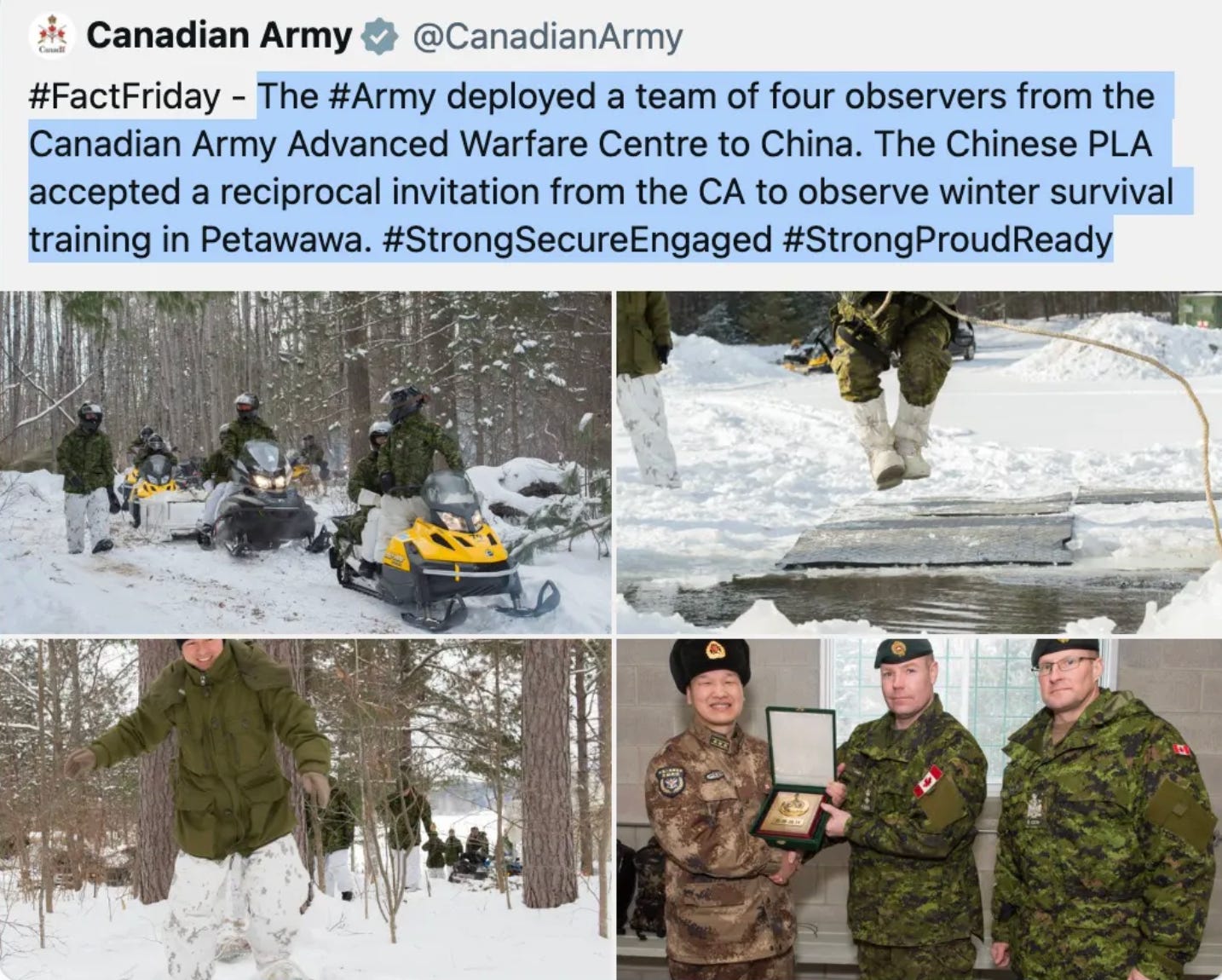
OTTAWA — A former senior Canadian defence official suing the federal government over a dismissal her lawyer links to Mark Carney’s pivot toward China is pointing to the government’s newly disclosed military engagement with Beijing — and to what she calls growing public recognition that Canada’s partnership with China has impeded trade talks with Washington.
Raquel Garbers was the principal architect of the small team that drafted Canada’s 2024 defence policy, Our North, Strong and Free. On Oct. 15, 2025, she published an opinion piece warning that Ottawa’s increasingly anti-American rhetoric was dividing the Western alliance and benefiting Beijing and Moscow.
Those hostile states — principally China — had been waging a covert war against Canada and the United States for about a decade, Garbers wrote. Two days later, Foreign Affairs Minister Anita Anand was in Beijing describing China as a strategic partner. Four weeks after that, Garbers was told her position was being eliminated.
She filed a wrongful-dismissal claim in the Ontario Superior Court of Justice in June. In an interview, Garbers’ lawyer said Carney’s strategic pivot toward Beijing had chilled parts of Ottawa’s bureaucracy and created a perception that Garbers was fired as a warning to others. None of the allegations has been tested in court.
Writing on LinkedIn on Monday, Garbers responded to a story The Bureau published the same day: Canada’s military had formally reopened its Defence Coordination Dialogue with the People’s Liberation Army on Sept. 4, but Canadians learned of the meeting only through a two-paragraph notice from China’s defence ministry.
“The [government] mismanaged the public politics of its defence/military deal with Beijing,” Garbers wrote. “In staying silent while Beijing shouted about it across the globe, Ottawa handed Beijing a major propaganda win.”
Garbers’ second point concerned Carney’s collapsed trade talks with the Trump administration.
Days before the Victoria military conference opened — an event attended by a Chinese delegation led by General Yang Zhibin, commander of the PLA’s Eastern Theater Command — Carney was describing Canada’s relationship with Washington in warlike terms.
“Last evening, I instructed our negotiators to return to Ottawa,” he said on Aug. 22. “We cannot accept what they’ve offered, and we will not give what they’ve asked.”
That same day, he characterized the relationship this way: “You’re at war when you get attacked. We got attacked.”
In her LinkedIn post, Garbers argued that Ottawa’s failure to disclose the renewed engagement with the People’s Liberation Army means media “coverage of the deal will put Ottawa’s reputation for accommodating China front of mind just as the public is realizing that its partnership with Beijing played a pivotal role in crashing CUSMA talks.”
Garbers’ third point was sharper, presenting the implications of Canadian military cooperation with Beijing as an unavoidable factor in relations between Ottawa and Washington.
“[With respect to] questions [around] the impact on US relations, the [government] must either admit de facto US ‘consent’ of the deal (a blow to its domestic chops) or it must deny US ‘consent’ (a win for DC’s claim that [Canada] is Beijing’s backdoor into the US).”
Put plainly, Garbers argues that Ottawa faces two politically damaging possibilities.
If it says Washington knew about the military engagement and did not object, Ottawa risks appearing to concede that a sovereign Canadian defence decision required the approval of the administration Carney has described as attacking Canada. If it says Washington was unaware, it lends support to an argument already circulating in the U.S. capital: that Canada offers Beijing a back door into American security.
Meanwhile, the Department of National Defence told The Globe and Mail that the Sept. 4 meeting took place in Ottawa and characterized it as “working-level dialogue.”
But an unnamed Canadian official told the newspaper that military participants ranged in rank from major-general to colonel. The reported presence of a major-general — an officer holding one of the Canadian Armed Forces’ highest ranks — raises questions about Ottawa’s characterization of the meeting with the People’s Liberation Army as merely “working-level.”
The bilateral talks occurred two days after the Indo-Pacific Chiefs of Defense Conference concluded in Victoria. DND’s public account of that conference said it brought together 32 senior military representatives from 29 countries, but did not identify the Chinese delegation or disclose the subsequent meeting in Ottawa.
Garbers’ fourth point anticipated what the government might say when it addresses the matter publicly.
“Forthcoming talking points about ‘security guardrails’ on the deal will invite scrutiny of Canada’s much too lax security posture — and could the timing for that possibly be worse as the [government] prepares to host investors in sensitive defence sectors?”
Garbers closed with some advice for Carney and his government.
“The flaws in the [government communications] strategy are many and serious. To be fair to the PM, he cannot be all things at all times. He really [should] add some real geostrategists to his team.”


This is clearly an own-goal. Dealing with the PLA, the army of the Communist Party of China, requires a clear-eyed recognition that you are dealing with a malicious, malevolent, mendacious partner. Be afraid, very afraid.