

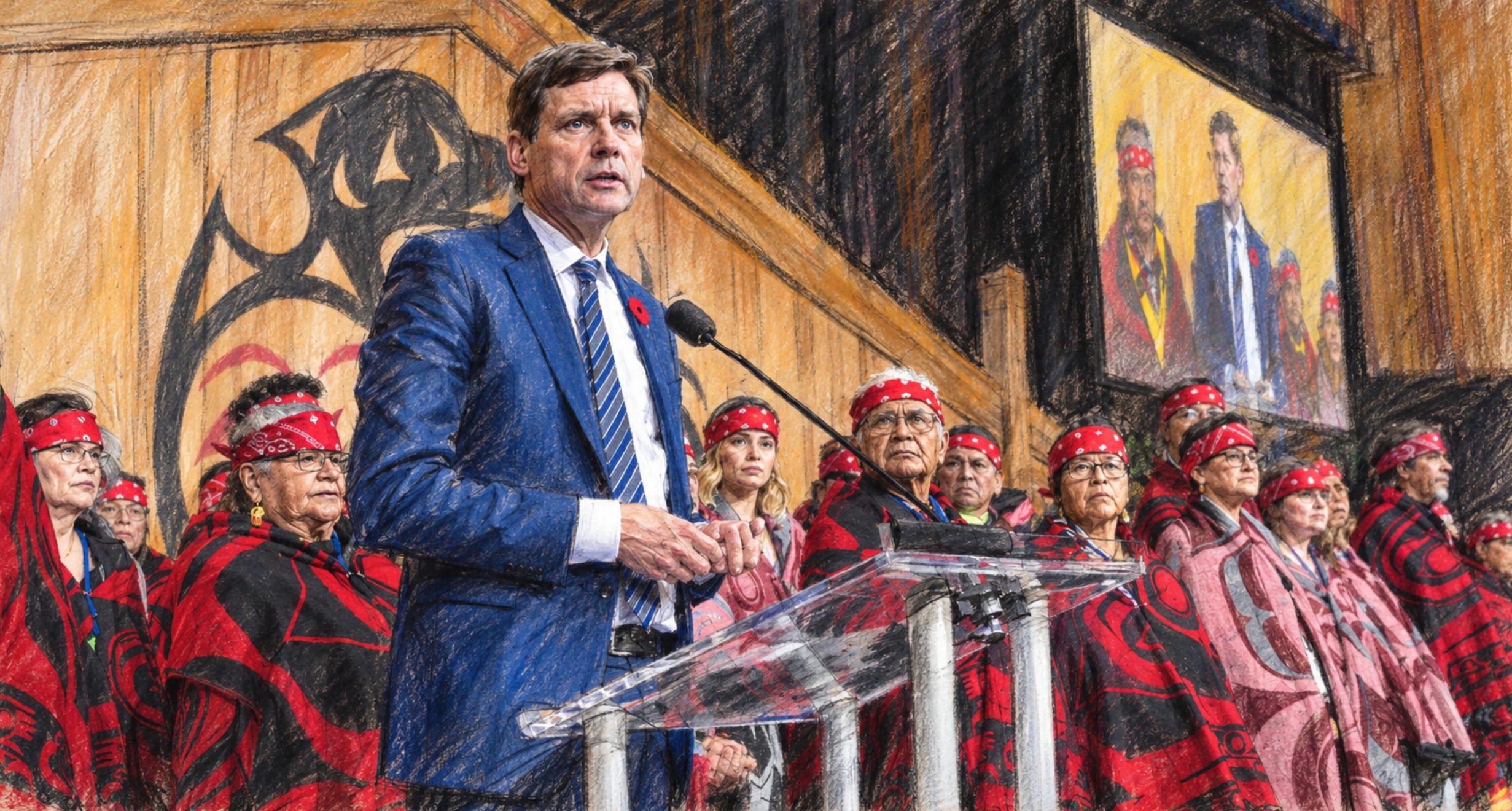
By Elbert King Paul, CPA CA
“The question of what remains of Aboriginal title after the granting of fee simple title to the same lands should be reversed. The proper question is: what remains of fee simple title after Aboriginal title is recognized in the same lands?” — Madam Justice Barbara Young
VANCOUVER — An insightful recent op-ed by Fran Yanor of Northern Beat, entitled “Cowichan Rulings: A relentless legal strategy wins, landowners lose,” details how Madam Justice Barbara Young dismissed a petition in June to re-open the Cowichan Tribes trial.
This resulted in a “delayed judicial scrutiny of her own controversial 2025 finding of Aboriginal title on private property and capped 12 years of court proceedings which shut landowners out of the legal process that laid siege to the security of their fee simple titles.”
The evidence supports Yanor’s verdict that there is a “very wide gap between the truth and how David Eby and his government officials have publicly portrayed the administration’s role in the proceedings and Cowichan’s intentions regarding private fee simple titles.”
Yanor adds that “as the former attorney general who issued orders to government lawyers directly affecting their arguments in this case, Eby should have known full well Cowichan’s legal strategy has been unshakably focussed on retaining the option to go after private titles.”
This incompetence demonstrated by Premier Eby in protecting the public interest is shameful.
Equally disquieting is the profound negative impact created by Premier Eby resulting from the 2019 introduction of the B.C. Declaration on the Rights of Indigenous Peoples Act (DRIPA).
It was originally described by the provincial government as an aspirational framework to align provincial laws with UNDRIP.
UNDRIP, the United Nations Declaration on the Rights of Indigenous Peoples, is a non-binding resolution adopted by the United Nations in 2007 that sets out standards for the rights of Indigenous peoples, including their rights to land, culture and self-determination.
However, a landmark B.C. Court of Appeal decision in December 2025 (the Gitxaała case) ruled that DRIPA obligations are legally enforceable.
This meant courts could find provincial systems—such as mineral rights or land management—inconsistent with DRIPA, exposing the province to immediate legal liabilities and impacting private property expectations.
In early 2026, Premier Eby announced intentions to unilaterally suspend or amend key portions of DRIPA for up to three years to mitigate these legal risks. This move provoked severe backlash from Indigenous leaders in an April 2026 meeting reported by The Canadian Press that revealed Indigenous leaders confronting Eby directly, labeling his proposed suspension an “absolute betrayal” and a return to colonial-style governance.
Concurrently, the government was justifiably criticized by the public for rushing the DRIPA process, employing non-disclosure agreements, and attempting to bypass standard consultation protocols.
Specifically, Part 1, Section 2(1)(e) of the B.C. Lobbyists Transparency Act excludes communications between members of an aboriginal governing body, however organized and established by aboriginal people within their traditional territory in British Columbia, persons on the staff of those members, or employees of that governing body and the Government of British Columbia.
This means that voters in B.C. have no access to lobbying by First Nations with the Government of British Columbia.
B.C. voters are justifiably disturbed by this lack of transparency and would like to know who was lobbying whom when Premier Eby made billions of dollars of commitments to implement DRIPA.
What Premier Eby and the NDP government fail to acknowledge is what significant progress has been made in advancing reconciliation with First Nations communities.
For example, the Truth and Reconciliation Commission of Canada (TRC) was officially launched in 2008 as part of the Indian Residential Schools Settlement Agreement (IRSSA).
Intended to be a process that would guide Canadians through the difficult discovery of the facts behind the residential school system, the TRC was also meant to lay the foundation for lasting reconciliation across Canada, implementing all of the 94 recommendations set out in the June 2015 summary.
More than 85% of Canada’s 94 Truth and Reconciliation Commission Calls to Action are completed or well underway a decade after their release, according to the Crown-Indigenous Relations and Northern Affairs Canada Update.
According to research published by the Fraser Institute, inflation-adjusted federal Indigenous spending in Canada jumped from $10.3 billion in 2014/15 to $40.8 billion in 2024/25. In British Columbia alone, Ottawa spent approximately $6.3 billion on program benefits for Indigenous people in 2024/25.
Specific studies noted that individual groups, such as the Cowichan Tribes, received an estimated $103.3 million ($18,359 per capita) in 2024/25 from combined federal and provincial sources.
In summary, I would assert that I, along with other voters, am seriously concerned about Premier David Eby’s lack of transparency, incompetence and deceptive behavior and failure to protect the public interest in responding to the Cowichan Rulings and UNDRIP.
He has profoundly divided British Columbians and diminished our vital journey of reconciliation with First Nation Communities.
Notwithstanding Premier Eby’s profound failure to protect the public interest, we need to continue to strive to address the reconciliation process with First Nations.
He has shown you, O mortal, what is good,
And what does the Lord require of you?
To act justly and to love mercy
and to walk humbly with your God.
Micah 6:8 — New International Version
Toxic politics, power and profit has strange bed fellows. Cannot be explained rationally, it dominates the present day narratives across the world.
Essentially this whole DRIPA scam is another nation (as they call themselves) ceizing cdn citizens land. OK, bring the cdn army in to defend cdns on our own soil, that is what we expect from our federal gvt.