Chinese Nationals Ran a Fraud Machine Out of Florida Mailboxes, Draining the Savings of Elderly Americans in Seventeen States: DOJ
ORLANDO – From a web of rented mailboxes in strip malls across Orlando, prosecutors allege, a cell of Chinese nationals operated one leg of a sprawling transnational fraud that stripped elderly Americans of more than two million dollars — persuading some they were investing in cryptocurrency or gold, and convincing many more that federal agents, big tech companies, or their own banks had detected a catastrophic breach in their accounts and that only immediate, secret fund transfers could save them.
Victims were coached to liquidate retirement savings, buy cashier’s checks and mail them to companies with the names of construction firms. The companies built nothing. Within days, according to a sworn federal affidavit, the money was wired out of the country, most of it to Hong Kong banks, some of it to Bahrain.
The affidavit describes what may be the operation’s most efficient feature. The callers, investigators believe, were overseas. They worked from more than one script, and could pivot a target from one story into another depending on how the conversation ran. A security breach for some. A federal criminal investigation for others. A gold or cryptocurrency investment for those who bit at that instead. The result, the affidavit says, was that people from all walks of life could be drawn in by the same operation.
That structure resembles branching algorithmic logic run from a foreign command center more than improvisation. And it is what allowed a cell of six on the ground in America to work victims in seventeen states at once.
The cell’s methods and the routes its money traveled resemble those of a far broader scam complex that The Bureau has previously linked to arms of the Chinese state — though the complaint filed in Orlando alleges no state involvement of any kind.
Six people were charged by criminal complaint in the Middle District of Florida on July 29, and the case was unsealed on Tuesday.
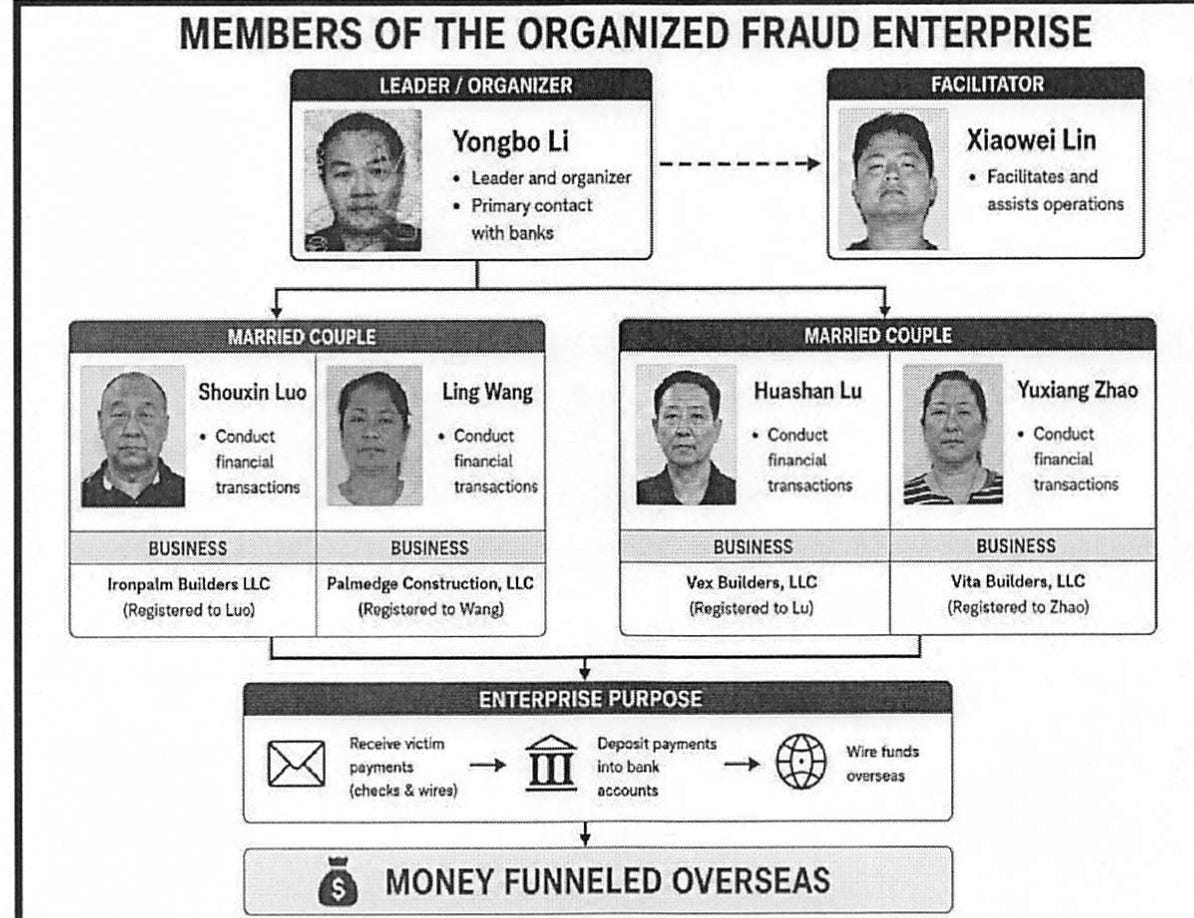
Three are in custody: Yongbo Li, thirty-six, Huashan Lu, sixty-two, and Yuxiang Zhao, sixty. United States Attorney Gregory Kehoe said all three had overstayed their visas. Three others named in the complaint — Ling Wang, Shouxin Luo and Xiaowei Lin — remain at large and are believed to be in China, which has no extradition treaty with the United States. Each defendant faces a single count of conspiracy to commit mail fraud. While money laundering and organized crime is frequently mentioned in the court filings, those accusations are not charges.
Each of the accused is presumed innocent unless and until proven guilty.
Twenty-eight victims across seventeen states have been identified, most of them over sixty-five, several between seventy and eighty-seven. Investigators expect that number to grow. The affidavit describes further suspected victims they have not been able to reach, others who refused to discuss the wires and checks they had sent.
A key factor of the fraud was that victims believed they were speaking with U.S. officials or corporate spokespeople.
The investigation was led by Postal Inspector Charles Johnsten of the United States Postal Inspection Service, working with the Orlando Police Department’s financial crimes unit and, at the far ends of the scheme, local officers in Chandler, Arizona, and Tonawanda, New York — small departments sent to knock on the doors of elderly strangers who had mailed away their savings and, in some cases, did not yet know it.
It began with one of them.
On June 5, a woman identified in court papers as L.S., living in McHenry, Illinois, received an email purporting to come from Apple, telling her she was the victim of pornography fraud and that warrants would follow unless she paid. She called a number she was given and spoke to a man calling himself Skylar Liam, who said he worked for her bank. She withdrew forty-nine thousand five hundred dollars as a cashier’s check and mailed it to a post office box on East Central Boulevard in Orlando. The check, according to the affidavit, was the life savings of her husband and herself. Skylar Liam told her that if she mailed it, “this would fix it and all go away.” He told her to say nothing, because “this was a secret.”
Three days later she reported it. Postal inspectors intercepted the parcel in transit and returned it to her. Then they went to the mailbox.
What they found there opened the case. Employees at the UPS Store recognized the box immediately and named the three people who came for its mail. Surveillance video from that same day showed Li retrieving packages. Over the following six weeks, investigators watched the group move in a fixed daily circuit — from a house to mailboxes in Orlando and Winter Park, then to Chase, Bank of America, Truist, Wells Fargo, Fifth Third, TD Bank and PNC, opening envelopes in the back seat of a white Genesis as it drove, discarding the packaging as they walked. Officers pulled the discarded boxes from trash cans and read the shipping labels, and that is how they found the next victims: an eighty-four-year-old woman in Arizona who had surrendered roughly $612,000 dollars in cash, gift cards and checks to men posing as federal agents, and a seventy-four-year-old woman in New York who told police she had not been scammed and had sent nothing.
The companies at the center of the scheme were registered in Florida in January and February of this year: Palmedge Construction, Ironpalm Builders, Vita Builders and Vex Builders. None holds a construction permit.
Bank records subpoenaed by investigators show no payroll, no materials, no subcontractors, no equipment, no insurance — the accounts opened with $100 and then funded almost entirely by cashier’s checks and wires from strangers across the country. Palmedge received at least $1 million; Ironpalm at least $1,386,097.
Between May and June, according to the affidavit, the Palmedge account sent seven international wires totaling $552,500, most of it to an entity bearing the same name at an address on Queens Road in Central, Hong Kong, and the rest to a firm called Hongkong Realpower Limited. The Ironpalm account sent seven wires totaling roughly $455,400 — to Veyra Tech Limited and Hongyin Trade Limited in Hong Kong, and $328,600 to a company called Krasmata Limited in Bahrain. The affidavit describes the pattern as consistent with funnel accounts aimed offshore.
Canada’s financial intelligence agency has been describing this architecture for years.
In a July 2023 operational alert issued under Project Athena, the nation’s anti-money laundering watchdog Fintrac, found professional money launderers routing wire transfers from money services businesses in China, notably Hong Kong, into the accounts of unrelated Canadians who listed themselves as students, homemakers, office managers or unemployed — money mules and straw buyers, in the agency’s assessment — with Hong Kong serving as the transition point because, as a Special Administrative Region, it sits outside the currency controls binding the rest of China.
The Bureau documented that system operating in the Greater Toronto Area in 2024, in internal HSBC Canada records showing accounts opened by declared homemakers with no income that went on to receive large transfers from China and issue checks for property purchases. In Orlando the current runs the other way, out of the United States and back to accounts in Hong Kong, via wire transfers.
It was the banks, not the victims, that first pushed back. Wells Fargo closed a credit account. TD Bank closed one of the suspect accounts outright. Truist froze another.
The response, investigators allege, was to quickly bring in replacements: one married couple, Mrs. Zhao and Mr. Lu, with two dormant companies already registered in their names, had fresh accounts opened at PNC and Truist within weeks.
On July 8, at a Wells Fargo branch on North Orlando Avenue, a manager questioned Zhao about a wire transfer she was attempting. Zhao directed every question to the cell’s alleged bank account fraud controller, Yongbo Li. An officer inside the bank overheard the manager say it would be “hard because it’s China.”
The case arrives as the Trump administration elevates fraud to a whole-of-government priority. In January the Justice Department announced a National Fraud Enforcement Division. In March the President signed one executive order directed at cyber-enabled fraud by transnational criminal organizations and a second establishing a Task Force to Eliminate Fraud, chaired by Vice President Vance with Federal Trade Commission Chairman Andrew Ferguson as its vice chair.
There is an irony in the record. Among the officials the scammers impersonated, according to the affidavit, was a man they called the Federal Trade Commission’s chief investigator, Andrew Ferguson.


Scams are as old as mankind and they will continue in this game of Whack-a-Mole, different story/different people and public ads can't save everyone and we lnow that China hides many sinners. But when will the big fraudsters like Fauci, Trudeau, Tam get arrested for health fraud? It cost cdns billions of dollars, health, lives and on going visible suffering all the while they scrapped million and millions of dollars off the top. It is still going on today!