


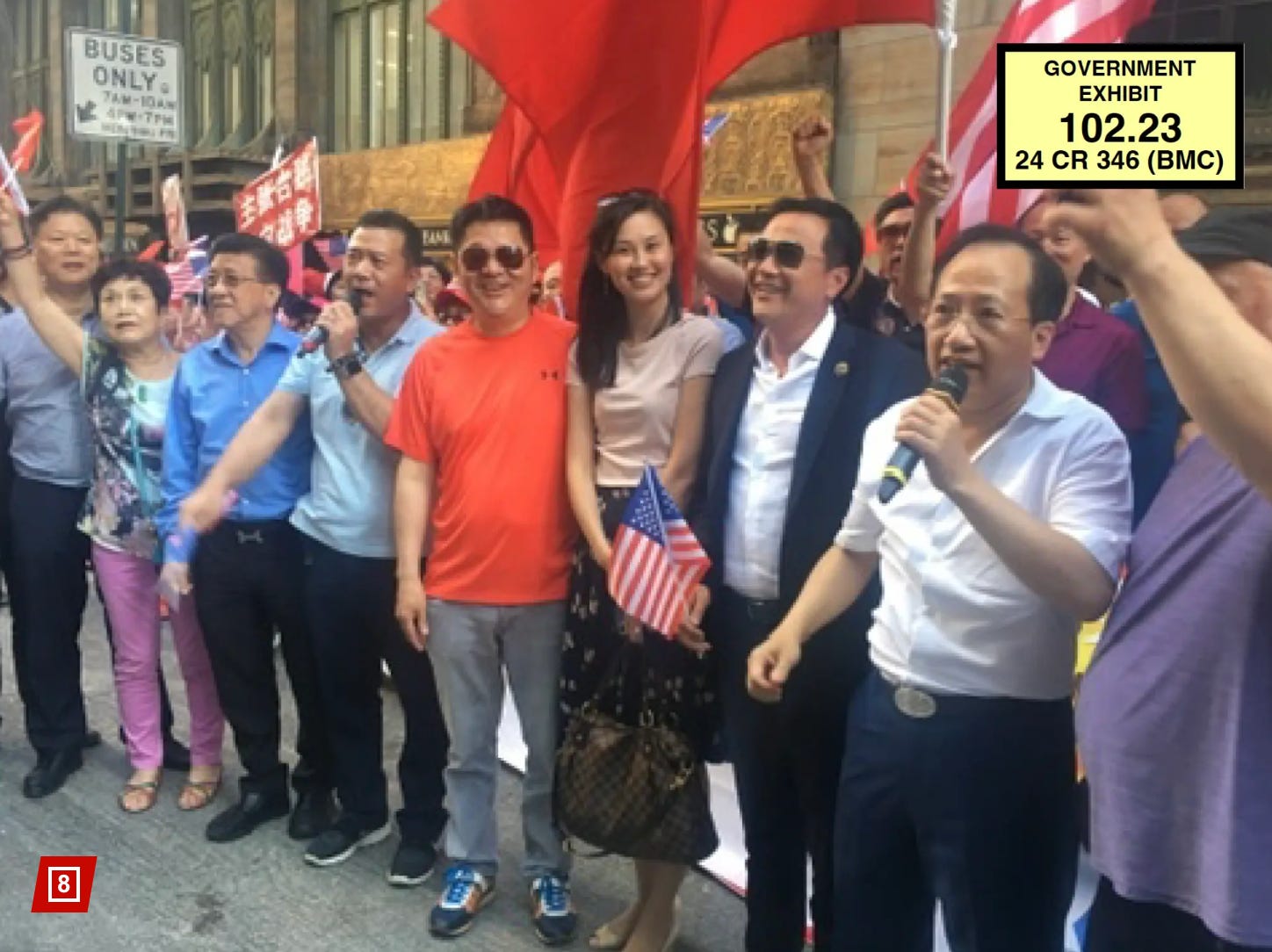
BROOKLYN — Yan Po Zhu, a Long Island real estate developer who stood beside Linda Sun, the former aide to Governor Kathy Hochul now facing retrial on charges that she served as a covert agent of the Chinese government, at a 2019 New York demonstration against the visit of Taiwan’s president, and who also donated to the Fujianese association whose offices housed the Chinatown police station run for Beijing by the now-convicted Lu Jianwang, has been indicted in a sensational bribery scheme that prosecutors say monetized New York City’s emergency migrant-shelter program through a former senior aide to Mayor Eric Adams, with the payoffs laundered through a pair of law firms.
The developer, also known as Andy Zhu, is charged alongside Frank Carone, the power broker who ran City Hall as Adams’s chief of staff. Carone, prosecutors allege, accepted roughly $120,000 to steer a lucrative shelter contract toward Zhu’s hotel over the repeated objections of the city’s own social-services professionals, who warned that New York already had too many migrant-shelter hotels concentrated in Long Island City.
The hotel ultimately collected $6,825,000. All four defendants—Zhu, Carone, Carone’s brother Anthony, and Zhu’s business manager Crystal Chen—have pleaded not guilty and are presumed innocent. Eric Adams himself is not accused of wrongdoing.
Andy Zhu is no marginal condo salesman.
His company’s own description credits him with leading more than five million square feet of development across commercial, warehouse, mixed-use and residential projects, with completed work valued at over $3 billion—a portfolio that straddles the United States and China.
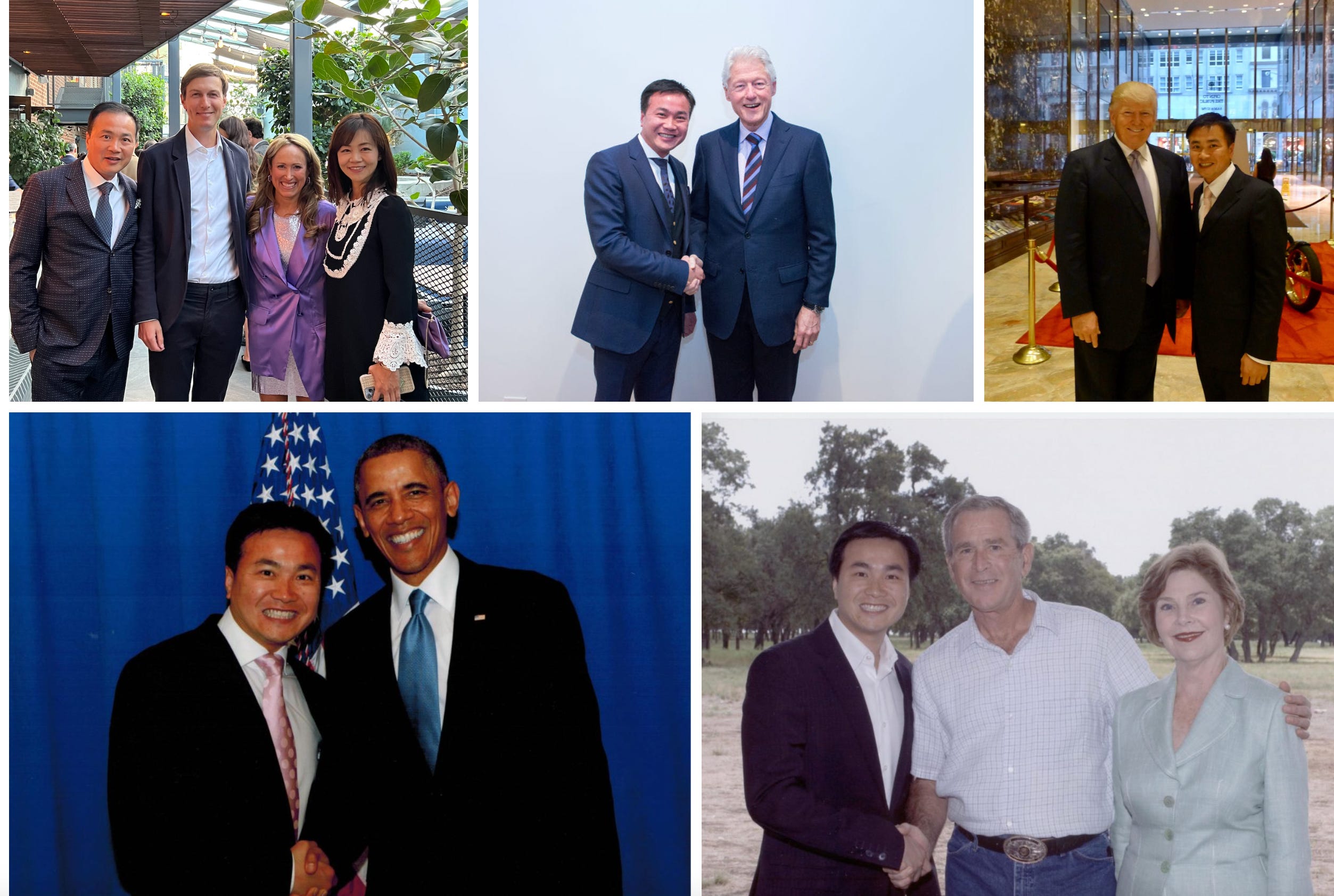
In Queens, the center of his holdings, his work has run to large residential projects: in the mid-2010s, through Triple Star Realty, he was tied to the Assi Plaza site in Flushing, where plans called for a fifteen-story mixed-use building with 265 condominium units. It is wealth on a scale, built on China-to-US investment flows, that placed Zhu among the donors and dinner companions of New York’s political class—his company’s website features him smiling beside four United States presidents, Barack Obama, Bill Clinton, Donald Trump and George W. Bush.
The Bureau’s reporting, alongside this week’s coverage in the New York Times and the New York Post, has traced a dense tangle of connections running from Zhu into Chinese state-linked financing and into the diaspora networks surrounding both Linda Sun and Harry Lu—community associations now drawing scrutiny from the House Select Committee on the Chinese Communist Party, which has pressed federal agencies over concerns that their tax-exempt status is being exploited in ways that could enable election interference, a concern the committee grounded in a Times investigation.
And Zhu’s real estate wealth carries Chinese state ties, The Bureau has confirmed. The data service PincusCo lists his Long Island City condo holdings as financed in part by the Industrial and Commercial Bank of China, a state-owned Chinese bank, including a roughly $13 million loan in March 2020 and an $11.4 million loan in December 2025.
On its face the case is a New York story as old as Tammany: money moving through brokers to bend a public decision. Zhu is charged in neither Sun’s nor Lu’s influence case, but his documented ties run into both—including, in the Sun prosecution, his presence at what amounts to one of the most overt acts the government has illustrated in photographic and video evidence, the 2019 protest against Taiwan’s president.
Just as prosecutors allege that Sun and her husband exploited the Covid-19 emergency to steer lucrative pandemic-supply contracts to favored Chinese vendors, the case against Zhu and the Carone brothers turns on the monetization of another crisis of that era—the migrant influx that overwhelmed New York City’s shelter system. Zhu’s hotel, the Microtel in Long Island City, had been rejected by the Department of Social Services as too small and too clustered among shelters the neighborhood was already resisting.
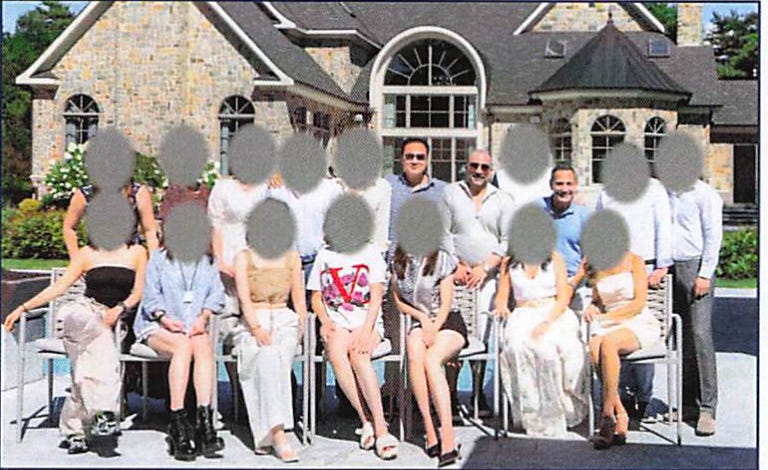
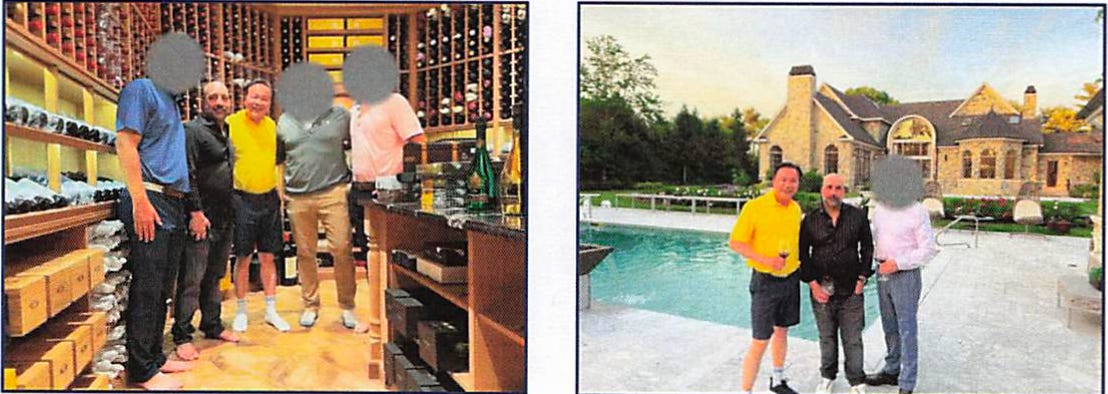
So Zhu, prosecutors say, leaned on a growing personal friendship with Carone, socializing at his Nassau County mansion and texting him the hotel’s address directly. “Thank you my big guy,” Zhu wrote in September 2022.
Within days the directive to reconsider the Microtel was moving down through the agency. By October a city official told staff the hotel had “come directly from the top . . . I know it is in Long Island City, but we should assume it is approved.” Career staff warned it would house fewer migrants in a crisis and force the city to open still more sites. The contract went through anyway.
What the money meant to the people moving it shows in a set of messages, originally in Mandarin and translated by the government, between Chen and an employee who wired the payments.
“The boss completely trusts the two brothers,” Chen wrote of Frank and Anthony Carone, through whose dormant law-firm account the bribes were funneled as sham legal fees. Asked whether it all came down to handing over the money, she answered: “In the end, it’s all about money and giving the two brothers a way out.” In the same thread the wiring employee spoke of leverage—that the payments had bought a hold that could be used again.
New York political access did not come from nowhere. Zhu is a prolific donor across the American political spectrum.