


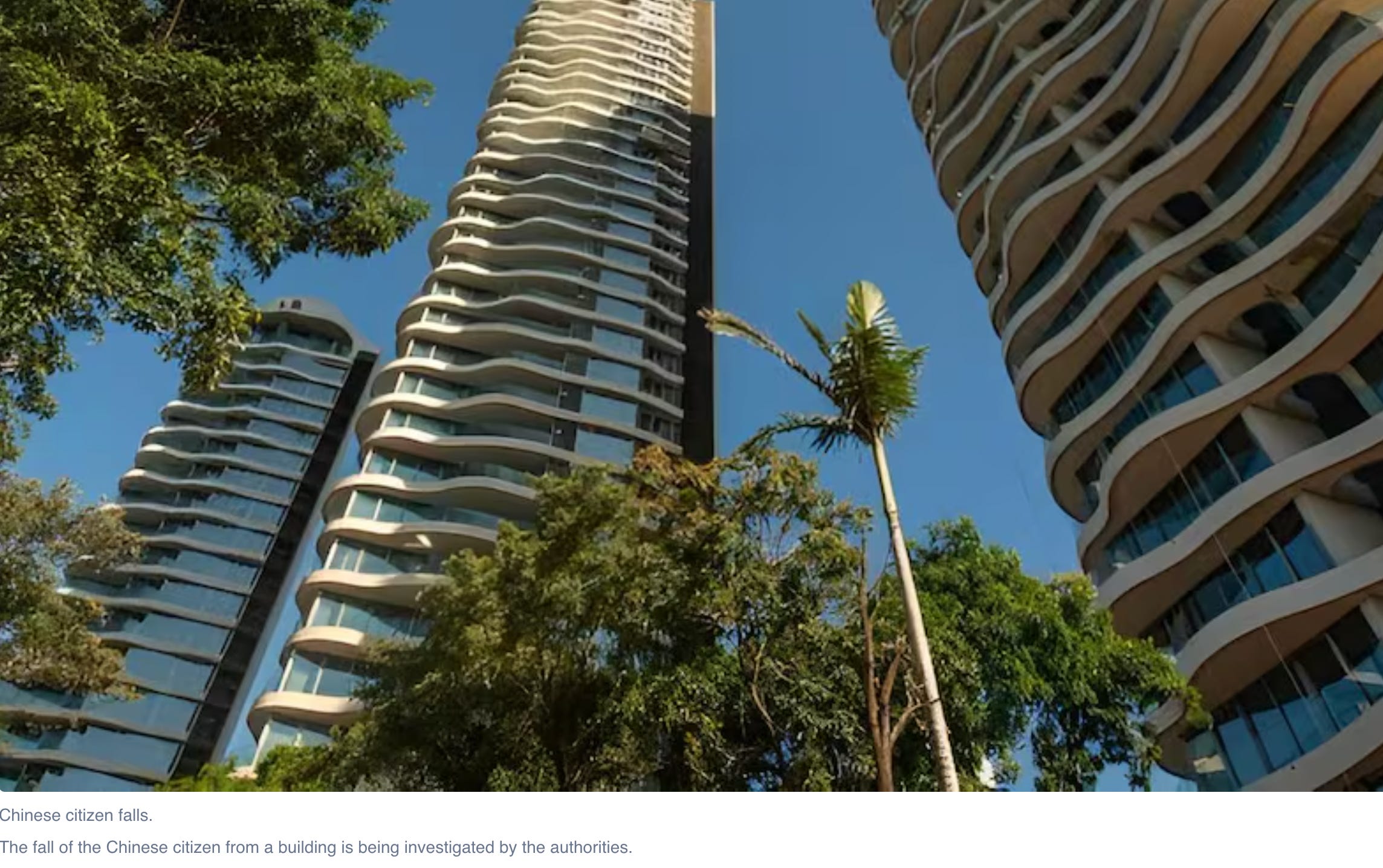
VANCOUVER — Harry Chun Tak Yeh, a Hong Kong-born Canadian who became an early Bitcoin investor and later founded Quantum Fintech Group, was found dead at about 4:30 a.m. on August 7, his body at the foot of the tower, naked and covered by a black plastic bag, according to Paraguayan reporting citing police interviews.
What investigators found upstairs was equally suggestive.
Police and forensic investigators entered a 30th-floor space used by Yeh and found doors open and the interior in considerable disorder. Police Director Francisco Ávalos reported that objects were strewn across the floor and some electrical cables appeared to have been ripped out. The head of the homicide unit, Abel Cantero, said evidence gathered from two units rented by Yeh was turned over to the Public Prosecutor’s Office.
Yeh occupied both the 30th and 27th floors, according to Ávalos. Police described the upper floor primarily as a work space containing numerous high-end computer systems, while Yeh apparently lived on the 27th floor with his Brazilian partner.
According to reports from Paraguay, a police investigator said the building’s extensive physical security and video surveillance made it difficult, in his assessment, for an unknown person to have entered without being detected.
A Canadian Chinese-language report published Thursday, citing prosecutor María del Carmen Palazón, said preliminary evidence was leaning toward suicide but that investigators would not make a final determination until autopsy and other forensic results were complete. The report said forensic specialists had taken bodily-fluid samples to test for substances that could have affected Yeh’s behavior, and had documented handprints and apparent contact marks around an open glass window near the 30th-floor office.
But The Bureau’s review of British Columbia Supreme Court records found another significant dimension to Yeh’s history: years before his international crypto ventures expanded, he had been a substantial customer and one of the larger known claimants in one of Canada’s more notorious cryptocurrency exchange collapses.
In December 2019, Yeh sued Vancouver’s Einstein Exchange and related companies, alleging fraud, forged or falsified wire-transfer confirmations and the failure to return more than US$4.3 million in cryptocurrency.
The lawsuit alleged that Yeh used Einstein not simply as a personal cryptocurrency account, but to process transfers for himself and his clients. Beginning in 2017, according to the claim, he regularly moved Bitcoin and other cryptocurrency through the exchange and used affiliated companies to facilitate wire payments to clients and creditors.
The claim also alleged that Einstein companies provided false or forged confirmations for several wire transfers. Yeh said the episode damaged his reputation and client relationships and forced him to cover obligations arising from transactions conducted through Einstein.
Yeh ultimately obtained a judgment by default against Einstein Capital Partners after the company failed to respond to his lawsuit, with damages and costs left to be assessed. But the subsequent court record reviewed by The Bureau shows no damages award or recovery, suggesting Yeh was never able to collect the millions he sought.
Einstein’s principal later admitted in March 2026 that he was responsible for the Einstein companies’ fraud and agreed to pay the British Columbia Securities Commission $1 million, the maximum amount available for that misconduct. Separately, in 2019, the commission notified the RCMP of possible money-laundering concerns raised by a former Einstein employee. By the time Yeh filed his lawsuit, the companies were already in receivership; an interim receiver found less than $45,000 in cash and cryptocurrency against customer liabilities exceeding US$18 million, and the companies were dissolved in 2020 with no assets remaining.
Paraguayan police said Yeh had entered the country as a tourist using a Canadian passport, while Canadian Chinese-language reporting published Thursday noted that Yeh had also displayed a Canadian passport in his own social-media postings.
A remarkably detailed 2010 profile, originally reported by the Vancouver edition of World Journal and republished by China News Service, the state-run news agency operating within China’s united front system, described Yeh as a Hong Kong-born Canadian Chinese immigrant entrepreneur. It reported that his family had moved from Hong Kong to Canada and that his parents built an import-export business, bringing merchandise from Hong Kong into Canada.
Caixin, a Beijing publication backed by state-linked Chinese capital, reported from Hong Kong on Thursday that Yeh was an ethnic-Chinese cryptocurrency figure born in Hong Kong who emigrated to Canada while young.
Long before Bitcoin, Yeh was reportedly building businesses in the Vancouver technology sector.