

By Brenda Shaffer
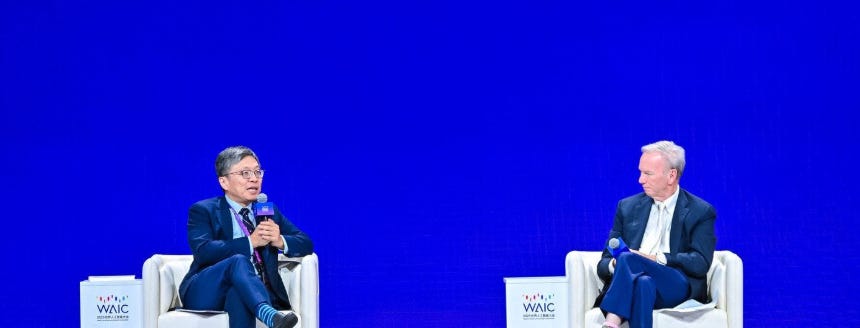
WASHINGTON, D.C. — Former Google CEO Eric Schmidt is one of the smartest and most successful people in the world. Yet even he has fallen for the myth that China’s economy runs primarily on renewable energy. In a recent interview discussing China-US competition in the field of AI, Schmidt boldly remarked that “China has infinite energy, most of it renewable.”
In reality, wind, solar and hydropower provide 31% of China’s electricity—a renewable share far below Canada’s 66% and the EU’s 54%. Renewables provide only 6% of China’s overall energy supplies, lower than the 9% in the United States. China is also one of the most reliant countries in the world on coal, consuming more than all other countries combined, and is the world’s largest emitter of greenhouse gases. The electric vehicles that comprise a relatively large percentage of China’s cars (10%) should not be called EVs, but CVs—coal vehicles.
Despite that, China has successfully projected an image of itself as a green powerhouse by relying on a few pillars of propaganda.
First, many people are unaware of basic facts about how the world produces and consumes energy. Fossil fuels make up 86% of global energy consumption and 86% of China’s energy consumption. Many who promote China as a green hero confuse electricity statistics with figures for energy consumption as a whole; in most countries, electricity makes up about a quarter of overall energy consumption.
Second, the most important sources of energy data, the International Energy Agency (IEA) and the Energy Institute, regularly praise China’s role in the “energy transition,” a nonexistent phenomenon that activists try to speak into existence. The IEA calls communist China “a leader of renewable energy expansion worldwide and a key country for global energy transitions.” The London-based Energy Institute states that China is emerging as the “green energy leader”. People who don’t have time to comb through the data trust the assessments of these important institutions despite their renewable energy agendas.
Third, few mainstream journalists cover energy and climate issues with objectivity. Media outlets like the Associated Press and the Guardian publish stories from journalists who are sponsored by outside foundations to report on climate and energy in a way that promotes the energy transition and climate emergency narratives. Even The Globe and Mail receives funding from Rolex to support its climate coverage.
Finally, climate organizations have promoted cooperation between Western governments and Beijing in the name of fighting climate change, which they see as the greatest threat to humanity. Many such organizations have told their governments to ignore China’s human rights violations for the sake of climate, including by criticizing the Biden administration’s ban on imports of Chinese solar panels produced with Uyghur slave labor. And, they often promote their image as a green leader.
Many of these climate organizations are Canadian.
The Executive Director of Climate Action Network Canada, Caroline Brouillette, praised the Mark Carney–led government for establishing a strategic partnership with China earlier this year: “This is Canada’s firmest statement on climate cooperation since Mark Carney took office—and it’s notably in partnership with a global superpower.” Brouillette also praised Carney’s reductions of tariffs on Chinese electric vehicle imports.
China does lead the world in manufacturing hardware for renewable energy, including wind towers and blades, solar panels, and electricity inverters, which it sells to Western countries who happily ignore the fact that most of it is produced by coal-fired electricity. Western dependence on this hardware gives Beijing a means to infiltrate Western energy systems and a revenue stream that will continue as long as its customers remain reluctant to manufacture domestically—which is to say indefinitely.
Due to China’s reliance on cheap home-grown coal, many Western countries with higher levels of renewables in their mix and thus higher electricity production costs cannot compete. As the West adds significant amounts of renewable energy capacity to its grids, electricity production there will become more expensive and less stable. Exporting manufacturing to China may get emissions off Western books, but it increases emissions overall.
China has earned billions selling renewable-energy hardware, while policymakers in energy-abundant countries like the United States and Canada have been persuaded to leave valuable resources in the ground and rely on that hardware instead.
The same networks that have promoted China’s image as a green leader are also battling the establishment of data centers in the West. As Beijing aggressively builds its own data center capacity, it is investing resources to convince Westerners that these centers are dangerous, energy-sucking blights. China knows that the easiest way it can win the AI race is by convincing the West to restrict itself—and after its propaganda successes with renewable energy, who can blame it?
If Eric Schmidt, someone who played a ground-breaking role in the global data revolution and has better access to data than most, believes the majority of China’s energy is renewable, China must find it easy to convince our publics of many myths.
Prof. Brenda Shaffer is a faculty member in the Energy Academic Group at the U.S. Naval Postgraduate School and a nonresident senior fellow at the Atlantic Council’s Global Energy Center. An international energy and foreign-policy specialist, her research focuses on energy security, Iran, the Caspian region and the relationship between energy and geopolitics.
China makes up more than half of the world's coal consumption, 92.2 exajoules.
China emits over 30% of the world's greenhouse, gases, almost triple of the USA.