Cartels Shift Border Crossings North, As U.S. Indictment Alleges Smuggling Ring Flew Mexican Migrants Into Canada, Guided Them Across Vermont
OTTAWA/WASHINGTON — U.S. federal prosecutors have unsealed an indictment alleging that a Dominican national and a U.S. citizen conspired to move foreign nationals from Mexico and Central and South America into the United States by flying them into Canada, staging them through Quebec, and then guiding them on foot and by vehicle across the Vermont border — a pattern investigators say reflects Mexican cartel-linked human-smuggling networks exploiting a “north border” pathway long viewed as secondary to the U.S.–Mexico frontier.
The case, announced February 11 by the U.S. Department of Justice’s Criminal Division, is the latest in an accelerating series of federal prosecutions targeting smuggling networks that use Canadian airspace and lightly patrolled border crossings — stretching from Vermont and northern New York into New Hampshire and, increasingly, Maine — as a transit corridor for narcotics and human cargo into New York City and the American interior.
For The Bureau, the indictment confirms a threat architecture this publication identified in prior reporting: the direct line between Ottawa’s 2016 decision to lift visa requirements for Mexican nationals, the deepening cartel foothold in Canada documented by the country’s own border intelligence, and the emergence of the Canada–Vermont corridor as a functioning smuggling pipeline — all of which were flagged by CBSA’s own analysts, whistleblower testimony, and U.S. border-encounter data well before these allegations reached a federal grand jury.
Court documents unsealed this week charged Francisco Antonio Luna Rosado, 27, a Dominican national described as illegally present in the United States, and Jesus Hernandez Ortiz, 37, of Puerto Rico, with conspiracy and 12 counts of smuggling foreign nationals into the country for profit — charges tied to a September 17, 2023 crossing event. Luna Rosado also faces two counts of transactional money laundering, alleging that after delivering his human cargo from Canada to New York City and collecting payment from the migrants themselves, he funneled the proceeds through the U.S. banking system in transactions exceeding $10,000.
From at least August 2022 through March 2024, in the U.S. government’s telling, Luna Rosado coordinated the movement of groups who first flew from origin countries — Mexico, Guatemala, Honduras, El Salvador, Colombia, and elsewhere across Central and South America — into southern Canada, then crossed the Canadian border into northern Vermont guided by live, shared cellular location data. From there, prosecutors say, Luna Rosado relied on an encrypted chat group of roughly 70 participants to dispatch drivers — including Jesus Ortiz — to collect the migrants at prearranged points and transport them south to New York City, where payments were made in U.S. currency.
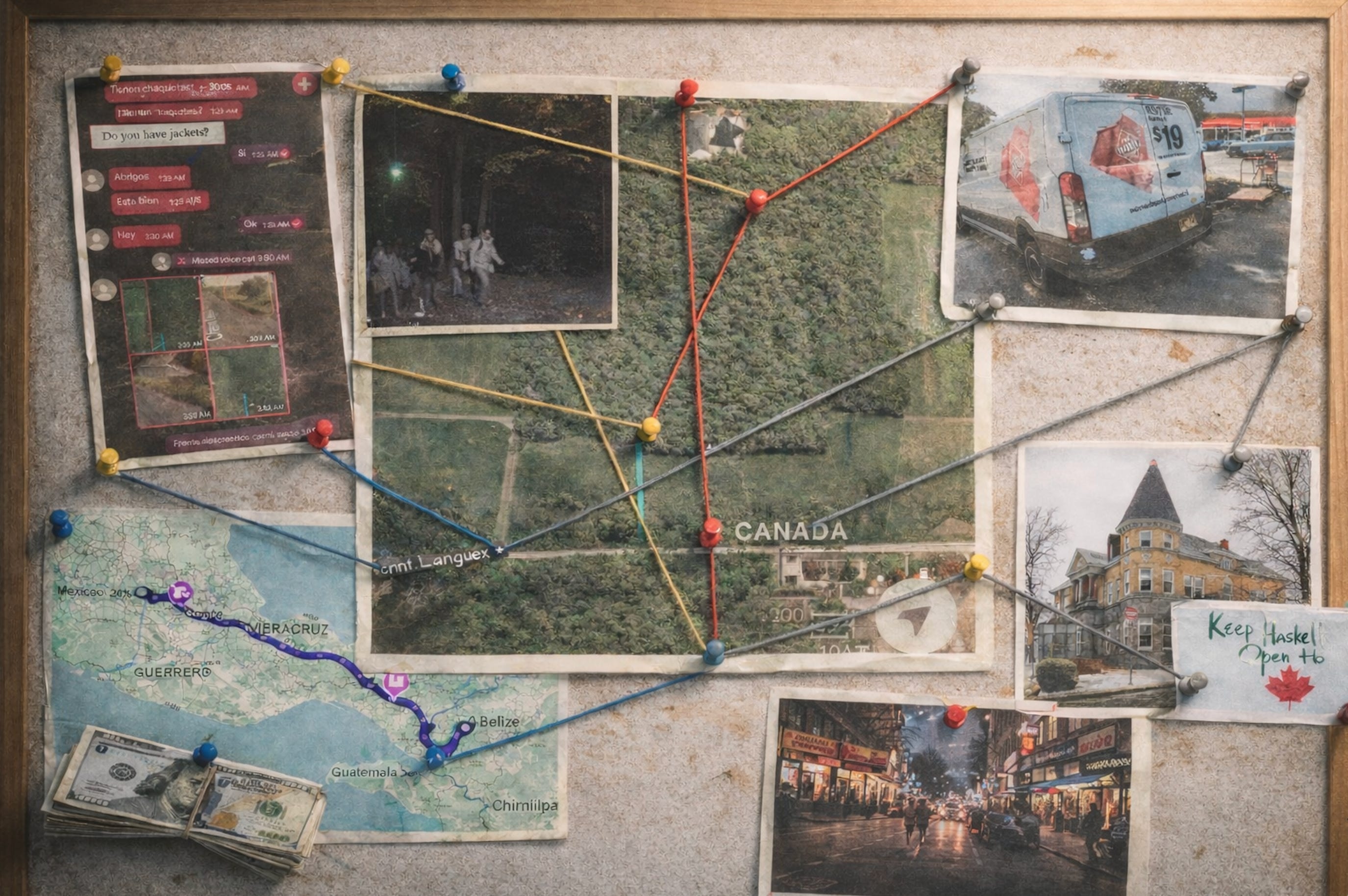
Investigators included still images in the charging materials showing groups walking through rural border terrain in the dark and a rented Home Depot cargo van that law enforcement later stopped during one of the alleged runs. Prosecutors also cited translated text-message exchanges between the two men and separate communications with the migrants themselves, arranging pickup locations, wayfinding details, and payment terms.
The crossing point, according to case evidence and photographs, was a wooded stretch along Chemin Lagueux in Stanstead, Quebec — a small border town so intertwined with its Vermont neighbors, Derby Line and Holland, that a library straddles the international boundary and drinking water is pumped from Canadian wells into an American reservoir. It is located just 150 kilometers south of Montreal, a growing nexus of Latin American cartel drug and human trafficking networks that move product, humans, and synthetic narcotics south across the border.
Court filings from the investigation, which also involved the Vermont U.S. Attorney’s Office and the sector’s northern Customs and Border Protection units, include satellite imagery captured from the smuggling network’s own phones showing a GPS-pinned route running south through dense forest from the Canadian side of Chemin Lagueux into Vermont.
Text messages exchanged in the early morning hours between Luna Rosado and the migrants he was guiding paint a granular picture of the operation at ground level: “Tienen chaquetas?” — Do you have jackets? — at 1:23 AM, followed by photos of rural roads and a farmhouse sent as wayfinding landmarks in the dark, and the instruction “Frente a la casa ahi caminaremos” — We will walk in front of the house. By 3:33 AM, the group was moving. The images and messages were captured from the network’s communications and included in the government’s motion for pretrial detention, filed February 11, 2026.
The location itself speaks to concerns voiced by FBI Director Kash Patel, who has argued before Congress and in public statements that Mexican cartels, Chinese Communist Party-linked synthetic narcotics producers, and Iranian threat networks are exploiting the vast and largely unguarded border between Canada and the United States as a staging ground to move drugs, humans, and in some cases suspected terrorists into American cities. In public statements in 2025, Patel warned that the “effective resolution” of the southern border crisis had caused adversaries to shift resources northward, telling lawmakers: “Where’s all the fentanyl coming from still? Where are all the narco-traffickers going to keep bringing this stuff into the country? The northern border.”
Stanstead and its adjoining Vermont towns sit along one of the most porous stretches of the 90-mile Vermont–Quebec border: a landscape of dense second-growth forest, agricultural fields, and unmarked rural roads where the international boundary is, in most places, invisible to the eye.
The Luna Rosado indictment arrives in a prosecutorial sequence that has sharpened markedly since the fall of 2024, each case describing nearly identical operational mechanics: migrants flying into Canada, crossing on foot into Vermont’s rural northeast, and being driven south to New York City or beyond.
In September 2025, Attorney General Pamela Bondi announced in Tampa that the Justice Department would surge Joint Task Force Alpha resources specifically to the Canada–New York and Canada–Vermont borders, describing the same cartels designated as foreign terrorist organizations as now operating on the northern border. Bondi characterized the shift as significant in scale: smuggling across the northern border, she said, had become “much worse, much more prevalent,” and constituted part of a multibillion-dollar enterprise that would not cease once the southern border was secured.
A senior Department of Justice official confirmed at the time that the smuggling operators working the northern route were largely from South and Central America — not Canadian nationals — and were flying north. The official attributed the shift in part to progress dismantling organizations at the southern border, which had pushed networks to find alternative routes into the United States.
The Bondi announcement came alongside the indictment of Norma Linda Lozano, a 53-year-old Michigan woman charged with seven counts including conspiracy, who allegedly drove from Michigan to Vermont between February and November 2024 to collect migrants from Guatemala, Honduras, Mexico, and El Salvador who had crossed from Canada on foot using GPS coordinates provided by the smuggling organization. That case was described as the first prosecution in the District of Vermont coordinated under Joint Task Force Alpha.
Earlier, in a case that concluded with a guilty plea in 2024, a Mexican national named Barragan-Palacios admitted to making approximately 30 smuggling trips between August 2023 and January 2024, moving nearly 100 migrants from the Canadian border in Vermont to the New York City area. He was apprehended after leading Swanton Sector Border Patrol agents on a high-speed pursuit through icy roads in a rented pickup truck carrying six migrants unsecured in the bed.
In December 2025, a Plattsburgh, New York woman was indicted under JTFA and Operation Take Back America for smuggling migrants across the northern border for profit, demonstrating that the corridor extends across the full Swanton Sector into New York state.
By the DOJ’s own accounting, Joint Task Force Alpha has now produced more than 435 domestic and international arrests of leaders, organizers, and significant facilitators of alien smuggling, more than 385 U.S. convictions, and more than 330 significant jail sentences. The Attorney General has expanded the task force’s mandate to include Canada, the Caribbean, and the maritime border — an institutional acknowledgment that the northern approach is no longer a secondary concern.
The Canadian Cartel Nexus
For Canadian authorities, the Vermont indictments underscore a persistent vulnerability long discussed in security briefings but less frequently visible in court filings: the use of commercial air routes into Canada combined with short overland movements into lightly populated U.S. border sectors.
This is the corridor The Bureau has reported on extensively. In prior analysis, this publication traced the origin of the Canada–U.S. smuggling vulnerability to a specific policy decision: Prime Minister Justin Trudeau’s December 2016 removal of visa requirements for Mexican nationals, which proceeded despite unambiguous intelligence warnings from the Canada Border Services Agency that the move would facilitate travel to Canada by individuals with criminal records, including drug smugglers, human smugglers, money launderers, and cartel foot soldiers.
CBSA intelligence reports released under access-to-information laws and examined by The Bureau showed that “serious-crime” flags tied to Mexican nationals jumped from 28 in 2015 to 53 in 2016 — an 89 percent year-over-year rise. By mid-2017, the figure had reached 65, with national-security flags in the first half of that year exceeding the previous two years combined. Analysts warned that removing visas would enable entry by major cartels including Sinaloa, Jalisco New Generation Cartel, La Familia Michoacana, and Los Zetas.
By 2019, Canadian media reported that at least 400 Mexican criminals connected to drug trafficking, including sicario hitmen, were operating in Canada, half of them in Quebec. Whistleblower Luc Sabourin, a former CBSA officer who testified under oath and supplied an affidavit to The Bureau, stated that when Ottawa removed the visa requirements, more than 400 members of Mexican cartels entered Canada, and that CBSA subsequently could not locate many of them, with several hundred believed to be operating freely in the country.
In a recent interview, Sabourin, who maintains contact with some of his former colleagues inside the agency, said he understands that cartel smuggling routes are continuing to expand beyond the region southeast of Montreal detailed in this new indictment, pushing into even more remote locations along Maine’s northern border with Quebec.
Sabourin said he believes Ottawa continues to ignore his urgent warnings about Canada’s border vulnerabilities — including what he describes as the infiltration of CBSA by organized crime networks that he believes have gained access to Canadian government files and have leveraged weak policies around immigration, passports, and visas to move operatives and contraband with impunity.
On the U.S. side, Customs and Border Protection recorded an 846 percent spike in encounters along the northern border’s Swanton Sector — Vermont, northern New York, and New Hampshire — between October 2022 and January 2023, driven largely by Mexican nationals re-routing via Canada. The operational timeline alleged in the Luna Rosado indictment — beginning August 2022 — maps almost precisely onto this surge.
Federal officials emphasized the case falls under Operation Take Back America, the nationwide DOJ initiative that, according to the department, marshals its full resources to, in its words, “repel the invasion of illegal immigration” and “achieve the total elimination of cartels and transnational criminal organizations.”
The rhetoric is perhaps inflammatory, and politically incorrect to many North American voters, but the underlying problem is not. The operational pattern — fly into Canada, walk across the Vermont woods, ride to New York City — has been prosecuted in some form since at least 2023, and was foreseeable, on the basis of publicly available intelligence, considerably earlier than that.
Swanton Sector apprehension data illustrates both the scale of the problem and the impact of an enforcement surge. In March 2024, U.S. Border Patrol recorded 1,109 apprehensions in the Swanton Sector; by March 2025, apprehensions were down to 54—a roughly 95 percent decline. Border Patrol officials cautioned, however, that even as crossing totals fall, human-smuggling and contraband trafficking networks can persist and adapt.
And as Luc Sabourin, the Canada Border Services Agency whistleblower, argues, cartel-linked routes could be shifting to even more remote stretches of the Houlton Sector—the U.S. Border Patrol sector that covers Maine—along the Quebec and New Brunswick border approaches.


Organized crime at this level doesn't happen without a combination of corruption and misdirection of enforcement. I have seen little evidence of direct corruption by Mexican crime groups. Given the collaboration between Chinese and Mexican organized crime, and the depth of political influence and outright corruption by Chinese organized crime and political groups, are the Chinese acting as a go between to ease Mexican human smuggling and drug trafficking? Whether or not, at best, Canada is looking ever more like a falled nation. At worst, a rogue nation that is a threat to the free world.
Years ago, I reported to the RCMP, First Nations miltary style exercises with automatic weapons. They told me they have no authorization to conduct police operations on FN reserve lands. It makes sense that Mexican organized crime would exploit this "loop hole" across Canada.