

OTTAWA – As Canada prepares to unveil a new national security strategy, The Bureau’s exclusive reporting exposes an uncomfortable test for the Liberal government: what has it done to close the vulnerabilities Canada’s intelligence community identified seven years ago—and is Mark Carney now making them worse by deepening partnerships with governments accused of exploiting them?
Classified 2019 material from the National Security and Intelligence Committee of Parliamentarians, obtained exclusively by The Bureau, describes foreign governments reaching into Canadian communities to monitor dissidents, manipulate organizations and influence political decisions.
Yet Carney’s drive to reduce dependence on Washington, Canada’s Five Eyes intelligence partner, is drawing Ottawa closer to China, India and Turkey—governments implicated in those assessments. If misguided commercial ambition continues to outpace protection against interference, his promised economic independence risks giving foreign governments greater leverage over Canadian life.
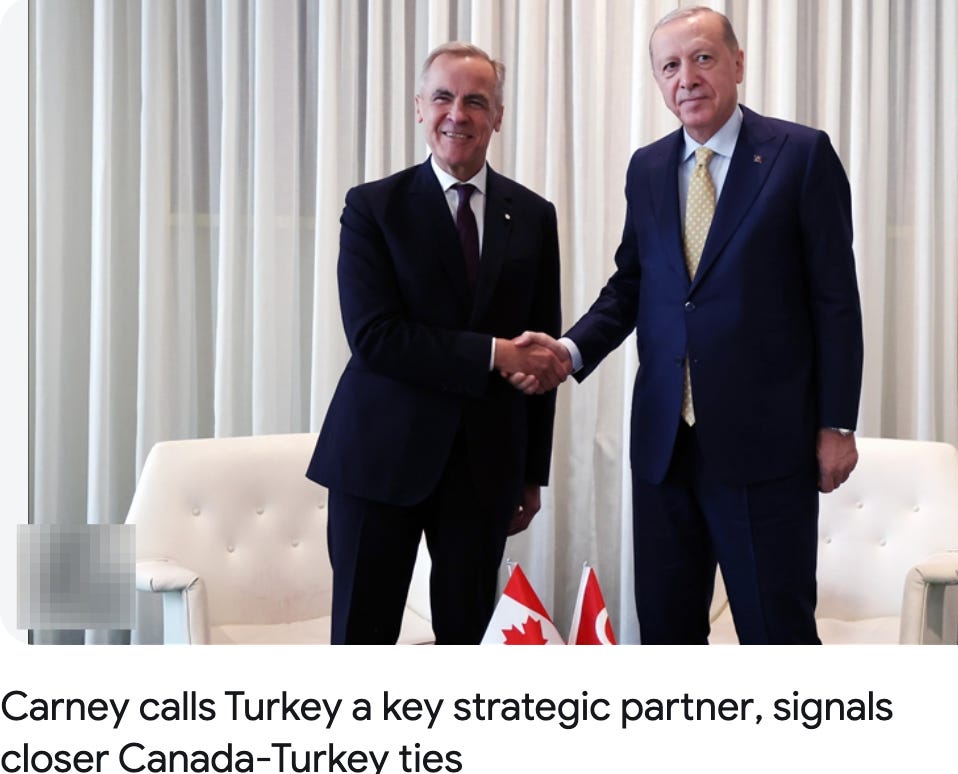
Consider Turkey, which Carney last week called “an exceptional partner” while standing alongside President Recep Tayyip Erdoğan in Ankara.
The intelligence record obtained by The Bureau presents a darker picture: CSIS estimated, in an assessment cited by the 2019 report, that hundreds of individuals in Canada had been “blacklisted” by the Turkish state. The report describes Turkey’s covert surveillance of suspected Gülen movement affiliates here—and persecution, travel bans, frozen bank accounts and lost education and employment opportunities for some who returned to Turkey.
The underlying intelligence assessment, identified in a footnote, was dated December 17, 2018: “Turkey’s anti-Gülenist activities in Canada.”
Last week, Carney and Erdoğan launched a strategic partnership encompassing trade, investment, energy, defence and security. Carney announced that free-trade negotiations would begin the following month. The government’s public account offers extensive detail about opportunities. It does not explain how Canada’s longstanding intelligence concerns about Turkey’s activities here are being addressed.
The broader report explains an unaddressed vulnerability in Canada’s multicultural society, shaped by high levels of immigration.
“The targeting and manipulation of ethno-cultural communities is the primary means through which these states control messages and seek to influence decision-making at all levels of government,” it states.
That sentence should anchor Canada’s security debate.
The report describes diplomats maintaining the illusion that local organizations express freely formed community opinion when officials of foreign states are directing them. It identifies threats, harassment, detention of relatives abroad and denial of travel documents among the methods used to enforce conformity.
Then it identifies the largest perpetrator in this discussion.
“The single biggest perpetrator, however, is the PRC.”
Against that assessment, Carney’s new strategic partnership with Beijing—announced in January with an emphasis on energy, agriculture and trade—requires a much fuller explanation of how engagement will coexist with resistance to coercion.
The report’s China findings are damning.
Chinese consulates manipulated community leadership contests. They created conflict among dissident groups. They pressured diaspora members to adopt pro-China positions, denied visas to Canadians acting against Beijing’s interests and arranged for their ostracism through community organizations.
The examples show how deeply interference penetrated everyday life.
A community leader was tasked with supplying China’s diplomatic mission with the names of Taiwan supporters. A meeting of local association heads was to be cancelled because one organization’s leader was Taiwanese.
Chinese officials or state-sponsored entities asked a local organization to lobby politicians against a Falun Gong-backed cultural performance. They dispatched a trusted community contact to a Falun Gong-related event to produce a written report. They tasked community members with preventing film screenings.
Other instructions concerned scheduling celebrations to draw audiences away from Falun Gong events, withholding support for a Taiwanese cultural festival and reprimanding leaders who attended a Taiwan-sponsored event.
The report also records a revealing boast: the PRC consul general in Vancouver claimed she controlled more than 100 community groups.
It also described clandestine, coercive repatriation activities under Beijing’s Fox Hunt and Sky Net campaigns, including threats against people residing in Canada.
Australia’s experience raises a question Carney’s government should have to answer.
Paragraph 73 records that a 2017 investigation by Four Corners and Fairfax Media found that two PRC-associated individuals had donated A$6.7 million to Australia’s Liberal, Labor and National parties over a decade. Reporting on suspected influence ties between those donors and former senator Sam Dastyari intensified pressure for action.
The Canadian connection is concrete: Ottawa was studying the warning. The report cites a Privy Council Office memorandum for the prime minister describing:
“A problem that many critics have long argued has been exacerbated by willful blindness on the part of current and former politicians, senior government officials, journalists and universities to the threat posed by Chinese authorities and their affiliates to the integrity of Australia’s sovereignty, political system, democratic institutions and economy.”
Are individuals with comparable ties to Beijing financing Carney’s Liberal Party—or other Canadian parties? What checks are those parties conducting, and what happens when intelligence warnings collide with fundraising interests?
A strategy that promises economic resilience must also explain how people targeted by foreign governments will obtain protection.
India belongs in the same discussion. The report attributes to CSIS an assessment that Indian intelligence used a diaspora blacklist to monitor people, restrict travel and recruit sources gathering information about Sikh activists. Carney is now pursuing a comprehensive economic partnership and expanded bilateral trade with India. The security implications require explicit treatment alongside the commercial objectives.
The report’s reach also extends beyond diaspora communities. It says Iranian diplomatic officials historically targeted First Nations leaders, alongside politicians at all three levels of government, often through intermediaries and clandestine funding. It qualifies that finding by saying Iran’s interference activities largely ceased after its embassy closed in 2012.
Canadian officials were documenting both the danger and counter-actions from Australia, a Five Eyes partner: new offences, a foreign-influence transparency scheme and a national coordinator.
Carney must show what protection accompanies the partnerships he is signing. Which interference activities have been disrupted? What consequences await governments that intimidate people here? How will Ottawa prevent commercial priorities from overriding intelligence warnings?
Claims of economic independence and reduced security reliance on the United States, purchased at the expense of that freedom and at the cost of tolerating abuses on Canadian soil, would amount to a failure of national security.
Turkey is an interesting dilemma. A NATO member, uses Russian missiles for defence, trying to relive the Ottoman Empire regionally, all the while playing all sides of the major political landscape.
Carney the Fool is being played by everyone for a piece of nothing.
Brazil has now blown up politically, can Canada be far behind? 2027 will test Canadian citizens tolerance for totalitarianism.
I really think Carney doesn’t care about interference just as long as he can maintain power. He has an agenda and he plans to fulfill it no matter what.