Carney’s Pivot to Beijing: Did the Canada China Business Council Help Pen Ottawa’s China Reset?
In a speech marking what Mark Carney cast as a new “era” for Canada, the prime minister thanked the Canada China Business Council for helping “bring us to this moment,” then unveiled his EV deal.
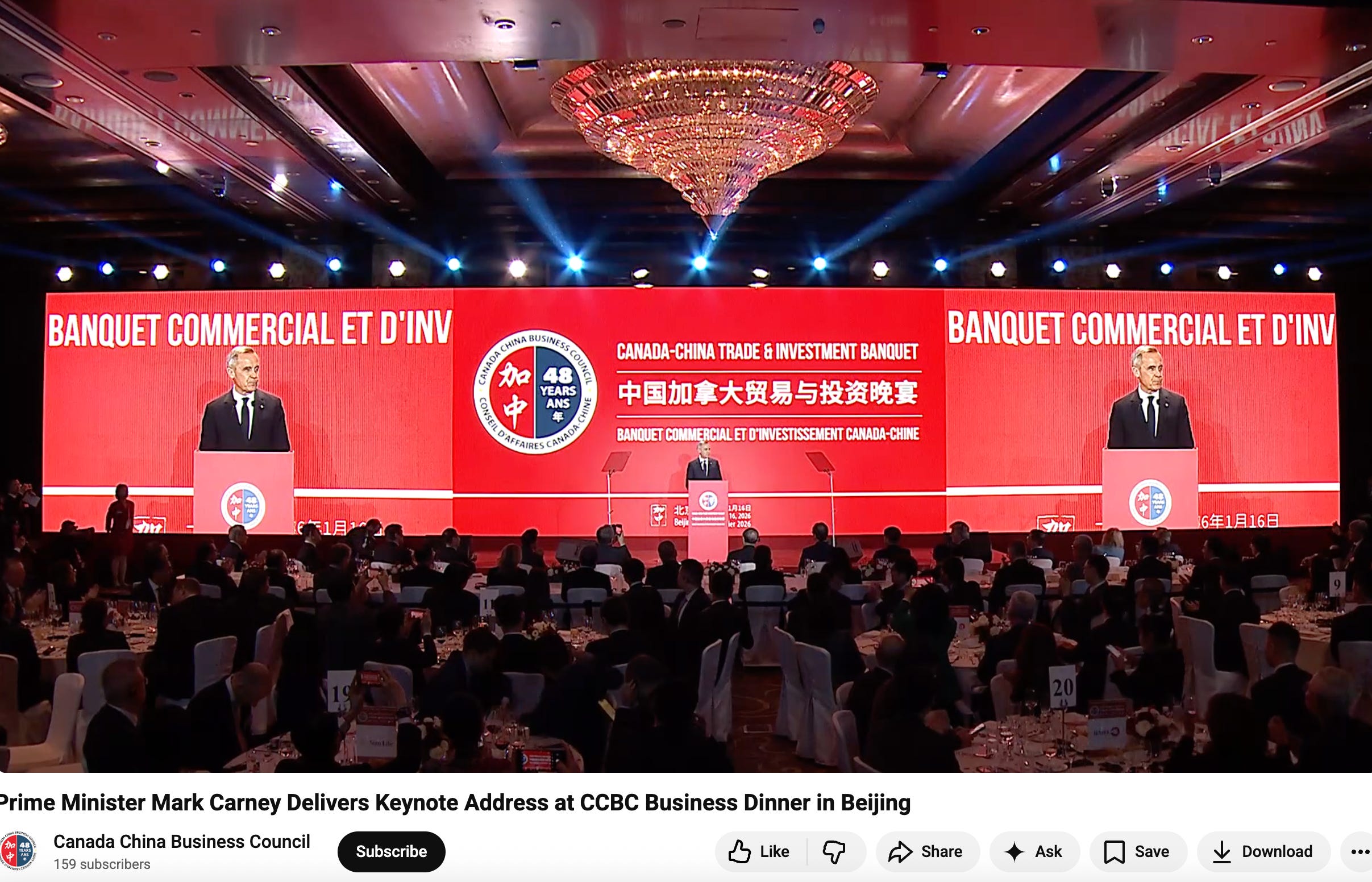
OTTAWA – In a polished Beijing banquet hall on January 16, 2026, Prime Minister Mark Carney opened what is perhaps the most important and least analyzed speech of his young premiership by turning first to Olivier Desmarais and the Canada China Business Council.
“We are honored and grateful,” Carney said. After first turning to Desmarais, grandson of former prime minister Jean Chrétien and a scion of the Power Corporation milieu of Montreal, Carney thanked “the team at the Canada China Business Council for your leadership in bringing together, look at this room, this remarkable room, together.”
He said that although recent years in Canada-China relations had been “challenging” and “uncertain,” “the leaders in this room” had “stayed resilient and focused.”
Then he delivered the line that framed everything that followed: “You’ve helped bring us to this moment.”
When “channels between governments had narrowed,” Carney said, it was “often business leaders, leaders in the educational sector, broader leadership who continue to build new possibilities and partnerships.” He thanked them for their “leadership and your persistence.”
That applause mattered more than it may have appeared.
A prime minister was publicly acknowledging, in Beijing, before a room of Canadian and Chinese business elites, that a private commercial lobby had sustained the conditions for a sovereign foreign-policy reset — and deserved credit for doing so. He was not thanking Parliament. He was thanking the Canada China Business Council.
The moment Carney said they had helped create was not a minor trade adjustment. It was the unveiling of a broad new alignment with Beijing: a “new strategic partnership” spanning electric vehicles, agriculture, investment, energy, public safety, multilateral coordination, and people-to-people ties.
A close reading of Carney’s Beijing speech offers circumstantial evidence pointing to the hidden hand behind his China pivot. The move was presented as pragmatic adaptation to a harsher world, and perhaps in part as a response to hard bargaining and bruising rhetoric from President Donald Trump. But the speech, read carefully, points to something deeper and more durable: a reset aligned with the longstanding preferences of the Canada China Business Council and the broader Power Corporation orbit, as documented in prior Bureau reporting.
The speech’s first signal that something larger was at work came in its dismissal of critics. “Nostalgia is not a strategy here,” Carney said. “In the face of global change and uncertainty, Canada is building at home, catalyzing massive new investment and diversifying and deepening our partnerships abroad.” He said Canada was “moving at pace in order to get results.”
The phrase did considerable work.
It pre-emptively cast skeptics of the China reset as backward-looking sentimentalists, while positioning the Canada China Business Council’s long years of quiet relationship maintenance — through the Meng Wanzhou affair, through Kovrig and Spavor, through the foreign interference revelations — as the sophisticated, forward-looking alternative. The people who had stayed patient and resilient were not naïve. They were, in Carney’s telling, the realists who had kept the door open until the right moment arrived. Then came the central proposition of the speech: “Diversifying our trade, deepening our relationships means above all engaging properly, respectfully, pragmatically, ambitiously with China.”
For observers who have questioned whether Carney’s government appears to be slow-walking difficult negotiations with Washington while quietly moving closer to Beijing, this speech offers an unusual number of clues. Carney did not describe China as a difficult counterpart to be managed cautiously while Canada preserved its real strategic center of gravity elsewhere. He described China as a pillar of Canada’s future prosperity.
“China is the world’s second largest economy,” he said. “It is the largest contributor year after year to global growth, contributing over the last year one-third of global growth.” He called China “our second largest trading partner” and “Canada’s third largest investor across Canada.” Trade with China, he said, supports “20 billion a year in wages” and “400,000 jobs.” “Farmers in the prairies, manufacturers and engineers in Ontario, miners in Quebec, harvesters in Atlantic Canada, all depend on trade with China.” “Two-way trade amounts to nearly $120 billion each year.” Canada, he said, has now “set the goal of doubling our exports to China by the end of this decade.” “There’s so much to build on this relationship, so much to gain,” Carney said. “The collaborative prosperity, the stability, the security.”
That language was not guarded, reluctant, or narrowly transactional. It was warm, expansive, and strategic. China was presented not simply as a large market but as an essential partner in a changing world.
The speech then moved to its organizing announcement. “Canada and China are launching a new strategic partnership,” Carney said. He defined the partnership across “five areas where we can make significant immediate gains”: “energy and climate competitiveness, trade particularly in agriculture and food, multilateralism, security and public safety, and deepening people-to-people ties.” The breadth of that formulation is striking. Carney did not describe a technical reopening in a few sectors. He described a framework extending from trade to security, from climate to public safety, from investment to social normalization.
The centerpiece was electric vehicles.
“China’s strengths, for example, in electric vehicles are formidable,” Carney said. “They’re undeniable. These are the most affordable and energy efficient and innovative vehicles in the world.”
This was not the careful language of a trade negotiator hedging against domestic critics. It was the language of admiration. And what followed confirmed it. He then set out the industrial logic in direct terms: “For Canada to build our own competitive EV sector, we need to learn from, partner with, and access and build supply chains with China.”
Those are among the most important lines in the speech. Carney was not saying Canada would temporarily tolerate Chinese electric vehicles because prices are high or domestic production remains insufficient. He was saying Canada’s own industrial future requires learning from China, partnering with China, and building supply chains with China. He was describing not managed competition but structured dependence — and presenting it as realism.
He then announced the deal itself. “To help deliver on the full potential of these partnerships and to bring down costs for Canadians, we’re going to start by allowing up to 49,000 Chinese electric vehicles into the Canadian market at the most favored nation tariff rate, which is 6.1%.” He said the agreement “returns shipments to the levels that existed prior to recent frictions,” but he presented it as the start of something much larger. “Within three years, this agreement will drive considerable Chinese investment in Canada’s auto sector,” he said, “creating good careers in Canada, accelerating our progress towards a net zero future and the auto industry of the future.” Within five years, he added, “more than half of these vehicles will be affordable EVs with an import price of less than $35,000.”
He was not merely opening Canada’s market. He was inviting Chinese capital deeper into Canada’s industrial base, and tying Canada’s affordability crisis, clean-tech ambitions, and auto-sector future to a restored partnership with Beijing.
The artificial-intelligence infrastructure reference is not a throwaway. It comes in a speech already committing Canada to deeper supply-chain integration with China across clean energy, advanced manufacturing, and financial services. The countries that shape the infrastructure of artificial intelligence shape the infrastructure of economic and strategic power. That Carney mentioned it in this context — as an investment opportunity within a broader China partnership — signals an ambition that extends well beyond a canola tariff adjustment.
He then gave the speech’s clearest summary judgment: “China is a natural and complimentary investment partner.” Canada and China, he said, have “different systems, histories, and perspectives,” but “we respect those differences.” In “a world that’s increasingly defined by uncertainty,” he said, “prosperity will belong to those who engage with strength, with pragmatism, and who can execute.” He closed with a declaration: “We’ve started a new era, a new chapter of our partnership.”
The Bureau’s prior reporting gives Carney’s speech a deeper context.
As previously reported, Power Corporation is “not simply a passive observer in the Canada–China file,” but “a powerful establishment actor with long-running China-facing commercial exposure in finance and investment channels.”
We reported that while there was “no sign of direct investments in Chinese electric-vehicle manufacturers,” Power’s “China exposure runs through China Asset Management Company (ChinaAMC), one of China’s leading fund managers.” The report states that Power is “an indirect major backer of ChinaAMC through its controlling stake in IGM Financial, which holds 27.8% of ChinaAMC.” It adds that ChinaAMC operates products “explicitly tied to the electric-vehicle supply chain,” including an ETF tracking the CSI New Energy Vehicle Index, spanning “the full new-energy vehicle chain.”
The Bureau’s conclusion was plain: “even without a disclosed Power-owned EV manufacturer, the China-facing financial architecture around Power’s orbit can still intersect with the sectors now at the centre of Ottawa’s China trade gamble.”
That same report places the Desmarais family and Power within a longer Canadian China-policy continuum. It draws on warnings from whistleblower Brian McAdam and the RCMP-CSIS Sidewinder intelligence report concerning “longstanding business ties between Power’s leadership and the CITIC system.” It cites that “CITIC Pacific’s own disclosures show that André Desmarais joined CITIC Pacific’s board in December 1997 while serving as President and Co-Chief Executive Officer of Power Corporation.” It also records Michael Kovrig’s warning, ahead of Carney’s mission to Beijing in January, that Canadians should watch closely for the business interests linked to former prime minister Jean Chrétien and Montreal’s Power Corporation, and ask who stands to benefit from the Beijing deals and the policy shifts that follow. Kovrig’s warning was explicit: “Chrétien served on the board of Power Corp., which has historic links to the Liberal party, and his daughter is married to André Desmarais, deputy chair of the financial services company.”
Meanwhile, in his speech in Beijing, Carney then widened the case through agriculture and tariffs. Canada and China, he said, had reached a “preliminary but landmark” agreement “to remove trade barriers and reduce tariffs.”
Canadian canola meal, lobsters, crabs, and peas would also benefit. “That’s a $7 billion immediate opportunity,” Carney said. He added that Canada expected “the resolution of many long-term trade obstacles on a range of agricultural sectors from beef to pet food,” and that the partnership would increase exports in this sector by 50 percent by 2030.
Then came the larger investment roadmap: “our new trade roadmap which aims to expand Canadian investment in China across financial services, energy, materials, aerospace, advanced manufacturing, agriculture, and other fields.” At the same time, he said, “we welcome Chinese businesses that plan to significantly scale up their investments in Canada in areas including clean energy, agriculture, consumer products, and beyond.” The purpose, he said, was to create “the stability and certainty that’s needed for new investment and opportunities for our workers.”
Carney extended the framework still further. Canada and China, he said, had the opportunity “to work more closely together to strengthen the world’s multilateral institutions.” They also had “the opportunity in the agreement and the framework to work together to combat crime and bolster public safety.”
In Carney’s telling, Canada and China are not merely trading more. They are participating together in stabilizing and shaping multilateral institutions, public-safety cooperation, and deeper social normalization.
The speech’s energy and infrastructure language was equally sweeping. Carney described Canada as “an energy superpower,” said Canada had “an over 80% clean grid,” and said this creates “tremendous opportunities for partnerships with China in investments including everything from energy storage to offshore wind.” He noted Canada’s oil and gas reserves, said that “this past July, Canada exported its first LG shipment to China,” and called it “a milestone in our growing role as a energy supplier.” He said that by 2030 Canada expects to produce “50 million tons” of LNG each year, “all of it destined for Asian markets,” and by 2040 plans to double that. He also said Canada is catalyzing “a trillion dollars of investment in new ports, in energy corridors, in artificial intelligence infrastructure and trade infrastructure within the next five years.”
Notably, not once did Carney — of course — embarrass his Beijing hosts with even a cautionary word about enduring human-rights concerns, including the vulnerability of supply chains to coerced labour. And Carney’s actions since, along with those of his MP Michael Ma, speak for themselves.
The “perfect crisis” reads clearly in the speech’s architecture.
Carney did not say Canada was turning to China because tariffs from Washington left no other choice. He said Canada was turning to China because China is formidable, because China is essential, because the leaders in that Beijing ballroom had the wisdom to keep the relationship alive when governments could not, and because now was the moment to “build big, build now.” Trump’s pressure did not create the agenda. It unlocked it. The destination — deeper Chinese investment in Canada’s industrial base, Canadian capital flowing into Chinese finance and advanced manufacturing, multilateral co-governance, social normalization — has the architecture of something long planned and long desired.
The question raised by Carney’s speech is larger than trade.
It is whether Canada’s governing establishment has chosen a course that is being sold as pragmatism but may amount to something else: a quiet, elite-driven repositioning toward Beijing, shaped inside the familiar corridor of Laurentian finance, legacy Liberal networks, and the Canada China Business Council, even as Canada’s most consequential economic and security partnership remains with the United States.
For observers trying to understand why Ottawa can seem hesitant, opaque, or strangely indirect in its dealings with Washington while sounding fluent, confident, and expansive in Beijing, Carney’s speech offers one answer in his own words. He appears to believe that in a world of uncertainty Canada can secure prosperity, investment, industrial renewal, and geopolitical room to maneuver through a broader and deeper partnership with China.
That belief may yet prove to be the defining gamble of his government.


You do know that the CBC, which is the arm of the government and the globe and other newspapers that have been handsomely paid by the government will never report on this. As well, Canadians have no clue and they don’t understand where they’re moving towards. It has been clearly evident that Kearney is China’s puppet. The problem that I see is that at a certain point we are going to have a reaction that is most unpleasant from our southern neighbor. You cannot have strategic alliances with China that can directly impact United States. As well, China does not like importing it likes exporting. Woe is Canada as it receives endless goods from China and sends soybeans and beef to China
Thanks Sam!