


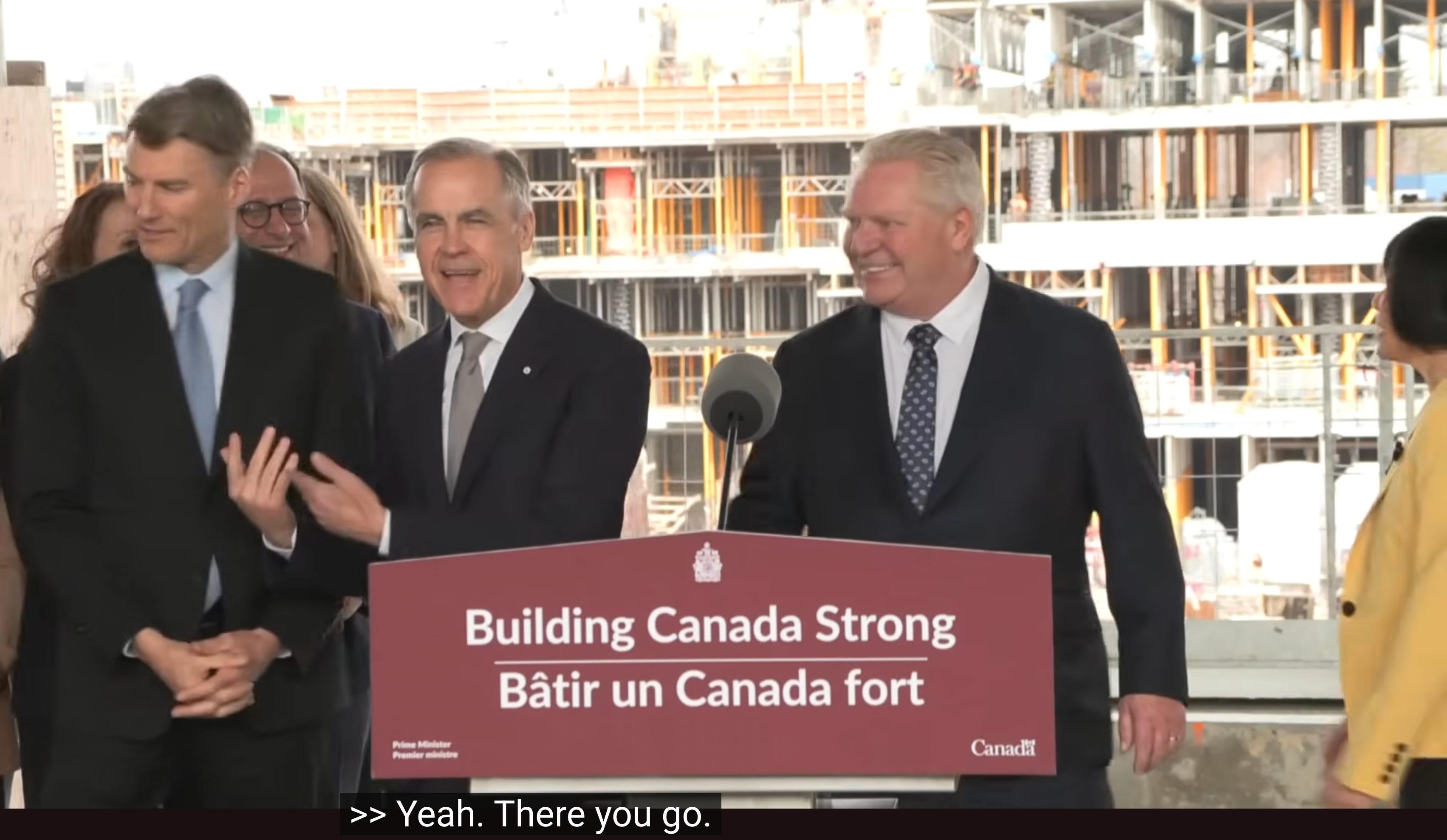
VANCOUVER — A national plan to absorb Canada’s unsold condos is unfolding in two very different shapes — one already called a bailout by some analysts but drawing little of the outrage, the other announced last week by Mark Carney and instantly setting the public on fire. Two cities, more than 4,400 unsold condos held on the books of wealthy private companies, both outcomes hard to predict — but Vancouver’s is already being cast by critics as a handout to well-connected Liberal insiders.
This is, first, a national story.
As Canada’s real estate market swoons and developers across the country sit on a record pile of finished condominiums no one is buying, two governments have moved within months of each other to take roughly the same product off the same falling market. In Toronto, a fund anchored by the province aims to acquire about 2,200 newly completed, unsold units and convert them to rentals. In Vancouver, Ottawa and British Columbia claim they will convert more than 2,200 vacant condos into affordable homes. The same maneuver, the same number, the same Prime Minister, former central banker Mark Carney, presiding over both.
Better Dwelling, the independent housing-analysis site followed closely by a generation of Canadians priced out of both markets, has built its audience on detailed and unsparing work; its co-founder, the financial analyst and former Toronto mayoral candidate Stephen Punwasi, has testified before Parliament on housing and was credited in a former RCMP deputy commissioner’s report on money laundering in real estate. Of the Toronto plan, Better Dwelling did not reach for euphemism. Ontario, it wrote, “just announced a bailout program, selling it as a housing affordability measure,” one that “clearly helps over-leveraged developers more than it helps with affordability.” It was not alone in the verdict: the BMO economist Robert Kavcic greeted the move with “Cue the bailouts.” If that is the standard, both cities qualify.
The question is how each bailout is built, and who is left holding the loss.
Only the Vancouver plan has become a firestorm, branded a bailout and interrogated daily. The asymmetry is not accidental. Toronto, the quieter case, may also be the more defensible one. The vehicle there is the GTA Rental and Affordable Housing Initiative, a partnership between the private firm High Art Capital and the Building Ontario Fund, an arm’s-length Crown agency created by Premier Doug Ford’s government in 2024.
The province’s contribution — up to $300 million — is structured primarily as mezzanine debt, a repayable loan, with a small equity stake. The fund’s own chief executive stressed that the deal requires no development-charge waivers, no tax breaks, and no direct subsidies. The remaining capital comes from private equity and bank debt. Critically, the arithmetic only works if the fund buys below the developers’ cost.