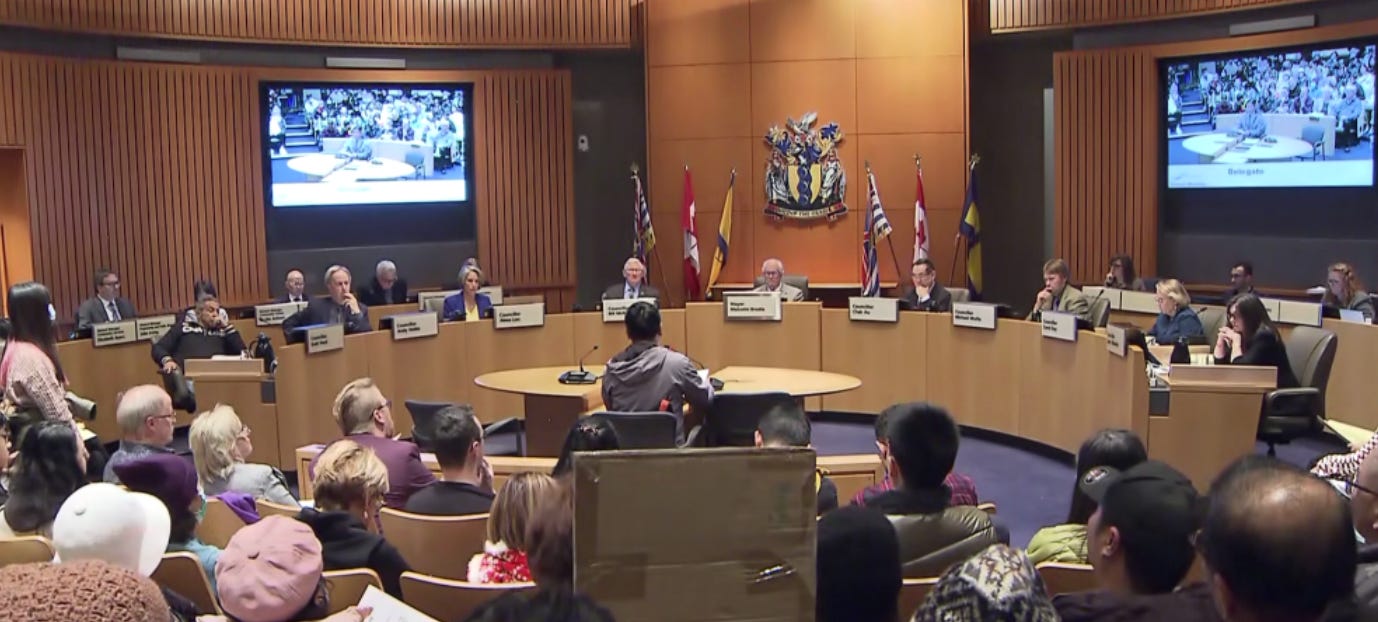
Canada's Spy Service Delivered a Closed-Door Briefing to Richmond's Mayor and Council on Chinese Threats to Election Candidates: Source
VANCOUVER — The Bureau has learned from a source with direct knowledge that Richmond’s mayor and city councillors were asked to attend an extraordinary closed-door briefing delivered by senior regional officials of the Canadian Security Intelligence Service.
According to the source, the briefing, in July, addressed threats facing municipal election candidates ahead of British Columbia’s October 17 general local elections, including significant vulnerabilities within the Chinese Canadian voting diaspora. The source said the material presented was not classified and included case knowledge previously canvassed in the Hogue Commission of Inquiry into foreign election interference. The substance of the warning, according to the source, concerned the prospect that individuals with ties to the People’s Republic of China may approach Richmond candidates in ways that could undermine election integrity.
The Bureau has agreed not to identify the source because of the sensitivity of the matter.
Several prominent British Columbia municipal leaders — former Vancouver mayor Kennedy Stewart and Port Coquitlam Mayor Brad West — have disclosed to The Bureau that the Service warned them of Chinese interference threats touching their own elections in recent years.
West was re-elected in 2022. Stewart lost the Vancouver mayoralty that same fall. As The Bureau has reported, based on leaked CSIS intelligence, Canada’s spy service concluded that Vancouver’s then Chinese consul general and a network of Chinese community leaders pushed Chinese Canadian voters to support a specific Chinese Canadian candidate in 2022.
When the Globe and Mail, working from the same intelligence The Bureau holds, reported that Chinese networks had supported the campaign of Ken Sim, the incoming Vancouver mayor, Sim rebuked the reporting indignantly, saying the insinuation would not have been made “if I was a Caucasian.”
British Columbia Premier David Eby said the Vancouver election was won “fair and square,” and has separately and categorically denied to The Bureau any suggestion that he met with or invited support from the Chinese consulate during his own 2022 party leadership campaign, calling the allegations completely false.
The Richmond briefing appears to be exceptional in British Columbia local government, with an entire mayor and council warned by the Service behind closed doors of the heightened Chinese interference threat landscape facing candidates. That senior officials would convene a council in closed session, three months before a general local election, and walk elected officials through case material at an unclassified level, indicates a judgment inside the Service that the risk to the coming municipal contest was concrete enough to warrant it.
Asked whether such a briefing took place, and on what authority the Service briefs municipal officials, CSIS declined to confirm the meeting but confirmed the power to hold one.
Recent amendments to the CSIS Act, spokesperson Magali Hébert said, have enhanced the Service’s ability to share information about threats to Canada’s national security with a wider range of entities beyond the Government of Canada. Those authorities, she said, enable CSIS to share information more frequently and with a broader range of sectors and partners to help strengthen Canada’s national security resilience. Increased sharing, she added, helps elected officials, other orders of government, industry, academia, and communities better understand and recognize threats, allowing them to protect themselves, their particular interests, and Canada more generally.
On the specifics, Hébert said CSIS does not publicly disclose details related to its engagement activities or its investigations, and does not confirm or deny whether an investigation is ongoing, in order to protect sources, tradecraft, and methods.
What the Service would not describe, the public record already reveals, in a series of cases matching the Hogue Commission precedents The Bureau‘s source said were canvassed at the Richmond briefing.
In August 2024, the Office of the Commissioner of Canada Elections concluded a 112-page investigation finding that foreign influence had been exercised in the Chinese Canadian community in Greater Vancouver during the 2021 federal election, in a campaign directed against Kenny Chiu, then the Conservative member of Parliament for Steveston–Richmond East.
Chiu was targeted, investigators found, for his support of Uyghur human rights and Hong Kong’s pro-democracy movement, and for his attempt to legislate a foreign agent registry. Chinese consular officials in Vancouver, local community associations, and Chinese-language media outlets combined to cast him as a threat to the very community he represented. Witnesses told investigators that community association leaders had served as messengers for consular officials. One recounted a community figure boasting at a post-election banquet that they had succeeded in defeating him.
No one was charged. Investigators could not trace the funding behind the campaign, identified no direct victims of intimidation willing to testify, and concluded the burden of proof under Canadian law could not be met. The investigation had opened only in December 2022, and only because journalists reported the allegations first.
An intelligence assessment dated October 31, 2022, reviewed by The Bureau, states that Chinese consular officials work through trusted interlocutors — proxy agents and co-opted community organizations — to channel monetary donations and other assistance to preferred candidates in elections, with the intent of fostering a bond of obligation. Should a candidate later pursue a course of action contrary to that of the foreign state, the assessment says, community support would likely be withdrawn and the candidate could potentially lose their next election.
The same document records that a Chinese consulate clandestinely supported a mayoral candidate in a British Columbia city by mobilizing the leadership of three co-opted Chinese Canadian community groups to provide material and financial support, and that the same consulate had used the same three groups to channel support to the same candidate in the previous municipal election four years earlier.
There is no suggestion in the assessment that the candidate knowingly accepted the support.
The document states plainly that interference actors and activities can span various levels of government, and that Beijing seeks to manipulate and influence key media entities during election periods. A 2019 record from the National Security and Intelligence Committee of Parliamentarians states that Vancouver’s consul general boasted of controlling more than 100 community groups. These documents contain intelligence, which does not carry the weight of evidence, and none of the cases has been proven in an election interference investigation.
British Columbia, unlike Alberta, Ontario, and New Brunswick, maintains no provincial intelligence office to advise elected officials on foreign interference threats. Stewart told The Bureau that CSIS warned him in late May 2022 that China would likely interfere in that fall’s municipal election, and that neither the city nor Elections BC had meaningful tools to establish where campaign money originated. Stewart won Vancouver’s 2018 election by 957 votes.
Turnout in Richmond’s 2022 municipal election was 24.5 percent. It is a margin structure in which a small mobilized bloc decides outcomes, and it is the reason officials describe local races as the softest ground in the Canadian system.
Richmond’s council has meanwhile become preoccupied with its own election information environment. On July 27, three weeks after the briefing described by The Bureau‘s source, councillors passed a motion demanding an apology over a Chinese-language social media graphic that set the city’s Chinese and South Asian populations against one another by share of the electorate, and referred the matter to the British Columbia Human Rights Tribunal.


