Canada’s Next National Security Battle Will Be Fought Through Money, Not Missiles
This is economic warfare conducted through financial systems: RCMP financial crimes and counter-narco veteran
By Garry Clement
Canadians have traditionally viewed national security through the familiar lens of spies, cyberattacks, military threats and terrorism. We imagine foreign adversaries stealing secrets, infiltrating government institutions or launching sophisticated cyber campaigns against critical infrastructure.
Those threats are real.
But they are no longer the primary battlefield.
The next generation of conflict is being fought through illicit finance.
Across Canada, transnational organized crime, hostile foreign states, underground banking networks, professional money launderers and economic influence operations increasingly rely upon the same financial infrastructure to move wealth, acquire strategic assets, evade sanctions, corrupt institutions and expand geopolitical influence.
This is not simply organized crime.
Nor is it merely foreign interference.
It is economic warfare conducted through financial systems.
For years I have argued that Canada has underestimated the convergence of organized crime and national security. The evidence is now overwhelming. The challenge is no longer whether these threats are connected, but whether our institutions are prepared to respond to them as a single strategic problem.
The recent testimony of veteran U.S. financial crime investigator John Cassara before the U.S. House Financial Services Committee should serve as required reading for every Canadian policymaker. His testimony does not simply examine Chinese money laundering networks; it explains the operating system that increasingly underpins global illicit finance.
His warning is clear: governments continue to fight financial crime as though money laundering were merely a banking compliance issue, while sophisticated criminal enterprises have transformed illicit finance into an instrument of geopolitical competition.
Canada cannot afford to ignore that warning.
The Cullen Commission exposed how British Columbia became vulnerable to money laundering through casinos, luxury vehicles, real estate, opaque corporate structures and underground banking. It confirmed what investigators had warned for years: illicit money had become deeply embedded in Canada’s economy.
Yet the Commission was necessarily provincial in focus.
Cassara places those same vulnerabilities into a much broader strategic framework.
What occurred in British Columbia was never simply a provincial policing problem, but one node within a sophisticated global financial ecosystem linking organized crime, illicit trade, underground banking, professional facilitators, foreign influence operations and state interests.
Canada has spent years studying the symptoms; we have devoted far less attention to understanding the system itself.
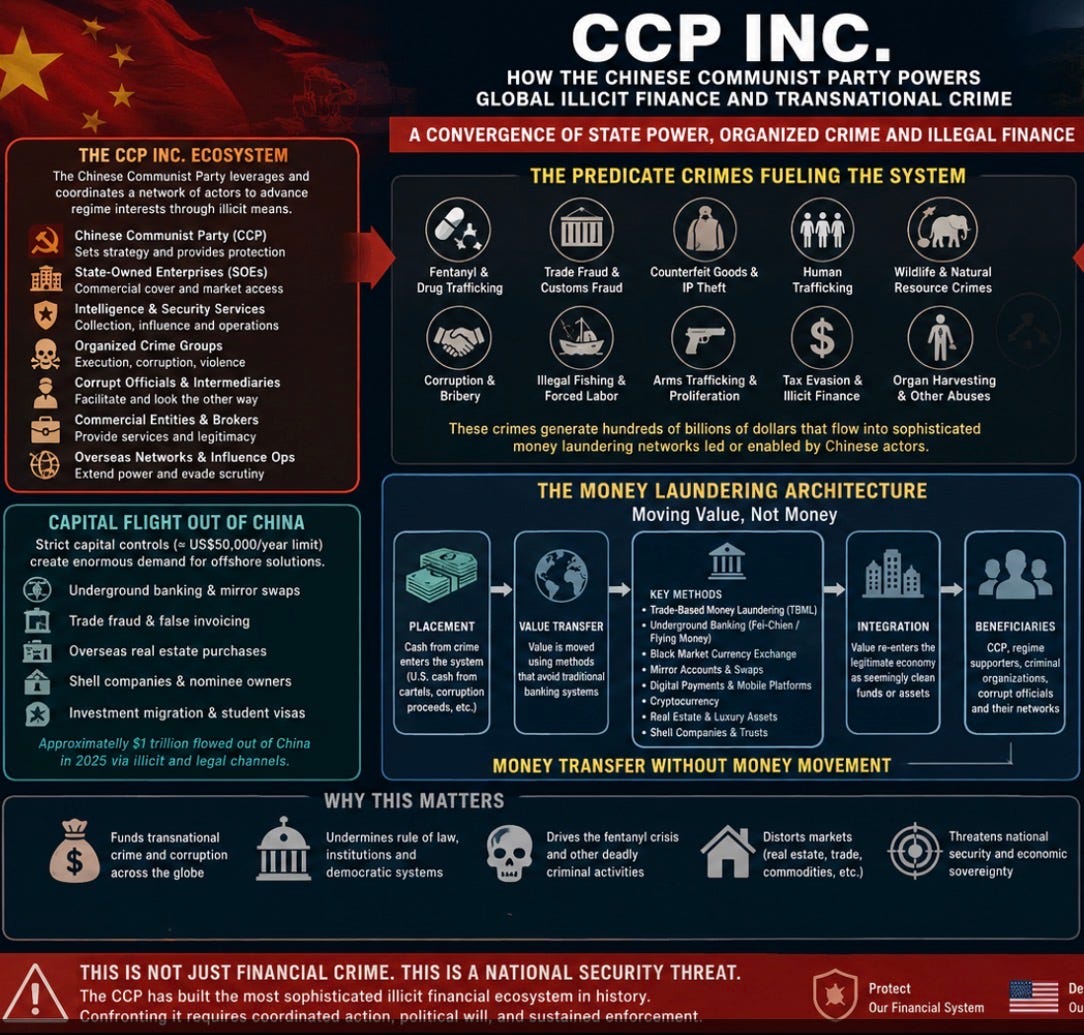
Perhaps the most important lesson from Cassara’s testimony is that modern money laundering is no longer primarily about moving money.
It is about moving value.
Traditional anti-money laundering systems were built to identify suspicious bank transfers.
Today’s criminal enterprises increasingly bypass those systems altogether: trade invoices replace wire transfers, underground banking replaces conventional remittance systems, mirror swaps settle transactions without funds crossing borders, cryptocurrency accelerates settlement across jurisdictions, commercial imports and exports disguise criminal proceeds, and real estate preserves illicit wealth.
In many cases, the dirty money never actually leaves the country where it was generated.
Equivalent value simply appears somewhere else.
The transaction disappears into legitimate commerce.
Our laws continue to follow money. Modern criminal enterprises follow value.
Canada possesses many strengths: a stable democracy, respected financial institutions, predictable courts and a trusted economy.
Ironically, those strengths have become strategic vulnerabilities.
Canada offers access to global capital markets, valuable real estate, sophisticated financial services and extensive international trade connections.
Sophisticated criminal organizations understand this.
So do hostile foreign states.
Whether the actors originate in China, Iran, Russia, India or Latin America matters less than the methods they employ.
Chinese underground banking networks, trade-based money laundering, professional laundering organizations, nominee ownership, cryptocurrency, trade fraud, shell companies, strategic land acquisitions and foreign influence operations are no longer isolated activities. They are interconnected components of an integrated financial ecosystem that enables organized crime, sanctions evasion, fentanyl trafficking, corruption, foreign interference and, increasingly, national security threats.
This is not theoretical.
Canadian investigations and public inquiries have documented Chinese underground banking networks operating alongside international drug trafficking organizations.
The Cullen Commission exposed laundering through casinos and real estate.
The Public Inquiry into Foreign Interference highlighted efforts by foreign states to influence Canadian institutions and democratic processes.
Law enforcement has documented relationships among organized crime groups, including Chinese Triads, outlaw motorcycle gangs, Iranian money laundering networks and transnational criminal organizations that increasingly share logistics, financial facilitators and underground banking systems.
The recent British Columbia civil forfeiture proceedings involving alleged international drug trafficking, nominee ownership structures and suspected proceeds invested in Canadian real estate are another reminder that Canada has become an attractive operating environment for sophisticated criminal enterprises. The allegations remain before the courts, but the broader pattern is familiar.
These are not separate challenges requiring separate strategies.
They are different expressions of the same financial ecosystem.
Our adversaries operate as integrated enterprises.
Canada responds through institutional silos.
Police investigate criminal offences.
FINTRAC analyzes financial transactions.
CBSA monitors borders.
CSIS investigates threats to national security.
Provincial regulators oversee corporations.
Financial institutions file suspicious transaction reports.
Each performs its mandate professionally.
Yet sophisticated criminal organizations deliberately exploit the spaces between them.
Money laundering is treated as a banking issue, trade fraud as a customs issue, foreign interference as an intelligence issue and tax evasion as a CRA issue. No single agency is responsible for understanding how they all connect.
That fragmentation has become one of Canada’s greatest strategic vulnerabilities.
For decades Canada viewed customs enforcement primarily through the lens of tariffs, taxes and immigration.
Today customs enforcement is a frontline national security function.
Trade-based money laundering has become one of the largest and least understood methods of moving criminal value worldwide.
False invoices, over- and under-invoicing, origin fraud and commercial misrepresentation finance organized crime while simultaneously supporting sanctions evasion, intellectual property theft, illicit technology transfers and strategic capital flight.
The same shipping container may represent legitimate commerce, criminal proceeds and geopolitical influence simultaneously.
Our enforcement architecture rarely sees the complete picture.
Canada does not require another study confirming that money laundering exists.
We already know.
What we need is a fundamental shift in how we understand the threat.
Illicit finance is no longer simply a criminal justice issue.
It is a national security issue.
That means integrating financial intelligence, customs intelligence, tax intelligence, criminal investigations and national security analysis into a common operational picture.
It means treating professional money laundering organizations as strategic threats rather than service providers to individual criminal groups.
It means recognizing trade-based money laundering as a national security vulnerability.
It means strengthening beneficial ownership transparency, expanding oversight of professional facilitators, enhancing customs intelligence and disrupting underground banking networks before they become the financial infrastructure supporting hostile foreign influence.
Canada has long enjoyed the advantages of an open economy, trusted institutions and democratic governance.
Those strengths remain worth defending.
But openness without resilience becomes vulnerability.
For too long we have debated organized crime, foreign interference, money laundering and national security as though they were separate policy challenges.
They are not.
They are different manifestations of the same strategic ecosystem powered by illicit finance.
The next generation of conflict will not be determined solely by military capability or cyber superiority.
It will also be determined by which nations can protect the integrity of their financial systems from exploitation by criminal enterprises and hostile states alike.
That battle is already underway. Canada’s greatest challenge is no longer recognizing the threat.
It is recognizing that the battlefield has fundamentally changed.
Garry Clement is a former RCMP superintendent and one of Canada’s leading experts on financial crime, money laundering and transnational organized crime. He served as the RCMP’s national director of the Proceeds of Crime Program and later held senior anti-money laundering roles in the private sector. He is the author of Under Cover: Inside the Shady World of Organized Crime and the R.C.M.P. and writes regularly on organized crime, illicit finance and national security for The Bureau.


Canada’s Next National Security Battle Will Be Fought Through Money, Not Missiles? That battle has already been lost and acknowledged when PM Carney stated that Canada and China are now strategic partners, indicating the Liberal Party and its leadership, and the Canadian gov't bureaucracy has been captured by China. Canadian foreign and domestic policy and legislative initiatives already reflect this change, an example being Bill C-9 becoming law which will no doubt dampen all criticism of Canadian gov't narratives, policies and legislation. This same legislation can and will likely be used by China, most likely indirectly through its many active political groups in Canada. Canada's next national security battle is already being fought with the USA, seeing Canada as a Chinese proxy and threat to US national and economic security on its northern border.
The managerialism of Mark Carney and Brookfield with their “innovative”financial approach explains why Canada now has a COO and that why human rights concerns have taken a back seat seat to the murky MOU management by globalist elites.
It’s confusing and hard to unpick. Read this article and get some clarity.
https://substack.com/@hardpressednorth/note/p-207606713?r=2duinz&utm_medium=ios&utm_source=notes-share-action