


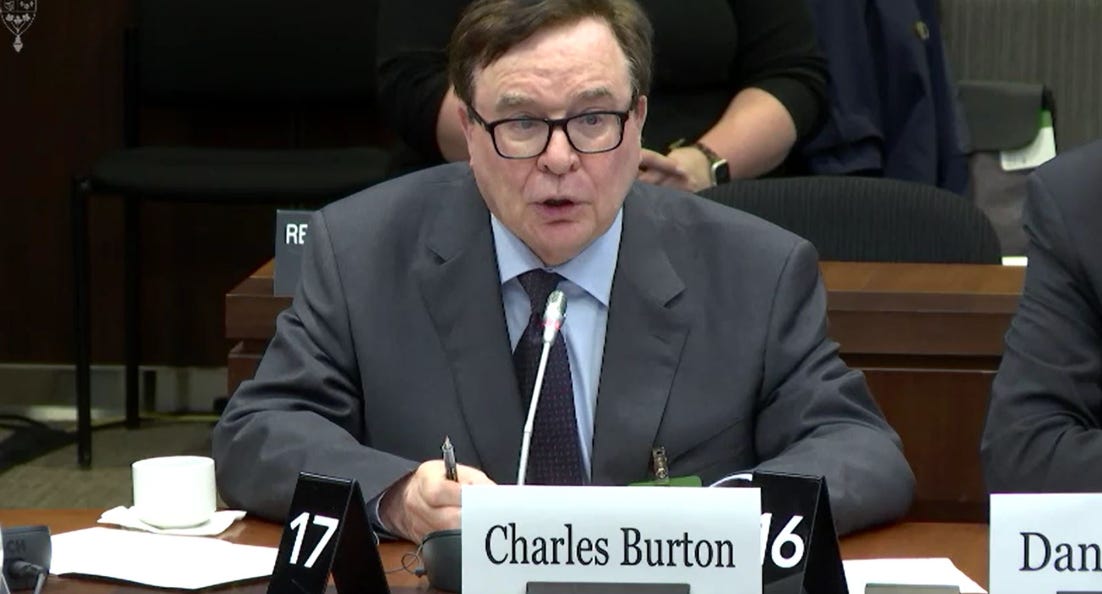
OTTAWA — Canada’s new foreign-influence registry suffered a privacy breach involving Dr. Charles Burton, a prominent China expert who says he was detained and interrogated by China’s Ministry of State Security in 2018 and warned registry leaders that Canada’s spy agency had told him Beijing had monitored his unencrypted communications since 2012.
In an August 20 letter obtained by The Bureau, Public Safety Canada told Burton that the Office of the Foreign Influence Commissioner of Canada had mistakenly emailed the response to his registration submission to another person the day before. The letter called the error a privacy breach. It said the exposed information included Burton’s name, an administrative submission number and the office’s determination that his registration was ineligible.
Correspondence obtained by The Bureau shows the commissioner’s office acknowledged on September 2 that a publicly accessible encrypted channel was still being developed.
The person who received Burton’s information by mistake alerted the office and forwarded the email to him. They said they then deleted their copies, keeping only redacted email records, according to Public Safety’s letter.
Public Safety’s letter describes a misdirected email, not an intrusion into the registry’s computer systems, and does not establish that a foreign entity obtained Burton’s correspondence.
In a September 8 statement to The Bureau, the commissioner’s office said only Burton’s name and an administrative registration number were disclosed. It said a comprehensive review had been conducted and the recipient confirmed the correspondence was destroyed.
Burton had voluntarily given the office details about foreign contacts, planned travel and expected national-security discussions. His correspondence with the office also underlines a second, distinct problem.
The office was receiving potentially sensitive information from people who may themselves be targets of foreign surveillance, while the publicly accessible encrypted communications channel Burton had requested remained unfinished.
Burton told The Bureau that, before the registry opened, he warned officials he had been told Chinese authorities monitored his unencrypted communications. In an August 21 letter to Commissioner Anton Boegman, written after the breach, he recalled a virtual meeting at which he asked Boegman to consider an encrypted channel for civil-society stakeholders.
He said lawyer Sarah Teich had also raised concerns about secure communications.
In the same letter, Burton said Canadian Security Intelligence Service had informed him that the Chinese government had monitored his unencrypted communications since 2012. He wrote that he had been detained by China’s Ministry of State Security in 2018 and believed, from his interrogation, that the monitoring was continuing then.
The Bureau asked CSIS to confirm or correct his description and to say whether it had assessed any additional risk following the registry breach.
In a September 8 response, the service said it “does not publicly disclose specific details related to its engagement activities or its investigations.”
It said it remained vigilant against foreign interference, espionage and transnational repression threats from all countries. It did not confirm or deny Burton’s account, provide figures on Canadians subjected to Chinese electronic surveillance, or say whether it had been notified of the registry incident.
Burton’s August 21 letter accused the commissioner’s office of negligence and incompetence in handling protected information.
Deputy Commissioner Dani Srour replied on September 2 that the office had added checks, retrained registry staff and separated review from response duties. She said a publicly accessible encrypted channel was still being developed and suggested that people concerned about leaving a digital trace send information by mail or courier, perhaps including an encrypted email address for replies.
The office later apologized for issues surrounding a meeting with Burton, saying a “major technical outage” had prevented officers from accessing “the system” and reaching him.
A second person, whose status as a registry applicant The Bureau verified and whose identity it is withholding, described the electronic registration process as nearly unworkable. They said the system appeared to have been hastily assembled and internet technology problems were apparent.
Burton also shared messages from Chinese-diaspora democracy activists, in which several said they could not enter an online information session about the new law scheduled for the week of September 7. One said they had registered but received an error stating, “Sorry, but you do not have access to this event.” Others said they could not get in.
The registry began accepting registrations on August 4.
At the launch, Public Safety Minister Gary Anandasangaree and Boegman presented it as a means of strengthening transparency and public trust in Canada’s response to foreign interference. Boegman is the country’s first Foreign Influence Transparency Commissioner, appointed to a seven-year term.
The registry’s history is bound up with the targeting of an early proponent of a similar measure.
Former Conservative member of Parliament Kenny Chiu introduced a 2021 bill to establish a foreign-influence registry that named no country.
He told Hogue Commission interviewers that, after introducing it, some constituents called him racist and anti-China.
During the federal election, false claims circulated that the bill would force anyone with ties to China to register. An unclassified election integrity brief recorded on September 12 that WeChat accounts in Canada continued to spread that claim.
Chiu lost his Richmond seat to Liberal Parm Bains, who, as The Bureau reported in 2024, told Rise Media ten days before the vote that a registry looked like “a very discriminatory policy.” That day, Rise Weekly ran a front-page paid ad for Bains and a separate article urging Richmond voters to support him. Bains denied improper influence and said the ad was not an endorsement by the publisher.
The Hogue Commission’s final report found that Canadian agencies knew of misleading narratives about Chiu and his proposed registry. Investigators later found indications that Chinese officials gave impetus and direction to a broader anti-Conservative campaign, though they did not establish a violation of the Canada Elections Act.
The election-security panel did not intervene in Chiu’s case because it could not attribute the online activity to a foreign state with sufficient confidence or clearly distinguish it from political debate. As The Bureau reported from the inquiry, Chiu testified: “It is almost like I was drowning, and they were watching.”