

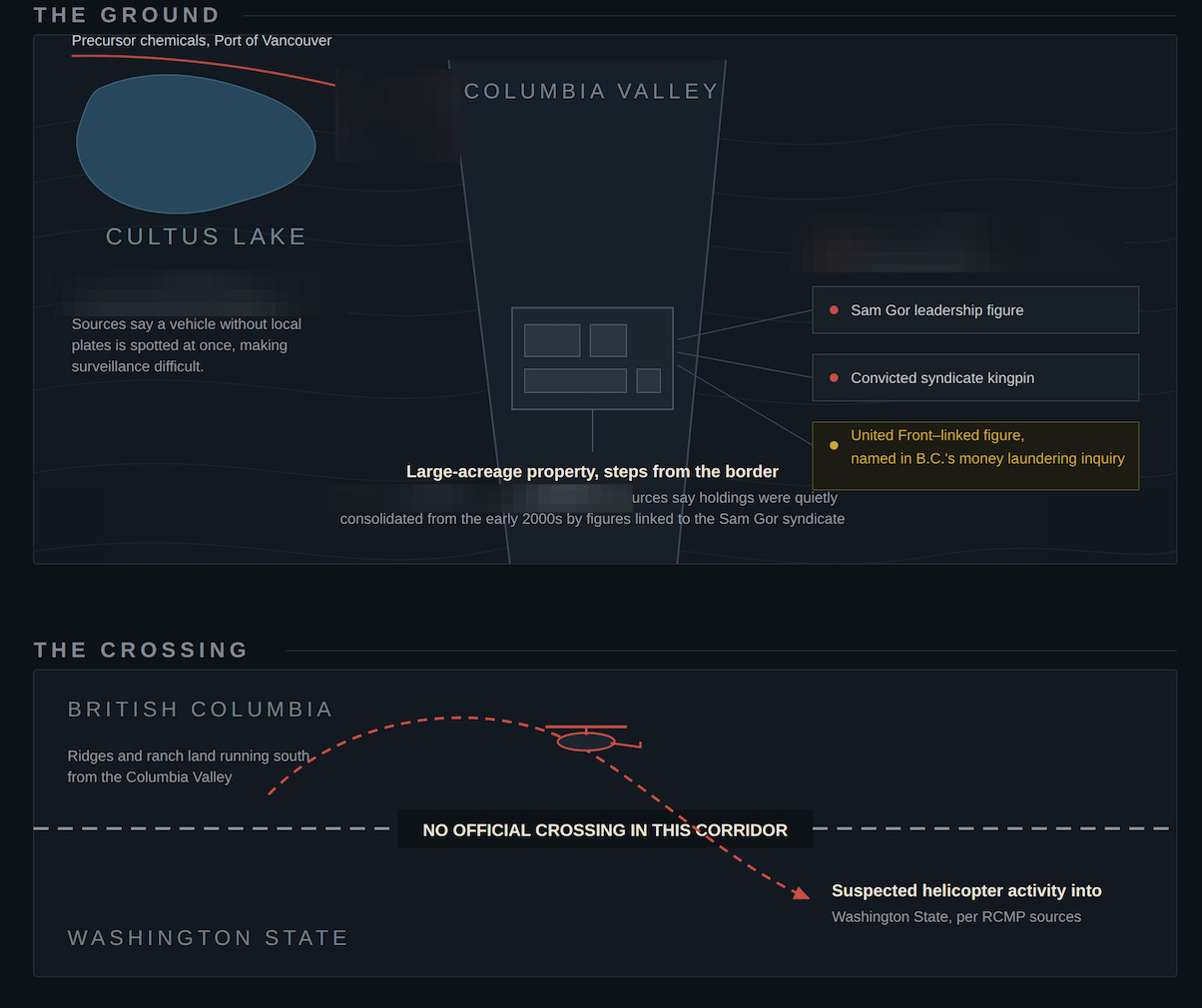
OTTAWA — Canada’s fentanyl czar has responded to President Donald Trump’s formal finding to Congress that fentanyl is produced in clandestine Canadian laboratories and that Chinese gangs operate along the northern border of the United States with a single statistic about drug seizures.
“Any fentanyl moving across the border is too much, and our goal remains to stop the flow of fentanyl entirely,” wrote Justin Bullen, communications advisor to fentanyl czar Kevin Brosseau, in a statement to The Bureau. “With that in mind, it should be highlighted that the U.S. Customs and Border Patrol data shows that seizures of fentanyl attributed to their northern border region accounted for approximately 0.1% of total U.S. fentanyl seizures involving border enforcement.”
Bullen continued: “Fentanyl is a global threat, and a national priority with local impacts, ravaging communities, families and individuals.” He listed legislation, border work with American partners, the disruption of criminal networks and precursor supply chains, and funding for treatment and prevention.
The statement does not address the Falkland superlab, the Port of Vancouver, the precursor chemicals arriving there from China, or the Chinese criminal and state-linked networks the President’s determination names.
The figure Ottawa offers measures one thing: how U.S. Customs and Border Protection seizures break down by border region, and the overwhelming share of those seizures is made on the Mexican border.
It counts nothing seized inside Canada by Canadian police, as in Quebec in July 2024, when the RCMP raided two synthetic opioid laboratories and stopped a 300,000-pill shipment in a case run by the Drug Enforcement Administration in Tampa.
It counts nothing seized inland in the United States, where fentanyl produced in Canada by the Chinese, Mexican and Iranian-linked networks American investigators have traced there is taken by the DEA, the Federal Bureau of Investigation, Homeland Security Investigations, or state and local police.
A case The Bureau reported in March shows how that accounting works.
Sebastien Rollin, a 49-year-old Montreal-area man known by the street alias “Stix,” was indicted in Florida on charges of importing protonitazene, a synthetic opioid researchers estimate is roughly three times as potent as fentanyl. According to the indictment, Rollin sold more than 10,000 pills disguised as M30 oxycodone tablets to an undercover officer on May 13, 2024, and 25,000 more on July 9, accepting payment in cryptocurrency sent from a wallet in Florida to Canada.
The pills that reached Tampa were acquired in an undercover purchase rather than stopped at a port of entry.
When Rollin negotiated the sale of 300,000 more that same month, the RCMP stopped the courier vehicle and seized the shipment, and executed search warrants the same day at two clandestine laboratories in Quebec, recovering millions of synthetic opioid pills, synthesis recipes and a firearm. Those seizures occurred inside Canada and appear in no American count.
Donald Im, the DEA’s former Special Operations Division lead on precursor chemicals and narco-terrorism, told The Bureau that in 2018 and 2019 the agency tried and failed to obtain a few grams from a 42-kilogram carfentanil seizure near Toronto, the largest in Canadian history, to test whether it matched American cases. “They wouldn’t give it to our lab,” Im said. “We just needed a small amount to determine the molecular structure — whether we could trace it or link it to seizures in the States.” Investigators in Atlanta tracing carfentanil overdoses at that time identified the supplier as Arden McCann, a Montreal lab operator selling carfentanil on the dark web, Im said. McCann was prosecuted in the United States.
“As part of that investigation, Canadian authorities seized approximately two million counterfeit Xanax pills, five pill presses, alprazolam powder, 3,000 MDMA pills, over $200,000 in cash, 15 firearms, ballistic vests, and drug ledgers,” the Justice Department said at McCann’s sentencing. “The drug ledgers revealed McCann and others purchased alprazolam from China, pressed the alprazolam into counterfeit Xanax pills, then sold the pills to customers throughout the United States.”
The Vancouver end of the Sebastien Rollin investigation shows the Pacific gap.
The February 2024 DEA affidavit that identified Rollin as a co-conspirator of Opinder Singh Sian, a Surrey, British Columbia gangster, also recorded an August 2023 meeting in a Vancouver coffee house. There a man later identified as Peng Zhou told a DEA undercover source that he could receive fentanyl precursor chemicals from China into Vancouver and move 100 kilograms a month to Los Angeles through a British Columbia trucking company fronted by an Indo-Canadian associate. Zhou said he had been doing it for roughly ten years and could synthesize fentanyl and methamphetamine from the precursors himself. Sian was arrested in July 2025 and pleaded guilty in November to conspiring to export methamphetamine from the Port of Long Beach to Sydney, Australia.
The Montreal and Vancouver legs of these investigations point to the criminal networks on America’s northern border that the President’s filing to Congress describes. In both, American counternarcotics agents originated the case and worked it with some cooperation from Canadian police.
A U.S. investigator involved in global fentanyl investigations has described to The Bureau a route that never touches the northern land border. Prime Minister Mark Carney’s government does not acknowledge it publicly, the source said. Cartel networks, the source said, are using the Port of Vancouver as a transshipment hub under cover of Canada’s trusted trade status.
“We are seeing containers going north from Mexico, from the port of Mazatlán, full of fentanyl pills going up to Vancouver and then being shipped down to western ports in the U.S. to make it look like the containers originated in Canada, to spoof our customs inspections,” the source said. “Another thing is we’re seeing fentanyl precursors going into Vancouver on a very large scale. Sometimes they stop in Mexico and then get shipped north; a lot of times they just go straight from China.”
A 4,300-litre shipment of precursor chemicals from China was intercepted in the Vancouver port system last year.
“How can Canada say, ‘Oh, we know the drugs are not going to the U.S., they’re going to Australia’? Well, we don’t believe that,” the source said. “Based on our sources in the Pacific Northwest, we keep hearing about fentanyl coming down from Canada into Portland, Seattle, all the way down to Los Angeles — coming out of Canada. These are coming on ships and other things, and we’ve seized some of this stuff. Some of them haven’t been made public because they’re part of ongoing investigations.”
The same source said U.S. officials believe Prime Minister Mark Carney has downplayed Canada’s role in fentanyl markets in meetings with senior State Department officials.